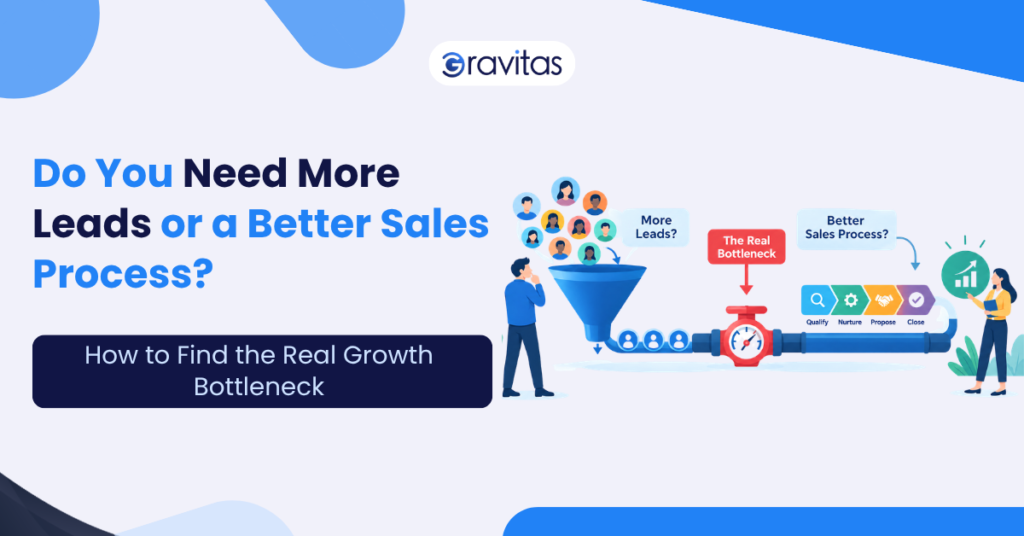

Having hundreds of leads in your CRM can look good on a dashboard. But if those leads are not progressing toward conversations, opportunities, proposals, and closed deals, your pipeline may not be as healthy as it appears.
A strong B2B sales pipeline is not simply about generating more leads. It is about consistently moving the right prospects through the sales process.
When prospects keep getting stuck at the same stage, follow-ups are missed, opportunities sit untouched, or sales teams spend time on poor-fit accounts, the problem is usually deeper than a lack of leads.
These are sales pipeline bottlenecks. And if they are not identified early, they can affect sales productivity, forecasting, conversion rates, and ultimately revenue.
A healthier approach is to look beyond lead volume and ask:
Are the right prospects entering the pipeline, and are they moving through it at a predictable rate?
This guide explores eight common B2B sales pipeline problems and practical ways to fix them.
What Is a B2B Sales Pipeline?
A B2B sales pipeline is a structured view of the prospects and opportunities moving through your sales process, from initial prospecting to conversion.
The exact stages differ between businesses, but a typical pipeline may look like:
Prospecting → Engagement → Qualification → Opportunity → Proposal → Negotiation → Conversion
Each stage represents a different level of buyer engagement and sales readiness. Salesforce similarly describes pipeline stages around activities such as prospecting, qualification, sales meetings, proposals, negotiation, and closing.
The purpose of a pipeline is not simply to show how many prospects you have. It should help your sales team answer questions such as:
- How many active opportunities do we have?
- Which opportunities are most likely to convert?
- Where are prospects dropping off?
- How long are opportunities staying in each stage?
- Which deals need immediate attention?
- Are we generating enough qualified opportunities to meet our revenue target?
This is where effective B2B sales pipeline management becomes important. Without clear stages and reliable data, it becomes difficult to understand whether your sales process is working or simply producing a large amount of activity.
8 Common Reasons Your B2B Sales Pipeline Is Stalling
You’re Targeting the Wrong Prospects
A pipeline can be full and still be unhealthy.
One of the biggest reasons is poor targeting. If your sales team is contacting companies that do not need your solution, cannot afford it, operate outside your target market, or do not have the right buying structure, opportunities are unlikely to progress.
This often starts with an unclear ideal customer profile (ICP).
An ICP should describe the type of company most likely to benefit from and purchase your solution. Depending on your business, this could include:
- Industry
- Company size
- Revenue range
- Geography
- Technology environment
- Business model
- Common pain points
- Buying triggers
- Decision-making structure
A useful ICP is more than a description of your “target audience.” It should help salespeople decide who to prioritize and who not to pursue.
HubSpot describes an ICP as a data-driven description of the company or customer type most likely to buy and generate long-term value.
How to fix it:
Review your existing customers and identify patterns among your highest-value accounts. Look at revenue, retention, deal size, sales cycle, industry, company size, and the problems that triggered their purchase.
Then use those patterns to refine your prospecting criteria.
The goal is not to generate the largest possible list.
It is to generate a list containing more companies that actually have a reason to buy.
Your Prospecting Process Is Inconsistent
Even with a strong ICP, your pipeline will eventually dry up if prospecting happens only when salespeople have free time.
Many businesses fall into a cycle:
Pipeline is full → prospecting slows down → deals close → pipeline becomes empty → prospecting starts again.
That creates unpredictable revenue.
Consistent prospecting keeps new opportunities entering the pipeline while existing opportunities are being worked. It can include outbound email, LinkedIn outreach, calling, referrals, partnerships, events, content-driven inbound leads, and other channels that fit your market.
The important part is having a repeatable process.
How to fix it:
Set clear prospecting expectations around:
- Target accounts
- Outreach volume
- Channels
- Follow-up frequency
- Messaging
- Qualification criteria
- Weekly pipeline creation targets
Also avoid relying on a single source of leads. A healthy pipeline should not collapse because one referral source or marketing channel slows down.
Leads Aren’t Being Qualified Properly
Not every lead is an opportunity.
Someone downloading a resource, filling out a form, responding to an email, or showing initial interest does not automatically mean they are ready to buy.
If every lead is treated as a sales opportunity, your pipeline becomes inflated with prospects that are unlikely to convert.
Effective lead qualification looks at factors such as:
- Does the prospect have a genuine business problem?
- Is your solution relevant?
- Is there a realistic budget?
- Who is involved in the buying decision?
- Is there a defined timeline?
- What happens if they do nothing?
Salesforce also recommends evaluating factors such as need, budget, and decision-making authority when qualifying leads.
This distinction matters because a pipeline filled with unqualified leads creates false confidence.
How to fix it:
Create clear qualification criteria before moving a lead into the opportunity stage.
For example:
Lead → Qualified Lead → Sales Opportunity
Each transition should have specific conditions rather than being based on a salesperson’s assumption.
If you need help building a more consistent top-of-funnel process, see our B2B lead generation services.
Follow-Ups Are Inconsistent
A prospect may be interested today and distracted tomorrow.
That is particularly common in B2B sales, where purchasing decisions can involve multiple stakeholders, internal approvals, competing priorities, and longer timelines.
When follow-ups depend entirely on memory, opportunities can easily disappear.
A salesperson may send an initial email, have a promising call, and then fail to follow up for two weeks. By then, the prospect may have moved on, chosen another provider, or simply forgotten the conversation.
How to fix it:
Create a defined sales follow-up framework.
For every active opportunity, your CRM should make it clear:
- What happened last?
- What is the next action?
- Who owns it?
- When should it happen?
- What is the current opportunity status?
Follow-up should also add value rather than simply asking, “Any update?”
For example, the next touchpoint could include a relevant case study, answer a question raised during the meeting, share a useful resource, or clarify the next step in the buying process.
A structured follow-up process makes it much easier to prevent otherwise valuable opportunities from going cold.
Your Sales Process Isn’t Clearly Defined
If five salespeople handle the same type of opportunity in five different ways, forecasting becomes difficult.
One salesperson may consider a prospect qualified after an introductory call. Another may require a confirmed budget and decision-maker. Someone else may move an opportunity into the proposal stage before the requirements are even clear.
That inconsistency creates problems across the entire pipeline.
Clear sales pipeline stages give your team a common framework for managing opportunities.
For example:
| Stage | What it means |
| Prospecting | Potential account identified |
| Engagement | Prospect has responded or interacted |
| Qualification | Fit, need and buying potential confirmed |
| Opportunity | Genuine sales opportunity established |
| Proposal | Commercial proposal presented |
| Negotiation | Terms, pricing or scope being discussed |
| Conversion | Deal won |
Your stages may be different, but each should have a clear definition.
How to fix it:
Document what must happen before an opportunity moves from one stage to another.
For example:
Qualification → Opportunity
Only when the prospect has:
- A confirmed business need
- Relevant decision-makers identified
- Reasonable purchase potential
- A defined or emerging timeline
This creates consistency and makes pipeline reviews far more meaningful.
Your Sales Pipeline Lacks Visibility
You cannot fix a bottleneck you cannot see.
If opportunity information is spread across spreadsheets, emails, personal notes, messaging apps, and different systems, sales managers may struggle to understand what is actually happening.
This is where CRM pipeline management can make a significant difference.
A CRM can centralize opportunity information and provide visibility into pipeline stages, activities, deal values, ownership, and next steps.
Salesforce notes that clear pipeline stages, updated deal statuses, reports, and dashboards can help teams identify roadblocks and monitor metrics such as win rates and sales-cycle length.
However, simply having a CRM does not solve the problem.
The data inside it needs to be accurate.
If opportunities remain in the wrong stage, closed deals are still marked as active, next steps are missing, or old leads are never cleaned up, the dashboard may look precise while telling the wrong story.
How to fix it:
Establish basic CRM data standards:
- Every opportunity has an owner
- Every opportunity has a defined stage
- Every active deal has a next step
- Close dates are regularly updated
- Stale opportunities are reviewed
- Lost opportunities have a reason recorded
- Duplicate or irrelevant records are removed
Accurate CRM data turns the pipeline from a database into a decision-making tool.
For more on managing opportunities through a CRM, see Salesforce’s guide to sales pipeline management.
Your Sales Cycle Is Too Long
A long sales cycle is not automatically a problem.
Some B2B purchases naturally take months because they involve large budgets, multiple stakeholders, technical evaluations, procurement, compliance, or complex implementation.
The problem is when opportunities remain inactive without a clear reason.
If a deal has been sitting in the same stage for weeks or months, ask:
What is preventing it from moving forward?
Common causes include:
- No clear decision-maker
- Unresolved objections
- Unclear requirements
- Delayed internal approvals
- Weak business case
- Lack of urgency
- Too many unnecessary sales steps
- Poor follow-up
This is where sales velocity becomes useful.
Rather than looking only at the number of opportunities, consider how quickly qualified opportunities are progressing through the pipeline.
How to fix it:
Start by identifying where opportunities spend the most time.
For example:
Qualification: 5 days → Proposal: 18 days → Negotiation: 47 days
If negotiation consistently takes the longest, investigate why.
Are pricing objections common? Is legal review delaying deals? Are decision-makers entering the process too late?
The objective is not to rush every buyer.
It is to remove avoidable delays from the sales process.
You’re Focusing on Lead Volume Instead of Lead Quality
More leads can look impressive in a monthly marketing report.
But 1,000 low-quality leads are not necessarily more valuable than 100 prospects that closely match your ICP.
What matters is what happens after the lead enters your database.
Look at the progression:
Leads → Qualified Leads → Opportunities → Proposals → Won Deals
This is your lead-to-opportunity conversion story.
If lead volume is increasing while qualified opportunities and revenue remain flat, adding even more leads may not solve the problem.
The issue could be targeting, qualification, messaging, follow-up, or the sales process itself.
How to fix it:
Track quality and progression alongside volume.
Useful metrics include:
- Lead-to-qualified-lead conversion
- Qualified-lead-to-opportunity conversion
- Opportunity-to-win conversion
- Average deal value
- Sales cycle length
- Pipeline velocity
- Win rate
- Opportunities by source
This gives you a much clearer picture of whether your B2B lead generation is actually contributing to revenue.
How to Fix a Stalling B2B Sales Pipeline
Once you identify where the pipeline is getting stuck, the next step is to build a more consistent operating process.
Define your ideal customer profile
Use your best existing customers to identify the characteristics that make an account a strong fit.
Standardize prospecting
Create a repeatable process for finding, researching, contacting, and following up with target accounts.
Improve lead qualification
Define exactly what makes a lead sales-ready and make those criteria consistent across the team.
Create a sales follow-up framework
Every active opportunity should have an owner, next action, and follow-up date.
Track pipeline performance
Monitor conversion rates, opportunity age, sales-cycle length, win rates, and pipeline movement not just the number of leads generated.
Review and optimize regularly
Pipeline reviews should identify patterns, not just ask salespeople for status updates.
For example:
- Which stage has the highest drop-off?
- Which lead sources produce the best opportunities?
- Which opportunities have been inactive too long?
- Which objections are appearing repeatedly?
- Which sales activities are producing qualified opportunities?
This turns B2B sales pipeline optimization into an ongoing process rather than a one-time cleanup.
When Should You Consider External Sales Support?
Sometimes the problem is not that your team lacks sales potential. It is that the existing team does not have enough time or capacity to consistently manage the entire sales process.
External sales support may make sense when:
- Prospecting is inconsistent
- Your sales team spends too much time researching accounts
- Lead qualification is taking too much internal bandwidth
- Follow-ups are frequently missed
- You are entering a new market
- You need to increase outreach without immediately hiring a larger team
- Your internal sales team needs more qualified opportunities to work on
External support can help create greater consistency across sales outreach, B2B lead generation, qualification, and opportunity management while your internal team focuses on conversations and closing.
The key is to treat external support as an extension of your sales process—not simply as a source of more contact lists.
Build a More Predictable Sales Pipeline with Gravitas
A predictable pipeline starts well before the sales call.
It starts with reaching the right accounts, identifying genuine buying potential, maintaining consistent outreach, and making sure qualified opportunities do not get lost between stages.
At Gravitas, we help businesses strengthen these parts of the process through:
- B2B lead generation
- Lead qualification
- Sales outreach
- Opportunity management
- Sales pipeline management
The focus is not simply on putting more names into your database. It is on building a more structured process for turning the right prospects into meaningful sales opportunities.
Is your sales pipeline struggling to convert?
Talk to Gravitas about building a more structured sales process.
Frequently Asked Questions About B2B Sales Pipelines
A B2B sales pipeline can stall because of poor targeting, weak lead qualification, inconsistent follow-ups, unclear sales stages, or inaccurate CRM data. Identifying where prospects are dropping off can help pinpoint the bottleneck.
Common problems include low-quality leads, inconsistent prospecting, poor qualification, missed follow-ups, unclear sales processes, limited pipeline visibility, and long sales cycles.
Define your ideal customer profile, improve lead qualification, standardize sales outreach, and maintain consistent follow-ups. Regularly reviewing pipeline metrics can also help identify areas that need improvement.
Start by finding where opportunities are getting stuck and why. Address the specific issue, whether it is qualification, follow-up, decision-making, pricing, or an inefficient sales process.
Businesses can optimize their pipeline by improving targeting, qualification, outreach, CRM data accuracy, and opportunity management. Tracking conversion rates and sales-cycle length helps measure whether the changes are working.