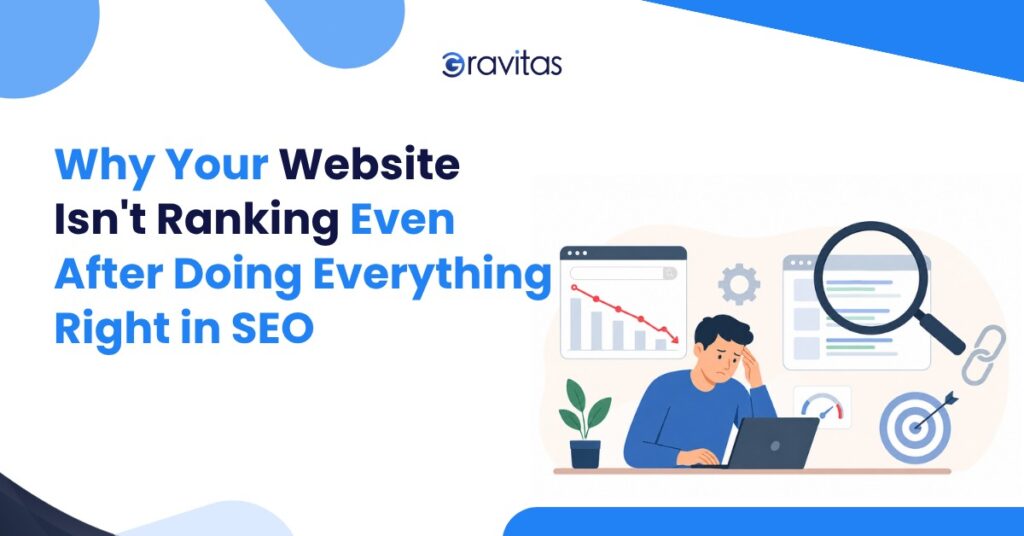
You have researched the right keywords, published content, optimized title tags, built backlinks, and followed an SEO checklist. Yet your website still isn’t appearing where you expected it to.
If you are asking, “Why is my website not ranking on Google?”, the problem may not be that you are doing SEO incorrectly. The bigger issue could be that your strategy is missing factors Google uses to determine which pages deserve stronger visibility.
SEO is not a checklist where completing ten tasks automatically earns a first-page position. Search engines evaluate relevance, content quality, technical accessibility, authority, user experience, competition, and many other signals. Google itself explains that its ranking systems use many factors and signals to determine which results are most relevant and useful for a search.
That means a website can be technically optimized and still struggle with website ranking issues.
In this guide, we will look at the less obvious SEO ranking problems that can hold a website back, how to diagnose them, and what you can do to improve your organic search performance.
Why Doing SEO Correctly Does Not Always Guarantee Rankings
SEO is a long-term process, not a one-time website upgrade. Even if your website has optimized pages, relevant keywords, and technically sound content, there is no guarantee that every page will rank immediately.
One reason is competition. Your website is not being evaluated in isolation. Google has to choose between potentially hundreds or thousands of pages that could answer the same search query.
Your competitors may have:
- More authoritative websites
- Stronger backlinks
- Better topical coverage
- More established brands
- More useful content
- A better match for search intent
- Stronger internal linking structures
This is why understanding Google ranking factors is more useful than simply checking whether keywords have been added to a page.
SEO Is More Than Keywords and Content
Keywords are important, but modern SEO requires much more than placing a target phrase throughout a page.
A strong SEO strategy considers:
- Technical SEO
- Search intent
- Content quality
- Internal linking
- Website architecture
- Page experience
- Backlinks and authority
- Indexability
- Mobile usability
- Competitive positioning
Google’s ranking systems work at the page level and use multiple systems and signals to understand and rank individual pages.
So if your website is not ranking, repeatedly adding the same keyword may not solve the actual problem.
10 Hidden Reasons Your Website Is Not Ranking
If you are experiencing website ranking issues, these are some of the areas worth investigating.
Your Website Is Not Meeting Search Intent
One of the most common reasons a page fails to rank is that it targets the right keyword but answers the wrong question.
Consider someone searching for:
“Best CRM for real estate companies”
They probably want to compare CRM options, features, pricing, and suitability. A page that simply explains what a CRM is may contain the keyword, but it does not satisfy the user’s intent.
Search intent can generally fall into categories such as:
- Informational
- Commercial
- Transactional
- Navigational
Before creating or optimizing a page, ask:
What is the user actually trying to accomplish with this search?
Look at the pages currently ranking for your target query. Are they guides, product pages, comparison pages, service pages, or listicles?
Your content needs to compete with the type of result Google is already showing.
Your Content Is Not Competitive Enough
Publishing content does not automatically make it competitive.
You may have a 2,000-word article targeting a keyword, while the pages ranking above you provide:
- Original research
- Real examples
- Expert insights
- Better explanations
- Relevant statistics
- Visual resources
- Practical steps
- Answers to related questions
The objective should not be to make your article longer simply because competitors have longer articles.
Instead, identify what your competitors provide that your page doesn’t.
For example, if the top-ranking pages explain five solutions but your article explains only two, you have a content gap. If they include original examples while yours contains generic explanations, you have a value gap.
Google says its systems are designed to surface relevant and useful results, while its original-content systems can help original material appear prominently in Search.
Your Website Has Technical SEO Problems
Sometimes the content is good, but search engines cannot properly access, understand, or index it.
Technical website SEO problems can include:
- Crawl errors
- Broken internal links
- Incorrect redirects
- Poor site architecture
- Slow pages
- Mobile usability problems
- Incorrect canonical tags
- Robots.txt restrictions
- Sitemap problems
- Duplicate URLs
- Indexing errors
This is why technical SEO should be treated as a foundation rather than an optional add-on.
A comprehensive technical SEO services approach can help identify issues related to crawlability, indexability, site structure, page performance, canonicalization, and other technical elements.
A technically healthy website gives search engines a clearer path to discovering and understanding your content.
Your Website Lacks Authority and Trust Signals
Even excellent content can struggle when competing against websites with significantly stronger authority.
Authority can be influenced by factors such as:
- Relevant backlinks
- Industry mentions
- Brand recognition
- Strong topical coverage
- Expert contributions
- Quality references
- A consistent online presence
Google’s ranking systems include link-analysis systems that use links between pages to help understand what pages are about and which may be useful for a query.
This does not mean collecting as many backlinks as possible.
A few relevant, trustworthy links can be more valuable than large numbers of low-quality or unrelated links.
Your Competitors Have Stronger SEO Strategies
Sometimes the answer to “Why is my website not ranking on Google?” is simply that your competitors are doing more strategically.
Your competitors may have:
- Better keyword targeting
- More comprehensive topic coverage
- Stronger backlinks
- Better internal linking
- More optimized service pages
- More established domains
- Better content that satisfies search intent
This is where competitor SEO analysis becomes important.
Instead of asking only, “What keywords should we target?”, ask:
“Why does Google consider these pages better answers than ours?”
Compare their content, page structure, backlinks, keyword coverage, internal links, and overall topical authority. This can reveal opportunities that a standard keyword research exercise may miss.
Your Pages Are Not Properly Optimized
A page can have excellent information and still have weak on-page SEO.
Review elements such as:
- Title tag
- Meta description
- H1 and H2 structure
- Target keyword placement
- Image alt text
- URL structure
- Internal links
- Content hierarchy
- Relevant supporting terms
However, optimization should improve clarity rather than turn the page into a collection of keywords.
For example, instead of repeating “website not ranking” ten times, structure the article around the actual questions a website owner has about ranking problems.
Good on-page SEO helps both search engines and users understand what the page offers.
Your Website Has Poor User Experience
A website can have strong content and still create friction for visitors.
Common user-experience problems include:
- Slow-loading pages
- Difficult navigation
- Intrusive pop-ups
- Poor mobile layouts
- Hard-to-read text
- Confusing menus
- Broken elements
- Poorly structured pages
Page experience should not be treated as a substitute for relevant content, but it is still an important part of building a website that people can actually use.
Your SEO strategy should therefore consider what happens after someone clicks your result, not just how to get the click.
Your Website Has Indexing Issues
If Google has not properly indexed a page, ranking optimization becomes irrelevant.
A page may fail to appear because of issues involving:
- noindex directives
- Robots.txt configuration
- Incorrect canonical tags
- Sitemap problems
- Crawl errors
- Duplicate URLs
- Server errors
This can create a particularly confusing situation: you have published and optimized a page, but Google simply isn’t treating it as an available candidate for search results.
Check whether important pages are indexed and whether Google is able to crawl them properly before assuming you have a content or keyword problem.
Your SEO Efforts Are Too Recent
Another common problem is expecting SEO results too quickly.
SEO usually requires time for search engines to discover changes, evaluate content, reassess pages, and respond to improvements.
The timeline varies depending on factors such as:
- Website age
- Industry competition
- Existing authority
- Content quality
- Technical condition
- Backlink profile
- Search demand
- Scope of SEO work
For example, a well-established website targeting a relatively achievable keyword may see movement sooner than a new domain trying to rank for an extremely competitive term.
SEO should therefore be evaluated through trends rather than a single ranking check.
You Are Targeting Highly Competitive Keywords
Not every keyword is equally achievable.
A new website may struggle to rank for highly competitive terms such as:
“digital marketing agency”
while having a much better opportunity with a more specific search such as:
“B2B digital marketing agency for SaaS companies.”
Highly competitive keywords generally require stronger authority, excellent content, relevant backlinks, and sustained SEO effort.
This does not mean avoiding competitive keywords completely.
Instead, build a keyword strategy that combines:
- High-intent keywords
- Long-tail keywords
- Industry-specific searches
- Location-based searches where relevant
- Informational topics
- Commercial keywords
This creates multiple opportunities to build organic visibility while gradually strengthening your website.
How Google Determines Which Websites Rank Higher
So, what exactly determines where your page appears?
Google does not use one single ranking factor. Its search systems evaluate multiple signals and systems to determine which results are relevant and useful for a particular query.
Important areas include:
Content Relevance
Does your page actually answer the user’s query?
Content Quality
Does the page provide useful, original, accurate, and sufficiently detailed information?
Website Authority
Does your website demonstrate credibility within the topic?
Page Experience
Can users access and interact with your content easily?
Technical Performance
Can search engines crawl, render, and understand your website?
User Satisfaction
Does the page provide a useful answer to the searcher’s need?
Google’s own Google Search ranking systems documentation explains that Search uses numerous systems to understand content and determine relevant results.
The important takeaway is that there is no single SEO switch you can turn on to guarantee rankings.
How to Diagnose Why Your Website Is Not Ranking
Instead of guessing, diagnose the problem systematically.
Check Google Search Console Data
Start with Google Search Console.
Look at:
- Impressions
- Clicks
- Average position
- Queries
- Pages receiving impressions
- Indexing status
- Crawl-related issues
The data can help you identify what is actually happening.
For example:
High impressions + low clicks
Your page may need stronger titles or better search-result positioning.
Low impressions + relevant content
Your targeting, authority, or search demand may need investigation.
No impressions + recently published page
The page may simply need more time or may have indexing issues.
Sudden traffic or ranking decline
Investigate technical changes, content changes, competitors, and search-system updates.
Analyze Competitor Websites
Don’t limit competitor research to keywords.
Look at the pages ranking for your target queries and compare:
- Content depth
- Search intent
- Page structure
- Internal links
- Backlinks
- Topic coverage
- Unique information
- User experience
The goal is not to copy competitors.
The goal is to understand what Google is rewarding for that particular search and where your page can provide something better.
Perform a Complete SEO Audit
A complete SEO audit should examine your website from multiple angles rather than checking only keywords.
Review:
Technical SEO → crawling, indexing, speed, mobile usability and architecture
On-page SEO → titles, headings, content, internal links and metadata
Content → search intent, quality, relevance and content gaps
Off-page SEO → backlinks, authority and relevant mentions
Performance → impressions, clicks, rankings and organic traffic
A SEO audit service can bring these areas together into a structured analysis instead of treating each ranking problem separately.
Proven Ways to Improve Your Website Rankings
Once you identify the actual problem, your next step is to fix it strategically.
Create Content That Provides More Value
Don’t create content simply because a keyword has search volume.
Create content because your audience has a question, problem, comparison, or decision they need help with.
Strong content should:
- Answer the main question quickly
- Address related questions
- Include useful examples
- Provide original insights
- Use clear structure
- Stay relevant to the search intent
- Be easy to read
The goal is simple:
Give the searcher a better answer than the alternatives.
Strengthen Internal Linking Structure
Internal links help users discover related content while helping search engines understand relationships between pages.
For example, a blog about SEO ranking problems could internally link to:
- Technical SEO
- Keyword research
- Content strategy
- Link building
- SEO audits
Use descriptive anchor text where it naturally fits.
A strong internal linking structure also helps distribute relevance and authority throughout your website rather than leaving important pages isolated.
Build Quality Backlinks
Backlinks remain an important part of SEO, but quality matters.
Focus on earning links from:
- Relevant industry websites
- Trusted publications
- Professional organizations
- Industry directories where appropriate
- Useful resource pages
- Genuine editorial mentions
Avoid building large numbers of irrelevant or manipulative links simply to increase backlink counts.
A good link should make sense for both the referring website and its audience.
Improve Website Speed and Experience
Review your website’s technical performance regularly.
Pay attention to:
- Core Web Vitals
- Mobile performance
- Image sizes
- JavaScript and CSS
- Server response time
- Page layout
- Navigation
A faster, more usable website creates a better experience for visitors and gives search engines fewer technical obstacles to deal with.
Update Existing Content Regularly
SEO does not end when you publish an article.
Review important content periodically and ask:
- Is the information still accurate?
- Have competitors created better resources?
- Are there new questions users are asking?
- Are statistics outdated?
- Can examples be improved?
- Are there broken links?
- Can internal links be added?
Google has systems designed to surface fresher content when freshness is particularly relevant to a query.
Updating content should therefore be based on usefulness, not simply changing the publication date.
Common SEO Mistakes That Keep Websites From Ranking
Some SEO mistakes are surprisingly common, even among websites that actively invest in optimization.
Publishing Without Proper Keyword Research
Choosing keywords based only on search volume can result in content that attracts the wrong audience or targets an unrealistic level of competition.
Ignoring Technical Issues
Excellent content cannot compensate for pages that cannot be properly crawled or indexed.
Creating Duplicate Content
Publishing multiple pages targeting the same intent can create unnecessary competition within your own website.
Not Tracking SEO Performance
If you don’t monitor impressions, clicks, rankings, traffic, and conversions, it becomes difficult to determine whether your SEO strategy is actually working.
Expecting Instant Results
SEO requires testing, implementation, measurement, and refinement.
A sustainable SEO strategy should continuously adapt based on performance rather than relying on a fixed checklist. A structured SEO strategy service can help businesses plan and refine their approach as search behaviour and search features evolve.
How Long Does It Take to See SEO Results?
There is no universal SEO timeline.
A website might see early movement within a few months, while competitive industries and newer websites may require considerably longer to establish meaningful visibility.
The timeline depends on:
- Website age
- Domain authority
- Industry competition
- Existing technical issues
- Content quality
- Keyword difficulty
- Backlink profile
- Frequency and quality of optimization
- Search demand
Gravitas notes that significant improvements can generally be observed within 4–6 months, although results vary based on competition, industry, and the website’s starting position.
Instead of asking only, “How many months until I rank?”, track leading indicators such as:
Crawling → Indexing → Impressions → Rankings → Clicks → Organic traffic → Leads
This gives you a much clearer picture of SEO growth.
Conclusion
If your Website Not Ranking despite months of SEO work, the answer may not be that SEO isn’t working.
The problem could be hidden deeper in your strategy.
Your website may have the right keywords but the wrong search intent. Your content may be useful but not competitive enough. Your pages may be strong but held back by technical problems, weak authority, indexing issues, or highly competitive keywords.
The solution is to stop treating SEO as a checklist.
Look at the complete picture:
Technical health + Search intent + Content quality + Authority + User experience + Competition + Continuous optimization
That is what ultimately drives sustainable organic search performance.
If you’re asking “Why is my website not ranking on Google?” and can’t identify the problem, a detailed SEO audit can help uncover the gaps. Not sure why your website isn’t ranking despite your SEO efforts? Our SEO experts can identify hidden issues and create a data-driven strategy to improve your search visibility.
Frequently Asked Questions
Your website may not be ranking because of search-intent mismatch, weak content, technical SEO problems, indexing issues, low authority, strong competition, poor internal linking, or highly competitive keyword targeting. The first step is identifying which issue is actually affecting your pages rather than making random SEO changes.
There is no fixed timeline. Competition, website authority, content quality, technical health, keyword difficulty, and the amount of SEO work being implemented all influence how quickly results appear.
Your competitors may have stronger content, better search-intent alignment, more relevant backlinks, greater topical authority, stronger internal linking, or more established websites. Competitor analysis can help identify the specific gaps between your pages and theirs.
Yes. Technical issues can affect how search engines crawl, render, understand, and index website content. Problems involving crawlability, indexability, site architecture, mobile usability, canonicalization, or performance should therefore be investigated when rankings are weak.
A ranking drop can have several causes, including technical website changes, content changes, increased competition, search-system updates, indexing problems, or changes in search demand. Check Search Console and your website’s recent changes before assuming that one specific factor caused the decline.
Start by identifying your biggest ranking barriers. Improve search intent alignment, strengthen content, resolve technical SEO issues, build relevant authority, improve internal linking, target realistic keywords, and continuously monitor performance.
Not automatically. Publishing more pages can create opportunities to rank, but quantity alone does not guarantee better visibility. Content should have a clear purpose, target a relevant search need, provide genuine value, and fit into your overall website structure.