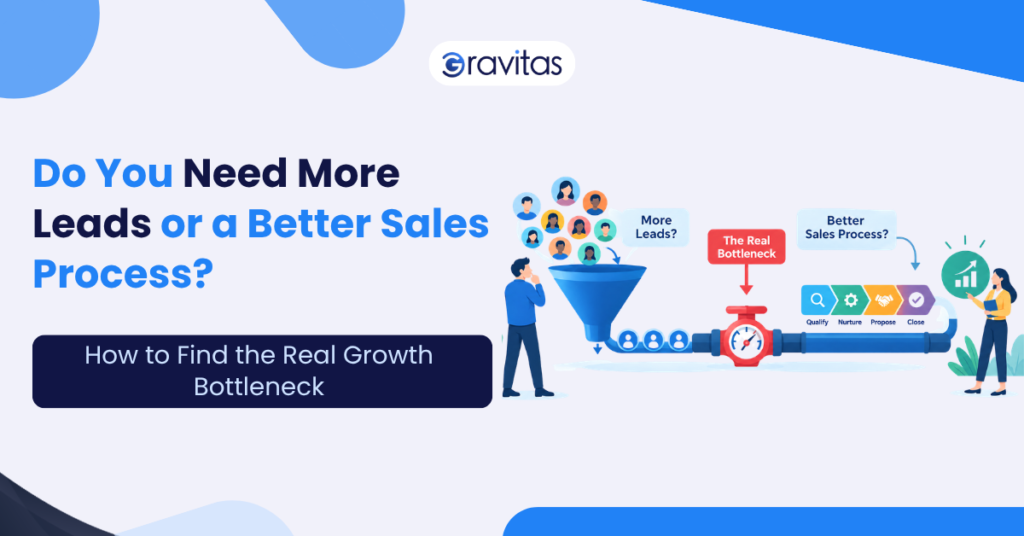
Finding potential customers is easier than finding the right customers.
B2B companies can spend weeks building prospect lists, running campaigns, sending emails, and booking meetings, only to discover that many of those prospects have little buying intent or do not fit their offering. The problem is not always a lack of leads. Often, it is a lack of a sales process capable of identifying and developing the opportunities that matter.
Marketing can bring prospects into the funnel, but sales needs to determine which of those prospects are worth pursuing, start meaningful conversations, and move genuine opportunities forward.
This is where Sales-as-a-Service becomes valuable. Instead of building every sales capability internally, businesses can bring in an experienced external team to support prospecting, outreach, qualification, appointment setting, and pipeline development.
For companies exploring B2B sales consulting, this approach can provide additional sales capacity without requiring the immediate investment of a large internal team.
In this guide, we will look at how Sales-as-a-Service helps businesses generate more qualified leads, where it fits into the modern B2B sales process, and what companies should consider before adopting the model.
What Is Sales-as-a-Service?
Sales-as-a-Service is an outsourced sales model in which an external team supports a company’s sales development activities on an ongoing basis.
The scope can vary depending on the business. A company may need support only with prospect research and outbound outreach, while another may require end-to-end sales development covering:
- Market and account research
- Prospect identification
- Outbound email campaigns
- LinkedIn prospecting
- Lead qualification
- Appointment setting
- Follow-up management
- CRM updates
- Pipeline reporting
The key difference from simply outsourcing a single sales task is the ongoing nature of the engagement. The external team becomes an extension of the company’s sales function and can adjust its approach as the business gathers more information about its market.
This model is becoming increasingly relevant as B2B buying becomes less linear. Buyers often research solutions independently, involve several stakeholders, and interact with a business across multiple channels before speaking to sales.
Harvard Business Review’s analysis of changing B2B sales practices provides useful context on how digital buying behavior is changing the role of modern sales teams.
Why Many Businesses Struggle to Generate Qualified Leads
The challenge usually starts before a salesperson ever makes a call.
A company may have a strong product and a sizable market, yet still struggle to create opportunities because its sales process is not designed around how the ideal customer actually buys.
Focusing on Quantity Instead of Quality
A database containing thousands of contacts can create the appearance of strong lead generation.
But a contact is not automatically a prospect, and a prospect is not automatically an opportunity.
If a business measures success mainly through the number of contacts generated, sales teams can end up spending valuable time on companies that have no relevant need, no buying authority, or no realistic reason to purchase.
A better approach is to assess fit and intent alongside volume.
Inconsistent Sales Follow-Ups
A promising prospect rarely converts because of one email.
A potential buyer may respond to an initial message, ask for more information, postpone a discussion, or simply become busy. Without a defined follow-up process, these conversations can quietly disappear.
This is particularly common when founders or small sales teams are responsible for prospecting while also handling meetings, proposals, customer relationships, and operational work.
The result is not necessarily poor lead quality. Sometimes, good opportunities are simply not developed properly.
Lack of a Structured Sales Process
When sales activity is handled differently by different people, it becomes difficult to understand what is actually working.
One salesperson may prioritize company size. Another may focus on job title. Someone else may consider a prospect qualified simply because they replied.
A structured process creates common criteria for prospecting, qualification, handoff, and reporting. It also makes the sales pipeline easier to evaluate.
How Sales-as-a-Service Generates More Qualified Leads
The value of Sales-as-a-Service is not simply having more people sending outreach. It comes from creating a more disciplined process around who gets contacted, why they are contacted, and what happens after they respond.
Starting With an Ideal Customer Profile
Before prospecting begins, the sales team needs to know what a good customer looks like.
An Ideal Customer Profile can include factors such as:
- Industry
- Company size
- Location
- Business model
- Revenue range
- Technology used
- Common operational challenges
- Buying triggers
- Relevant decision-makers
This prevents sales activity from becoming a broad search for anyone who might potentially need the product.
For example, an enterprise software company may discover that mid-sized companies with a particular technology stack and a growing operations team are significantly more likely to become customers. That insight can then shape the entire prospecting strategy.
Building Account-Level Intelligence
Modern B2B prospecting is increasingly about understanding the account, not just finding an email address.
Before contacting a company, a sales team can examine its business model, recent developments, existing technology, expansion plans, hiring activity, and potential business challenges.
This creates an opportunity to connect the company’s offering with something that is actually relevant to the prospect.
Instead of:
“We provide technology solutions. Would you like to schedule a call?”
The conversation can start around a specific business situation.
That difference can have a significant impact on response quality.
Reaching Multiple Stakeholders
B2B purchases often involve more than one person.
The person who experiences the problem may not control the budget. The technical team may evaluate the solution, while a senior executive makes the final decision.
A Sales-as-a-Service team can map relevant stakeholders within an account rather than relying on a single contact.
This creates a broader understanding of the buying group and reduces the risk of treating one contact as the entire opportunity.
Qualifying Conversations, Not Just Contacts
Qualification should happen throughout the sales conversation rather than being treated as a checkbox.
A sales team can use early conversations to understand:
- What problem is the prospect trying to solve?
- How significant is the problem?
- What are they doing currently?
- Who else is involved?
- Is there an expected decision timeframe?
- What would prevent the purchase?
The objective is not to force every prospect into a sales meeting. It is to determine whether there is enough business relevance to justify the next step.
Creating Relevant Sales Conversations
Personalization is often misunderstood as simply inserting a prospect’s first name into an email.
Useful personalization goes further.
It connects the outreach to something that matters to the prospect’s business. That might be an operational challenge, a market change, a new business initiative, or a problem common to companies in the same industry.
This makes the conversation more useful from the prospect’s perspective and gives sales representatives a stronger reason for reaching out.
Keeping Opportunities Moving
Once a prospect enters the pipeline, sales activity should not stop at the first meeting.
Different prospects may require different next steps. One may need a product demonstration. Another may need technical validation. A third may need internal approval before continuing.
A structured sales team can track these stages and make sure opportunities do not remain inactive simply because the next action was never assigned.
Businesses looking to strengthen the front end of this process can also explore lead generation services as part of a broader demand and sales development strategy.
Key Benefits of Sales-as-a-Service
The benefits go beyond adding more people to a sales operation.
Faster Market Testing
A company entering a new market does not always know which industries, job roles, messages, or use cases will generate the strongest response.
An external sales team can help test these assumptions through structured outreach.
Instead of spending months building an internal department before learning whether the market responds, businesses can gather market feedback earlier and refine their approach.
Greater Sales Capacity
Internal teams often reach a point where they have more opportunities than they can actively develop.
Sales-as-a-Service can add capacity without requiring the company to immediately recruit several salespeople.
This is particularly useful when a business has a proven offering but needs more activity at the top and middle of the funnel.
Access to Specialized Sales Skills
Building a sales team means finding people who can research accounts, write effective outreach, qualify opportunities, handle objections, maintain CRM data, and understand pipeline metrics.
An experienced outsourced sales team can bring these capabilities from the beginning.
Better Visibility Into Pipeline Health
Sales pipeline management becomes easier when activity is consistently recorded and measured.
Businesses can gain visibility into:
- Which accounts are being approached
- Which campaigns generate responses
- Where prospects are progressing
- Which opportunities have stalled
- Which industries convert better
- Where prospects are dropping out
This information can influence not only sales activity but also pricing, positioning, product development, and marketing.
More Flexible Cost Structure
Hiring an internal sales team creates ongoing costs regardless of how quickly the pipeline grows.
An outsourced model can give businesses more flexibility to scale sales activity according to their current requirements.
That can be particularly useful for startups, SMEs, and businesses testing a new market.
Sales-as-a-Service vs Hiring an In-House Sales Team
Choosing between an outsourced and internal model depends on the company’s stage and objectives.
| Feature | Sales-as-a-Service | In-House Sales |
| Hiring Time | Faster deployment | Requires recruitment |
| Initial Investment | Generally lower | Generally higher |
| Scalability | Easy to adjust | Requires additional hiring |
| Sales Expertise | Available from the start | Built over time |
| Prospecting Support | Can be included | Requires dedicated resources |
| Management | Shared with provider | Fully internal |
| Flexibility | High | Depends on team size |
An in-house team may make more sense when a company already has a mature sales function and requires deep internal ownership.
Sales-as-a-Service can be more attractive when the business needs to build sales capacity quickly, test a market, or avoid the overhead of creating an entire department.
Industries That Benefit Most From Sales-as-a-Service
There is no single industry that owns this model. It tends to work best where businesses have a defined B2B offering and need consistent access to decision-makers.
SaaS
Software companies often have clearly defined buyer roles, making them suitable for account-based prospecting and structured outbound sales.
IT Services
IT providers can use targeted outreach to identify organizations with technology projects, infrastructure requirements, modernization initiatives, or specialist resource needs.
Manufacturing
Manufacturers can use sales development to identify distributors, procurement teams, operations leaders, and businesses that match their product requirements.
Professional Services
Accounting, legal, HR, engineering, and other specialist firms can use structured prospecting to identify companies that match their service profile.
Consulting
Consulting businesses often sell expertise rather than a standardized product. Targeted outreach can help identify companies facing problems where that expertise is relevant.
Healthcare Technology
Healthcare technology companies may need to reach several stakeholders across providers, technology teams, administrators, and business leadership.
Logistics
Logistics companies can use account research and targeted outreach to identify businesses experiencing expansion, distribution changes, or supply-chain requirements.
Best Practices for Maximizing Results With Sales-as-a-Service
Outsourcing sales does not remove the need for strategic involvement from the business.
Define the Commercial Goal First
“Generate more leads” is not a useful sales objective by itself.
A better goal could be to generate a specific number of qualified meetings from a particular industry, enter a new geographic market, or create a defined amount of sales pipeline within a given period.
Clear objectives make performance easier to evaluate.
Give the Sales Team Enough Context
An external team cannot sell effectively if it only receives a product brochure.
The onboarding process should cover:
- Ideal customers
- Value proposition
- Competitors
- Customer pain points
- Common objections
- Existing sales process
- Pricing structure
- Qualification criteria
- Successful customer examples
The more accurately the team understands the business, the more relevant its conversations can become.
Establish Sales and Marketing Alignment
Marketing and sales should agree on what constitutes a qualified lead.
If marketing is optimizing for downloads and registrations while sales needs decision-makers from specific industries, the two teams may produce impressive numbers without producing a useful pipeline.
Shared definitions and regular feedback help close this gap.
Track Quality-Based KPIs
Lead volume is only one metric.
Businesses should also monitor:
- Qualified meeting rate
- Meeting-to-opportunity conversion
- Opportunity-to-customer conversion
- Pipeline generated
- Response rate
- Sales cycle duration
- Revenue generated
These metrics provide a much clearer picture of whether sales activity is contributing to growth.
Use Sales Data to Improve the Strategy
The conversations generated by an outsourced sales team can reveal valuable market information.
If prospects repeatedly object to pricing, positioning, implementation time, or a particular feature, that feedback should not remain inside the sales report.
It can inform future campaigns, product decisions, messaging, and customer targeting.
For businesses evaluating broader revenue growth strategies, this feedback loop can be just as valuable as the meetings themselves.
Common Mistakes Businesses Make When Outsourcing Sales
Sales outsourcing works best when the partnership is treated as a strategic extension of the business rather than a simple activity-based service.
Choosing a Provider Based Only on Price
A lower monthly cost does not necessarily mean a better sales outcome.
Businesses should evaluate the provider’s sales methodology, communication process, reporting, experience, and ability to understand the target market.
Starting Without a Defined ICP
If the business cannot clearly describe its best customers, the outsourced team will struggle to build an effective prospecting strategy.
The ICP should be agreed upon before campaigns begin.
Treating Outreach as a Volume Game
Sending more messages does not automatically create more opportunities.
Poorly targeted outreach can damage response rates and make it harder to identify what actually resonates with the market.
Skipping the Onboarding Process
Sales representatives need enough product and market knowledge to have credible conversations.
A short handover followed by immediate outreach may save time initially but create problems later.
Measuring Only Activity
Thousands of emails sent is an activity metric, not a revenue outcome.
Businesses should connect activity to responses, qualified conversations, opportunities, pipeline, and eventually revenue.
Expecting Immediate Revenue
B2B sales cycles can take weeks or months, particularly when multiple stakeholders are involved.
Early performance should therefore be evaluated through both leading indicators and final commercial outcomes.
Gartner’s research on the B2B buying journey also highlights the complexity of modern B2B purchasing, where buying groups and multiple stages can influence the path to a decision.
Conclusion
Qualified lead generation is not about putting more names into a CRM. It is about creating a repeatable way to identify the businesses worth pursuing and giving those opportunities the attention they need.
Sales-as-a-Service can help companies build that process without immediately creating a large internal sales department. From account research and market testing to stakeholder mapping and pipeline management, an experienced sales team can provide the structure and capacity needed to develop a healthier flow of B2B opportunities.
For growing companies, the biggest advantage may not simply be the number of meetings generated. It is having a sales process that becomes more informed with every conversation and gives the business a clearer understanding of where its next customers are likely to come from.
If your business needs more qualified opportunities without the overhead of expanding an internal sales team, explore Sales-as-a-Service solutions from Gravitas and build a sales strategy around your target market, goals, and growth stage.
Frequently Asked Questions
Sales-as-a-Service is an outsourced sales model where an external team supports activities such as prospect research, outbound sales, lead qualification, appointment setting, follow-ups, and pipeline development.
It uses a structured approach to identify companies that fit the ideal customer profile, reach relevant decision-makers, understand their requirements, and determine whether there is a genuine sales opportunity.
Yes. Startups can use it to establish a sales process without immediately taking on the cost and management requirements of a full internal sales department. It can also help startups test their target market and messaging.
An in-house sales team is recruited and managed directly by the company. Sales-as-a-Service provides external sales resources and expertise that can be scaled according to the company’s requirements.
Results depend on the market, offering, target audience, sales cycle, outreach strategy, and starting pipeline. Initial indicators such as responses and qualified meetings may appear before revenue is generated.
B2B companies with identifiable decision-makers and a clear value proposition are generally well suited to the model. SaaS, IT services, consulting, manufacturing, professional services, healthcare technology, and logistics are common examples.
It can reduce the fixed costs associated with recruiting, training, and maintaining a large internal sales team. However, the actual customer acquisition cost depends on the entire sales and marketing process and should be evaluated using the company’s own performance data.