Building a sales function takes more than hiring a few people and giving them a prospect list. Businesses need the right targeting, sales processes, technology, reporting, and people working together to create opportunities consistently.
For startups and growing B2B companies, building all of this internally can take significant time and resources. Recruitment takes time. New salespeople need training. Processes have to be developed. Technology needs to be configured. And the business still has to figure out what works in its market.
That is why many companies consider outsourced sales solutions as an alternative to building everything from scratch.
Gravitas Consulting Sales-as-a-Service is designed to give businesses access to sales expertise and execution without requiring them to build an entire sales operation internally. From defining the right market to managing sales outreach and measuring performance, the approach is built around the company’s commercial objectives.
If you are evaluating a Sales-as-a-Service provider, the important question is not simply whether an external team can make sales calls. It is whether that team can understand your business, represent it effectively, and contribute to measurable growth.
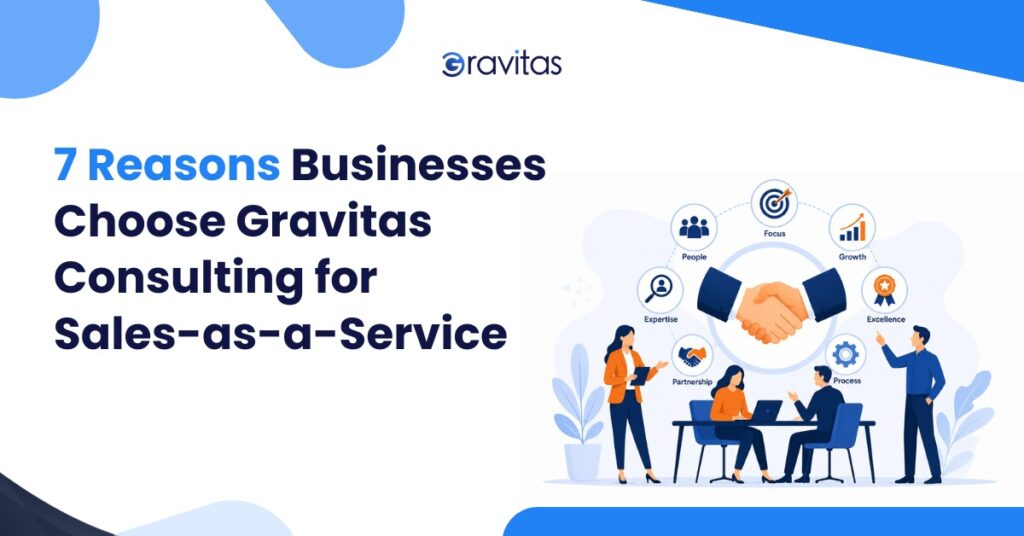
Here are seven reasons businesses choose Gravitas Consulting.
Why Businesses Trust Gravitas Consulting for Sales Growth
Choosing a sales outsourcing company is ultimately a decision about trust.
The external team is representing your brand in front of potential customers. That means the quality of its research, communication, positioning, and follow-up directly affects how prospects perceive your business.
Gravitas approaches sales as an extension of the client’s business rather than as a disconnected activity. The engagement can be structured around the company’s market, customer profile, sales objectives, and growth priorities.
That combination of strategic planning and execution makes the model relevant for businesses that want additional sales capability without handing over their entire commercial strategy.
7 Reasons Businesses Choose Gravitas Consulting
B2B Sales Expertise That Goes Beyond Prospecting
B2B sales can become complicated quickly.
The person receiving the first outreach may not be the decision-maker. A prospect may need technical validation before discussing pricing. Several stakeholders may influence the final decision. In some industries, the buying cycle can stretch across several months.
That requires more than sending cold emails.
Gravitas brings a B2B sales consulting perspective to the process, helping businesses approach prospects based on their market and buying environment.
The focus is on understanding:
- Who the business needs to reach
- What matters to those buyers
- How the offering solves a business problem
- Which conversations are worth pursuing
- What should happen after initial interest
This allows sales activity to be connected to the commercial context rather than treated as a standalone outreach campaign.
A Sales Strategy Built Around Your Business
Two companies can sell similar products and still require completely different sales strategies.
A SaaS company targeting enterprise buyers may need account-based outreach and multiple stakeholder engagement. A consulting firm may depend more heavily on thought leadership and relationship-driven selling. An IT services company may need to identify businesses experiencing specific technology challenges.
That is why a one-size-fits-all sales playbook rarely works well.
Gravitas can tailor the sales approach around the company’s:
- Target industries
- Ideal Customer Profile
- Buyer roles
- Geographic markets
- Value proposition
- Sales cycle
- Business objectives
The result is a business growth strategy that reflects where the company actually wants to go rather than simply increasing sales activity.
A Stronger Path From Prospect to Opportunity
Generating interest is only one part of sales development.
The bigger question is what happens after someone responds.
Gravitas can support the progression from initial prospecting through qualification and appointment setting, helping businesses avoid a common problem: having conversations but failing to turn them into meaningful opportunities.
The process can involve identifying relevant accounts, engaging the right contacts, understanding their requirements, and determining whether a conversation warrants moving forward.
This creates a more structured route from prospect to opportunity and gives internal sales teams better conversations to work with.
Sales Expertise Without Building Another Department
Hiring a sales team internally involves more than filling positions.
Businesses need to recruit the right people, train them, establish processes, introduce tools, manage performance, and continuously develop the team.
For a growing company, this can become a significant operational commitment.
An outsourced sales team gives businesses access to experienced sales professionals without requiring them to build every capability themselves.
This can be particularly useful when:
- A startup needs its first structured sales function
- An SME wants to increase sales capacity
- A company is entering a new market
- An existing sales team needs additional prospecting support
- Leadership wants to test a sales channel before hiring internally
Instead of waiting for a new team to become productive, businesses can begin with an existing sales framework and adapt it as results and market feedback come in.
Decisions Backed by Sales Data
Sales teams generate a lot of information. The problem is that businesses often fail to use it.
Which industries are responding?
Which job roles engage most often?
Which messaging produces conversations?
Where are prospects losing interest?
Which opportunities are progressing?
These questions can reveal much more than whether a campaign generated a certain number of meetings.
Gravitas can use sales analytics and reporting to monitor performance and identify areas that need attention. Tracking the right sales KPIs allows businesses to make decisions based on actual market response rather than assumptions.
For companies looking to build a more structured sales function,Sales consulting services can provide a broader framework for assessing performance and refining the sales approach.
Sales Capacity That Can Change With the Business
Sales requirements do not remain constant.
A company may need additional support during a product launch, market expansion, or new territory rollout. Later, its priorities may shift toward account development or a different customer segment.
Building a permanent internal team for every change can make the sales operation difficult to adjust.
A scalable sales solution provides more flexibility. Businesses can increase sales support when they need additional capacity and adjust the engagement as priorities change.
This is especially useful for companies that are still determining which markets or segments offer the strongest commercial opportunities.
The Focus Is on Commercial Outcomes
Sales activity can look impressive on paper.
A campaign can generate thousands of contacts. Hundreds of emails can be sent. Dozens of conversations can take place.
But none of those numbers matter if they do not contribute to the business.
Gravitas focuses on connecting sales activity with commercial outcomes. That means looking beyond surface-level activity and considering metrics such as opportunity creation, conversion, pipeline contribution, and revenue potential.
The objective is not simply to keep salespeople busy.
It is to build a sales operation that contributes to the company’s wider business objectives.
How Gravitas Consulting’s Sales Process Works
A successful sales engagement needs a clear starting point. Rather than immediately launching outreach, the process begins by understanding the business and establishing the foundation for execution.
Business Discovery
The first step is understanding the company.
This includes its products or services, existing customers, competitive position, market, sales challenges, and commercial objectives.
Without this context, even a well-executed campaign can miss the mark.
Ideal Customer Profile Development
The next step is identifying who the business should actually pursue.
The ICP can include company characteristics, industries, locations, buyer roles, business situations, and other indicators that help identify stronger-fit accounts.
This gives the sales team a clear definition of the market it needs to address.
Prospecting and Outreach
Once the target market is established, relevant accounts and contacts can be identified.
Outreach can then be developed around the audience rather than using the same message for every prospect.
Depending on the campaign, this may include email, LinkedIn, phone, or a combination of channels.
Lead Qualification
A response does not automatically make someone a sales opportunity.
Qualification helps determine whether the prospect has a relevant requirement, fits the target market, and is worth progressing to the next stage.
This gives the sales process a clearer distinction between interest and genuine opportunity.
Performance Tracking
Sales activity needs to be measured continuously.
Performance tracking can cover outreach engagement, meetings, qualification rates, opportunities, conversion, and pipeline contribution.
The findings can then be used to refine targeting and sales execution.
Who Can Benefit From Gravitas Consulting Sales-as-a-Service?
Sales outsourcing is not limited to companies that do not have a sales team.
Different businesses can use the model for different reasons.
Startups
Startups can use Sales-as-a-Service to establish a repeatable sales process while founders and internal teams focus on product development, customers, and business operations.
SMEs
Small and mid-sized businesses can add sales capacity without immediately taking on the cost and management requirements of a larger internal department.
SaaS Companies
SaaS businesses often operate in competitive markets where reaching the right decision-makers consistently is essential to building pipeline.
IT Services Companies
IT providers can use structured outbound sales to identify businesses with relevant technology requirements and initiate conversations with decision-makers.
Consulting Firms
Consulting businesses can use targeted prospecting to identify organizations facing challenges that match their expertise.
Manufacturing Companies
Manufacturers can use sales development to reach procurement teams, distributors, operations leaders, and other relevant business stakeholders.
Professional Services Firms
Professional services businesses can use targeted sales engagement to expand into new accounts, sectors, or geographic markets.
Why Outsourcing Sales Can Be More Cost-Effective Than Building an Internal Team
The cost of an internal sales team extends beyond salaries.
There is recruitment, onboarding, training, management, sales technology, data, tools, and the time required for new employees to become productive.
For some businesses, especially those still testing their sales model, committing to all of these costs upfront may not be practical.
| Factor | Gravitas Sales-as-a-Service | In-house Sales Team |
| Hiring Cost | Lower upfront commitment | Recruitment required |
| Training Time | Faster deployment | Longer onboarding |
| Scalability | Easier to adjust | Requires additional hiring |
| Expertise | Available from the outset | Developed internally |
| Sales Technology | Sales infrastructure can be included | Additional investment |
| Revenue Ramp-Up | Can begin sooner | Depends on recruitment and ramp-up |
The right choice depends on the business. An internal team can provide deep ownership and long-term institutional knowledge, while an outsourced model can provide flexibility and faster access to sales capabilities.
As modern sales organizations continue to rethink how internal and external capabilities work together,Harvard Business Review’s discussion of modern sales organizations offers additional perspective on building more effective sales functions.
Common Challenges Businesses Solve With Gravitas Consulting
Businesses rarely look for an outsourced sales partner simply because they want “more sales.”
Usually, there is a specific problem behind the decision.
“We’re Getting Leads, But They Aren’t Relevant”
A large number of contacts does not help if most of them fall outside the target market.
A clearer ICP and more focused prospecting approach can improve the relevance of the accounts entering the sales process.
“Our Sales Pipeline Is Too Inconsistent”
Some months may be busy while others are quiet.
A consistent sales development process can help businesses avoid relying entirely on referrals, inbound enquiries, or occasional prospecting efforts.
“Our Team Doesn’t Have Enough Time for Prospecting”
Salespeople may spend most of their time on existing opportunities and customers, leaving little time for finding new business.
External sales support can take on prospecting responsibilities while internal teams concentrate on later-stage opportunities.
“We Don’t Know Which Markets to Prioritize”
When businesses enter new markets, they often have assumptions about which segments will respond.
Outbound sales activity can provide direct market feedback and help identify where commercial opportunities are stronger.
“We Want to Grow Without Hiring Too Quickly”
Growth does not always require immediately adding several full-time employees.
An outsourced model can provide additional capacity while the business evaluates its longer-term sales structure.
For businesses that specifically need help strengthening the top of the funnel, Lead generation services can complement the wider sales process.
Conclusion
Choosing a Sales-as-a-Service partner is not simply about finding someone to handle outbound sales.
It is about finding a team that can understand your market, represent your offering credibly, adapt to your sales objectives, and provide visibility into what is happening across the sales process.
That is where Gravitas Consulting Sales-as-a-Service can fit into a company’s growth strategy. With B2B sales expertise, tailored execution, performance tracking, and flexible sales support, businesses can add sales capability without taking on the full operational burden of building another department.
For companies considering outsourced sales solutions, the goal should be more than generating activity. The right partner should help create a sales process that supports measurable commercial outcomes.
Ready to scale your sales without the cost and complexity of building an in-house team?
Explore Gravitas Consulting’s Sales-as-a-Service and discuss a sales strategy built around your business, target market, and growth objectives.
Frequently Asked Questions
Gravitas Consulting Sales-as-a-Service is an outsourced sales model designed to help businesses develop sales opportunities through activities such as prospect research, outreach, qualification, appointment setting, and sales performance tracking.
Businesses can work with Gravitas to access B2B sales expertise, tailored sales strategies, sales execution, reporting, and flexible support without having to build every sales capability internally.
The approach can support B2B organizations across sectors such as SaaS, IT services, consulting, manufacturing, and professional services. The sales strategy is adapted to the business’s target market and offering.
It can help businesses create a more consistent approach to prospecting, improve the quality of sales conversations, and give internal teams additional sales capacity. Revenue impact ultimately depends on the offering, market, sales cycle, and execution.
Yes. Startups and SMEs can use outsourced sales to access sales expertise without immediately building a large internal sales department.
There is no universal timeline. Results depend on factors including market size, offer, target audience, sales cycle, outreach strategy, and existing brand presence. Early indicators may include prospect engagement and qualified meetings, while revenue results typically take longer.
The first step is to discuss your sales objectives, target market, current challenges, and growth plans. This allows the sales approach to be aligned with what your business actually needs rather than applying a generic sales model.