Introduction
A few years ago, SEO teams spent most of their time doing repetitive work exporting keyword sheets, manually optimizing metadata, analyzing competitors page by page, and rewriting the same content structures repeatedly.
Today, that workflow looks completely different.
With the rise of generative AI and intelligent automation, SEO has moved from being heavily manual to deeply data-driven. Tools powered by artificial intelligence can now analyze search intent, identify ranking gaps, generate content frameworks, optimize on-page structure, and even predict what users are likely to search next.
This shift is why AI in SEO has become one of the biggest transformations in digital marketing.
And no, AI is not just helping marketers write blogs faster.
Platforms like Claude, ChatGPT, Gemini, Surfer SEO, Clearscope, and MarketMuse are changing how brands approach everything from keyword research to technical optimization and content strategy. Businesses that once needed large SEO teams to scale content are now building streamlined workflows powered by automation and machine learning.
At the same time, search engines themselves are becoming AI-first.
Google’s AI Overviews, conversational search experiences, and semantic ranking systems mean websites can no longer rely on outdated SEO tactics like keyword stuffing or publishing thin content at scale. Search engines now prioritize relevance, context, expertise, and user satisfaction more than ever before.
That means the real opportunity is not simply “using AI.”
It’s learning how to combine AI efficiency with human expertise.
Businesses investing in AI-powered digital marketing services are already using automation to improve rankings, scale high-quality content production, and respond to search trends faster than competitors.
SEO is no longer just about ranking pages.
It’s about building intelligent content ecosystems that match how modern users search.
What is AI in SEO?
AI in SEO refers to the use of artificial intelligence, machine learning, and automation technologies to improve how websites are optimized for search engines.
But to understand why this matters, it helps to look at how search itself has changed.
Traditional SEO focused heavily on exact-match keywords and technical optimization. If someone searched for “best running shoes,” Google primarily matched pages containing those exact words.
Modern search engines work very differently.
Today, Google’s algorithms use machine learning systems to understand:
- User intent
- Search context
- Behavioral signals
- Semantic meaning
- Content depth
- Topical authority
- Experience and trustworthiness
In other words, search engines are no longer just matching keywords. They are interpreting meaning.
That’s where AI SEO tools become valuable.
Instead of manually guessing what content might rank, AI systems analyze massive amounts of search data to uncover patterns humans would take weeks to identify.
For example, AI tools can now:
- Detect emerging keyword trends before they peak
- Group thousands of related keywords into topic clusters
- Identify gaps in competitor content
- Recommend semantic keywords automatically
- Optimize content for readability and intent
- Suggest internal linking opportunities
- Analyze SERP volatility in real time
This is why modern SEO workflows are becoming increasingly automated.
Not because marketers want shortcuts but because search itself has become too complex to manage manually at scale.
Key Capabilities of AI in SEO
Data Analysis at Scale
One of the biggest challenges in SEO is dealing with overwhelming amounts of data.
A single enterprise website may target thousands of keywords across hundreds of pages. Manually analyzing rankings, traffic trends, competitor gaps, CTR changes, and optimization opportunities is extremely time-consuming.
AI changes that completely.
Instead of reviewing spreadsheets manually, AI systems can process millions of search signals within seconds and surface actionable insights immediately.
For example, AI-powered SEO platforms can identify:
- Which pages are losing rankings
- Which keywords are gaining momentum
- Where competitors are outperforming you
- Which content needs refreshing
- What topics users are searching for next
This level of analysis helps businesses make faster strategic decisions instead of reacting months later.
Predictive Keyword Insights
Traditional keyword research tools tell you what people searched yesterday.
AI-driven SEO tools try to predict what people will search tomorrow.
By analyzing behavioral trends, seasonal patterns, SERP shifts, and conversational queries, machine learning systems can uncover rising topics before they become saturated.
This gives businesses a major advantage.
For example, companies using AI keyword forecasting during the rise of “AI productivity tools” created content months before competition intensified allowing them to dominate rankings early.
That’s a massive shift from reactive SEO to predictive SEO.
Automated Content Optimization
Content optimization used to involve manually checking:
- Keyword density
- Heading structures
- Readability scores
- Metadata
- Internal links
- Semantic relevance
Now AI systems handle most of this automatically.
Modern SEO automation tools analyze top-ranking pages and recommend improvements based on real SERP patterns instead of generic optimization rules.
This includes:
- NLP keyword suggestions
- Search intent alignment
- Missing topic coverage
- FAQ recommendations
- Content structure improvements
- Featured snippet opportunities
The result is content that aligns more naturally with how search engines evaluate relevance.
Automated Content Optimization
Content optimization used to involve manually checking:
- Keyword density
- Heading structures
- Readability scores
- Metadata
- Internal links
- Semantic relevance
Now AI systems handle most of this automatically.
Modern SEO automation tools analyze top-ranking pages and recommend improvements based on real SERP patterns instead of generic optimization rules.
This includes:
- NLP keyword suggestions
- Search intent alignment
- Missing topic coverage
- FAQ recommendations
- Content structure improvements
- Featured snippet opportunities
The result is content that aligns more naturally with how search engines evaluate relevance.
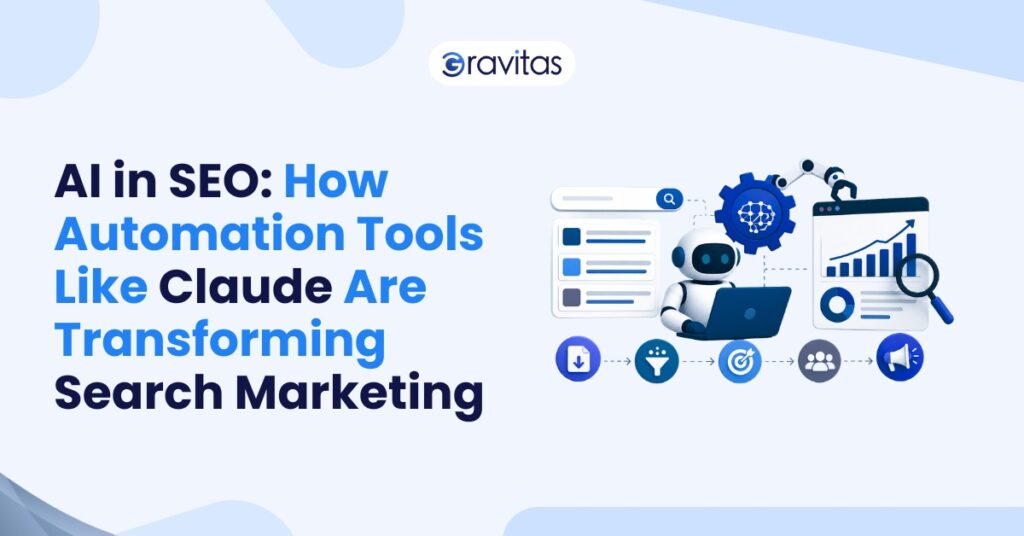
How Tools Like Claude Are Changing SEO
When most people think about AI tools like Claude, they immediately think about content writing.
But that’s actually just a small part of the transformation happening in SEO.
The real impact of generative AI is workflow acceleration.
SEO professionals are now using AI systems to reduce hours of manual work across strategy, analysis, optimization, and execution.
Instead of switching between multiple tools for keyword clustering, search intent analysis, SERP evaluation, and content planning, marketers can now use AI assistants to streamline entire workflows.
This changes how SEO teams operate.
A task that previously required:
- An SEO strategist
- A content writer
- A researcher
- A SERP analyst
can now be partially automated within minutes.
That doesn’t eliminate human expertise.
It changes where humans provide value.
SEO professionals are spending less time on repetitive production tasks and more time on:
- Content strategy
- Brand positioning
- User experience
- Authority building
- Conversion optimization
That’s a much more valuable role.
- Build FAQ sections
- Create title variations
- Draft meta descriptions
- Improve readability
- Reformat existing content
But here’s the important distinction:
The best-performing SEO content is not fully AI-written content.
It’s AI-assisted, human-enhanced content.
Why?
Because search engines increasingly reward:
- Original insights
- First-hand expertise
- Unique perspectives
- Credible information
- Helpful user experiences
Purely generic AI-generated articles rarely sustain rankings long term.
That’s why the strongest SEO teams use AI for speed and humans for depth.
Smart Keyword Research
Keyword research is becoming less about isolated keywords and more about search behavior.
Modern AI SEO tools analyze:
- Query intent
- Semantic relationships
- Topic relevance
- Conversational patterns
- User journeys
For example, older SEO strategies treated these as separate keywords:
- “best CRM software”
- “CRM for startups”
- “top customer management tools”
AI systems understand these are connected within the same topical ecosystem.
This allows marketers to build more comprehensive content clusters instead of creating disconnected pages targeting individual phrases.
AI-driven keyword research also helps optimize for conversational search.
As users increasingly search through voice assistants, AI chatbots, and conversational interfaces, queries are becoming more natural and question-focused.
Instead of typing:
“SEO tools”
Users now ask:
“What are the best AI SEO tools for content optimization in 2026?”
That’s a completely different search behavior.
Businesses exploring advanced AI systems can also explore Claude AI by Anthropic to understand how generative AI platforms are being used in modern content and automation workflows.
Benefits of Using AI in SEO
Faster Decision-Making
SEO is highly competitive. Waiting weeks to identify trends often means missing opportunities.
AI dramatically shortens decision-making cycles by providing real-time recommendations and predictive insights.
This speed matters especially in industries where search trends shift rapidly.
Improved Search Intent Optimization
One of the biggest reasons content fails to rank is mismatched intent.
A page may target the right keyword but still fail because it doesn’t satisfy what users actually want.
AI tools are becoming significantly better at understanding:
- Informational intent
- Transactional intent
- Navigational intent
- Commercial investigation intent
This helps marketers create content that aligns more closely with user expectations.
Better Content Coverage
AI tools help identify missing topical areas within content.
Instead of publishing shallow articles focused on a single keyword, brands can create more authoritative resources covering related questions, entities, and semantic variations.
This improves:
- Topical authority
- Engagement
- SERP relevance
- Internal linking opportunities
Competitive Advantage
The reality is simple:
Businesses already using AI in SEO are scaling faster.
They are:
- Publishing content faster
- Updating pages more efficiently
- Responding to SERP changes quicker
- Identifying opportunities earlier
Companies still relying entirely on manual SEO workflows are increasingly struggling to compete at scale.
Challenges of AI in SEO
Despite all its advantages, AI is not a magic solution.
And many businesses are already making the same mistake:
Publishing mass-produced AI content without strategy or quality control.
That approach rarely works long term.
Over-Reliance on Automation
Search engines are becoming better at identifying low-value content created purely for rankings.
If content lacks originality, expertise, or usefulness, automation alone will not save it.
AI should improve workflows, not replace strategic thinking.
Generic Content Risks
One of the biggest issues with AI-generated content is sameness.
Many AI-written articles:
- Repeat common information
- Lack depth
- Sound formulaic
- Provide little unique value
This creates a growing problem across search results:
Content saturation.
The brands that will win are not the ones producing the most AI content.
They are the ones adding the most original value.
Human Oversight Still Matters
Human expertise remains essential for:
- Brand voice
- Editorial quality
- Industry experience
- Storytelling
- Emotional engagement
- Strategic differentiation
The future of SEO is not AI vs humans.
It’s AI + humans working together effectively.
AI SEO and the Future of Search (AI Overviews & Chatbots)
Search is entering a completely new phase.
Google AI Overviews are already changing how users interact with search results by generating summarized answers directly inside SERPs.
At the same time:
- ChatGPT is influencing research behavior
- Gemini is integrating conversational search
- AI assistants are replacing traditional browsing patterns
This means businesses must optimize not only for rankings but for AI interpretation.
Future-focused SEO strategies now require:
- Structured information
- Entity optimization
- Conversational formatting
- Clear answer-based content
- Semantic relevance
Brands preparing for AI-driven search should also explore the future of search engine optimization to understand how search visibility is evolving beyond traditional rankings.
Best Practices to Use AI in SEO Effectively
Use AI for Enhancement — Not Replacement
The best use of AI is workflow enhancement.
- Accelerate research
- Improve optimization
- Automate repetitive tasks
- Generate insights faster
Use it to:
But keep humans involved in strategic decisions and quality control.
Focus on Helpful Content
Search engines increasingly reward genuinely useful content.
AI should help improve helpfulness, not mass-produce low-value articles.
Optimize for Conversational Search
Search behavior is becoming more natural and question-driven.
Content should answer questions clearly while maintaining depth and authority.
Build Topic Authority
Instead of creating isolated keyword pages, build interconnected content ecosystems around broader topics.
This aligns better with how AI-driven search engines evaluate expertise and contextual relevance.
CTA (Call To Action)
Want to build smarter SEO strategies powered by AI and real search intelligence?
Our team combines advanced automation tools, AI-driven optimization, and human expertise to help businesses improve rankings, scale content efficiently, and stay ahead in evolving search environments.
Explore our AI-driven SEO services and future-proof your search strategy today.
Conclusion
AI in SEO is not simply another marketing trend.
It represents a major shift in how search marketing operates.
From predictive keyword analysis and intelligent automation to conversational search optimization and AI-generated search experiences, tools like Claude are fundamentally changing how brands approach visibility online.
But the future of SEO does not belong to automation alone.
The businesses that will succeed are the ones that combine:
- AI efficiency
- Human creativity
- Strategic thinking
- Original expertise
- User-focused experiences
Because in the era of AI-powered search, helpfulness and authenticity matter more than ever.
FAQs
AI in SEO refers to using artificial intelligence and machine learning technologies to automate and improve SEO processes such as keyword research, content optimization, SERP analysis, and workflow automation.
Claude helps SEO teams with content generation, keyword clustering, optimization recommendations, content structuring, SERP analysis, and workflow acceleration.
No. AI automates repetitive tasks, but SEO experts remain essential for strategy, creativity, brand positioning, and content quality.
AI can improve rankings by helping businesses optimize content more effectively, identify search opportunities faster, and align better with user intent and search engine algorithms.
To optimize for AI search engines, focus on semantic relevance, conversational content, structured formatting, entity optimization, and clear answer-based content that aligns with user intent.