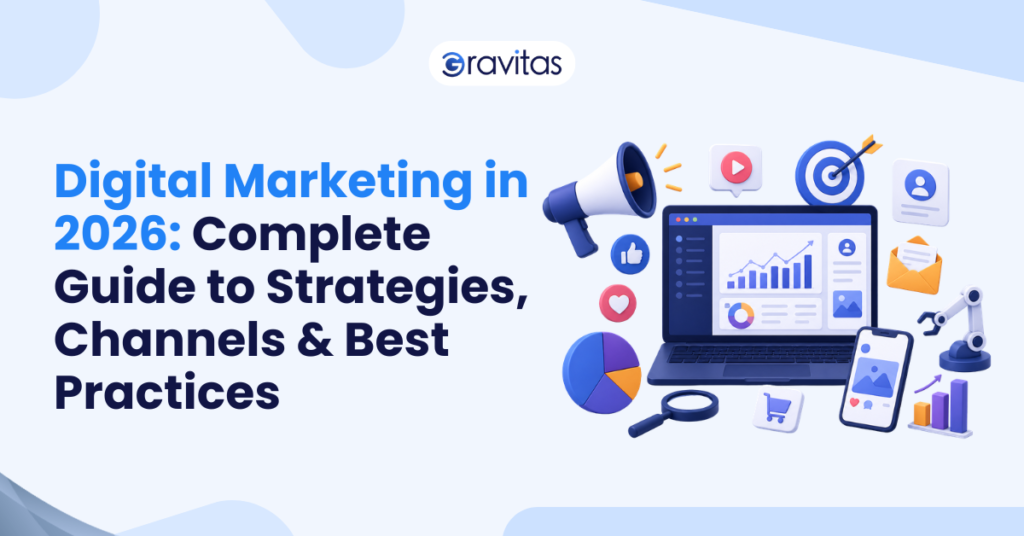
What is the Digital Marketing 2026 Guide?
The digital marketing 2026 guide is about understanding how marketing actually works today, not how it worked a few years ago.
People don’t search the same way anymore. They don’t just type keywords and scroll through links. They ask questions, expect direct answers, and often make decisions without even visiting a website. Search engines like Google are now built around this behavior, using AI to interpret intent and deliver results instantly.
For businesses, this changes everything.
Instead of focusing only on rankings or traffic, the focus has shifted to visibility, relevance, and usefulness. If your content doesn’t directly answer what users are looking for, it simply gets ignored no matter how well it’s optimized.
At the same time, marketing has become more data-driven and automated. Campaigns adjust in real time. Content is personalized. Decisions are based on insights, not assumptions.
If you’re just getting started, it’s worth understanding the foundation first: Digital Marketing Basics
Key Trends in Digital Marketing 2026 Guide
Marketing in 2026 isn’t changing randomly, there’s a clear pattern. Everything is becoming faster, smarter, and more user-focused.
AI-Powered Content Creation and Optimization
Creating content is easier than ever but creating useful content is harder.
Tools like ChatGPT and Gemini can generate articles, ideas, and even full campaigns in minutes. But that doesn’t mean everything they produce performs well.
What actually works now is content that:
- Answers real questions clearly
- Is structured in a way search engines can understand
- Offers something better than what’s already available
AI speeds things up, but quality still depends on how you use it.
Voice and Visual Search Dominance
More people are speaking their queries instead of typing them. Others are searching using images.
This changes how content needs to be written. Instead of short keywords, you need to think in terms of natural questions and complete answers.
For example, instead of optimizing for “best CRM,” content now needs to answer questions like:
“Which CRM is best for small businesses in 2026?”
Hyper-Personalized Customer Experiences
Users don’t respond to generic messaging anymore.
They expect content, ads, and emails to feel relevant to them. This is where AI plays a major role tracking behavior, preferences, and interactions to deliver more personalized experiences.
Done right, this leads to:
- Higher engagement
- Better conversion rates
- Stronger customer relationships
Zero-Click Search Optimization
One of the biggest shifts in the future of SEO 2026 is the rise of zero-click searches.
Users often get their answers directly on the search results page. That means your goal is no longer just to get clicks but to be part of the answer itself.
To do this, your content needs to:
- Be clear and structured
- Answer questions directly
- Provide quick, useful information
You can explore this further here: Google AI Search Updates
Automation in Campaign Management
Manual campaign management is slowly disappearing.
Today’s tools can automatically:
- Adjust ad budgets
- Test creatives
- Optimize targeting
This doesn’t remove the need for marketers, it shifts their role from execution to strategy.
Core Strategies in Digital Marketing 2026 Guide
Knowing the trends is one thing. Applying them effectively is what matters.
AI-First Content Strategy
An AI-first strategy is not about replacing human effort, it’s about working smarter.
Use AI to:
- Identify what your audience is searching for
- Generate content ideas quickly
- Improve structure and readability
But the real difference comes from adding original insights and clarity something AI alone cannot fully replicate.
Also, remember that discovery is no longer limited to search engines. Platforms like ChatGPT and Gemini are becoming places where users actively look for answers.
SEO Evolution Strategy
SEO has moved beyond keywords.
In 2026, it’s about understanding what users mean, not just what they type.
Effective SEO now includes:
- Covering topics in depth (not just single keywords)
- Structuring content clearly
- Matching content to user intent
If your content answers a question better than others, it will perform even without aggressive keyword targeting.
For a deeper understanding: SEO Strategy Guide
Social Media & Short-Form Strategy
Attention is limited and short-form content is winning because of that.
Platforms like Instagram, LinkedIn, and TikTok are prioritizing quick, engaging formats.
What works here:
- Clear, simple messaging
- Strong hooks in the first few seconds
- Content that feels authentic, not overly polished
Long content still matters but short content drives discovery.
Channels Covered in Digital Marketing 2026 Guide
A strong strategy doesn’t rely on just one channel, it combines several.
Search Engines
Search is still important, but it’s evolving. Platforms like Google and Bing AI now focus on delivering direct answers, not just links.
Social Media Platforms
Social media continues to drive awareness and engagement through platforms like Instagram, LinkedIn, and TikTok.
Email Marketing Automation
Email is still effective but only when it’s relevant.
Automated, behavior-based emails perform far better than generic campaigns.
Paid Ads (PPC & Programmatic)
Paid ads are becoming smarter, with AI handling targeting and optimization. The focus is shifting toward strategy and creative quality.
AI Chat-Based Discovery Platforms
More users are turning to tools like ChatGPT to find answers, compare options, and make decisions.
This is changing how content needs to be structured and presented.For broader insights: HubSpot Marketing Trends
Best Practices in Digital Marketing 2026 Guide
To stay competitive, focus on what actually matters:
- Prioritize user intent over keywords
- Create clear, useful, and structured content
- Build credibility and trust
- Use data to guide decisions
- Continuously test and improve
If your current strategy still focuses only on rankings or ad spend, it’s time to rethink it.
Use this digital marketing 2026 guide to start building a strategy that focuses on visibility, relevance, and long-term growth.
Conclusion
Marketing in 2026 is not about doing more, it’s about doing things better.
The businesses that succeed are the ones that:
- Understand changing user behavior
- Adapt to AI-driven platforms
- Focus on delivering real value
Platforms like ChatGPT, Gemini, and AI-powered search are not just trends they are shaping how people find and trust information.
Adapting early is what sets successful brands apart.
FAQs
It explains how marketing is evolving with AI, changing search behavior, and new digital channels.
AI helps automate tasks, improve personalization, and make better decisions using data.
Search engines, social media, email, paid ads, and AI-driven platforms are all important.
SEO focuses more on intent, content quality, and structured information rather than just keywords.
By adapting to AI tools, improving content quality, and building a strong multi-channel strategy.