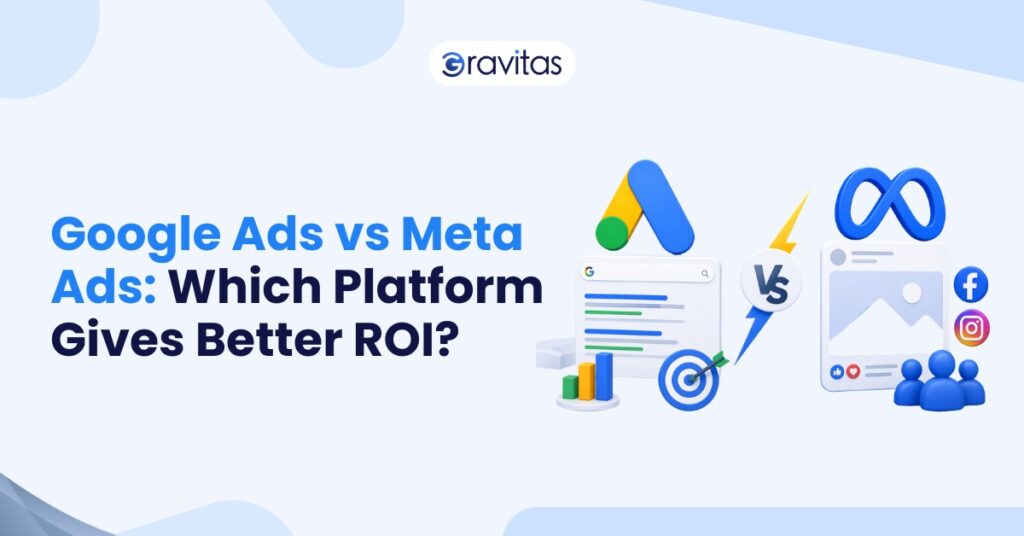
Businesses today are spending more on paid advertising than ever before but the biggest question remains the same:
Which platform actually delivers better ROI: Google Ads or Meta Ads?
The answer is not as simple as choosing one platform over the other. Both platforms dominate digital advertising, but they work in completely different ways. Google Ads captures users actively searching for solutions, while Meta Ads focuses on audience discovery, engagement, and demand generation.
According to recent industry benchmarks from WordStream and platform performance reports, Google Search Ads continue to deliver some of the highest conversion intent in digital marketing, while Meta Ads remains one of the most cost-effective platforms for audience reach and engagement.
Understanding the strengths, limitations, and ROI potential of each platform is essential for building a profitable paid media strategy in 2026.
What is Google Ads vs Meta Ads ROI?
When marketers compare Google Ads vs Meta Ads ROI, they are essentially trying to understand which platform generates stronger business results from advertising spend.
ROI in paid advertising is not just about getting traffic. It is about generating profitable traffic.
Businesses today evaluate ROI using metrics like:
- Return on Ad Spend (ROAS)
- Cost Per Click (CPC)
- Cost Per Acquisition (CPA)
- Conversion rates
- Customer lifetime value
The challenge is that Google Ads and Meta Ads influence users at different stages of the buying journey. Google often captures existing demand, while Meta helps create demand.
That difference alone changes how ROI should be measured.
Overview of Google Ads
Google Ads is built around intent-based advertising. Users search because they already want something.
When someone types:
- “Best CRM software”
- “Buy office chairs online”
- “Digital marketing agency near me”
they are already looking for a solution. That is why Google Ads consistently delivers some of the highest conversion intent in digital advertising.
According to the Google Ads official guide, businesses can advertise across:
- Google Search
- YouTube
- Google Display Network
- Shopping Ads
- Mobile Apps
This wide ecosystem gives advertisers multiple ways to reach users depending on campaign goals.
What makes Google Ads especially powerful is the quality of traffic. A user searching for a product or service is already much closer to taking action compared to someone casually scrolling through social media.
That is why businesses focused on:
- Lead generation
- High-ticket services
- SaaS products
- Local services
- B2B marketing
often see strong returns from Google Search campaigns.
Overview of Meta Ads
Meta Ads, on the other hand, operates very differently.
Instead of targeting search intent, Meta focuses on behavior and interests. Users are not actively searching for products while scrolling Instagram or Facebook they discover them.
This discovery-based advertising model is what makes Meta incredibly effective for building awareness and influencing buying decisions earlier in the customer journey.
Through the Meta Ads advertising guide, Meta explains how advertisers can target audiences based on:
- Interests
- Demographics
- Purchase behavior
- Engagement history
- Lookalike audiences
This advanced targeting system allows brands to place highly relevant products in front of users even before they realize they need them.
That is why Meta Ads performs exceptionally well for:
- eCommerce brands
- Fashion businesses
- Beauty products
- Fitness brands
- Lifestyle companies
Visual storytelling plays a huge role here. A strong Instagram Reel or Facebook video ad can create instant engagement and brand recall in ways traditional search ads cannot.
Key Differences Between Google Ads vs Meta Ads ROI
Intent vs Interest-Based Targeting
The biggest difference between these two digital advertising platforms comes down to user mindset.
Google Ads captures users actively searching for answers. These users already have intent, which naturally increases conversion potential.
For example, someone searching:
“Best accounting software for small businesses”
is much closer to purchasing than someone casually scrolling through Instagram.
This is why Google Ads typically generates:
- Faster conversions
- Higher lead quality
- Better direct-response performance
Meta Ads works differently. Instead of capturing intent, it creates interest.
A user might discover a product through an engaging video ad, save it for later, follow the brand, and eventually convert days or even weeks later.
This longer buying journey is why Meta Ads often contributes heavily to:
- Brand awareness
- Product discovery
- Assisted conversions
- Retargeting performance
Businesses comparing Google Ads vs Facebook Ads must understand this difference before deciding which platform delivers “better ROI.”
Cost Per Click (CPC) Comparison
One of the most common discussions in paid ads ROI comparison is CPC.
Google Ads generally has a higher CPC because advertisers compete aggressively for high-intent keywords. Industries like law, insurance, finance, and SaaS can see extremely expensive keyword costs.
According to WordStream benchmark studies, some industries regularly experience CPCs above $8–$10 per click.
At first glance, this may seem expensive. But higher CPC does not automatically mean poor ROI.
If a keyword generates highly qualified leads that convert consistently, the return can still be excellent.
Meta Ads usually offers:
- Lower CPC
- Lower CPM
- Broader audience reach
- More affordable engagement costs
This makes Meta highly attractive for businesses with smaller budgets or aggressive awareness goals.
However, lower CPC traffic does not always convert immediately. That is why businesses must analyze conversion quality not just traffic cost.
Conversion Rate Comparison
Google Ads tends to dominate when it comes to direct conversions.
Because users are actively searching, the buying journey is shorter. Someone searching for “emergency plumbing services” is far more likely to convert immediately than someone discovering a plumbing company through social media.
This is why Google Ads performs extremely well for:
- Service businesses
- Healthcare providers
- Local businesses
- Professional services
- B2B companies
Meta Ads often contributes through assisted conversions.
A customer might:
- Discover a product on Instagram
- Visit the website
- Leave without purchasing
- Later search the brand name on Google
- Convert through a Google Search ad
In this case, Meta influenced the purchase even if Google captured the final conversion.
This is one reason why businesses increasingly combine both platforms instead of choosing only one.
Advantages of Google Ads vs Meta Ads ROI
Benefits of Google Ads
Google Ads continues to dominate performance marketing because of one key advantage: purchase intent.
Users already searching for solutions are naturally easier to convert.
This gives businesses:
- Faster lead generation
- Better conversion quality
- Stronger short-term ROI
- Higher conversion intent
For companies focused heavily on direct sales and lead generation, Google Ads often becomes the foundation of their paid media strategy.Businesses looking to improve campaign efficiency can also explore Gravitasin’sperformance marketing services for data-driven paid advertising strategies.
Benefits of Meta Ads
Meta Ads excels in audience targeting and engagement.
Very few platforms can match Meta’s ability to segment users based on interests, behaviours, and engagement patterns.
This makes Meta extremely powerful for:
- Brand awareness campaigns
- Product launches
- Retargeting
- Audience nurturing
- Visual advertising
Meta also allows brands to scale visibility relatively affordably compared to search advertising.
For businesses focused on storytelling and customer engagement, Meta Ads often delivers excellent long-term value.
When to Choose Google Ads vs Meta Ads ROI
Best Use Cases for Google Ads
Google Ads is usually the better option when:
- Users actively search for your service
- Lead generation is the primary goal
- Immediate conversions matter
- Purchase intent is high
Industries that typically perform well include:
- Legal services
- Healthcare
- SaaS
- Home services
- Consulting
- Local businesses
Best Use Cases for Meta Ads
Meta Ads becomes more effective when:
- Visual content matters
- Brand awareness is important
- Products require discovery
- Retargeting plays a major role
Meta is especially effective for:
- Fashion brands
- Beauty products
- Fitness companies
- eCommerce stores
- Consumer products
Cost & ROI Comparison: Google Ads vs Meta Ads ROI
Budget Allocation Strategy
Many brands in 2026 are no longer choosing between Google Ads and Meta Ads.
Instead, they use both strategically.
A common budget split looks like:
- 60% Google Ads for conversions
- 40% Meta Ads for awareness and retargeting
This creates a full-funnel advertising approach where Meta generates interest and Google captures intent.
ROI Metrics to Track
To improve PPC campaign optimisation, businesses should focus on metrics like:
- CPC
- CPA
- CTR
- ROAS
- Conversion rates
Tracking these consistently helps improve overall customer acquisition cost ads performance.
Businesses can also compare broader industry data usingdigital advertising benchmarks.
Industry-Wise ROI Insights
For B2B companies, Google Ads often delivers better lead quality because buyers actively search for solutions.
For B2C and eCommerce businesses, Meta Ads frequently produces better engagement, audience growth, and retargeting performance.
The platform that delivers the strongest ROI usually depends on:
- Business model
- Sales cycle
- Audience behavior
- Product type
- Marketing goals
Common Mistakes to Avoid
One of the biggest mistakes businesses make is using the wrong platform for the wrong objective.
Running awareness-focused campaigns on Google Search or expecting cold Meta audiences to convert instantly often leads to poor performance.
Another major issue is weak creatives. Especially on Meta Ads, poor visuals can dramatically reduce engagement and campaign effectiveness.
Businesses also struggle when they fail to track conversions properly. Without accurate tracking through:
- Google Analytics
- Meta Pixel
- Conversion APIs
Campaign optimisation becomes extremely difficult.
Future Trends in Google Ads vs Meta Ads ROI (2026)
AI-driven optimisation is rapidly changing how advertisers manage campaigns.
Today, platforms increasingly automate:
- Bidding strategies
- Audience targeting
- Budget allocation
- Creative testing
Privacy-first advertising is also becoming a major priority as third-party cookies disappear.
This is pushing businesses toward:
- First-party data collection
- CRM integrations
- Server-side tracking
- Omnichannel marketing strategies
Brands are now combining:
- Google Ads
- Meta Ads
- YouTube
- Email marketing
- LinkedIn campaigns
to create stronger customer journeys and improve long-term ROI.
Conclusion
The debate around Google Ads vs Meta Ads ROI does not have a universal winner.
Google Ads excels at capturing high-intent users ready to take action, making it ideal for lead generation and direct-response campaigns.
Meta Ads shines when it comes to audience targeting, engagement, awareness, and brand discovery.
In 2026, the businesses achieving the strongest results are not choosing one platform over the other; they are using both strategically to create a full-funnel paid media strategy that balances demand generation with demand capture.
FAQs
Google Ads often delivers better ROI for high-intent lead generation, while Meta Ads performs strongly for awareness, engagement, and retargeting.
Generally yes. Google Ads typically has higher CPC because of keyword competition and stronger purchase intent.
Yes. Combining both platforms often creates stronger customer journeys and better long-term ROI.
It depends on the business type. Local service businesses often benefit from Google Ads, while product-based brands may perform better with Meta Ads.
You can improve ROI through better targeting, conversion tracking, retargeting, A/B testing, and landing page optimisation.