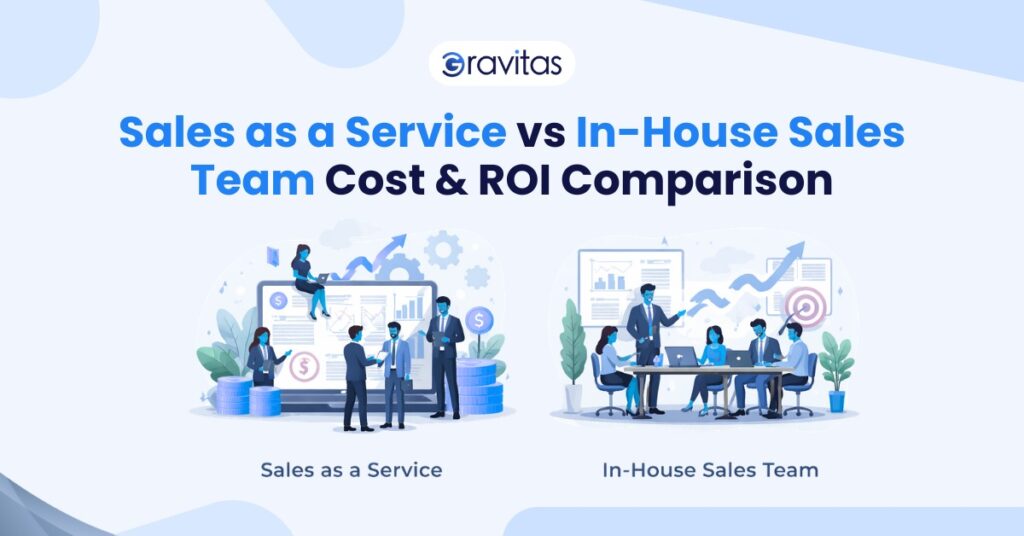
What is Sales as a Service vs In-House Sales?
At a surface level, this comparison looks like a simple operational choice—build internally or outsource. In reality, it defines how a business acquires revenue, manages risk, and allocates capital.
Sales today is not just about closing deals. It involves:
- Speed of execution
- Cost of customer acquisition
- Ability to adapt to market shifts
The decision between Sales as a Service vs In-House Sales determines whether your sales function behaves like a fixed cost center or a flexible growth engine.
What is Sales as a Service?
Sales as a Service is not just outsourcing, it is buying an already optimized sales system.
Instead of assembling a team, businesses plug into:
- Pre-trained sales talent
- Existing outreach infrastructure
- Tested messaging frameworks
- Performance tracking systems
The real advantage is not cost reduction alone, it is time compression.
What typically takes 4–6 months to build internally (hiring, onboarding, training) can be activated in weeks.
A detailed breakdown is available here:
outsourced sales model explained
From a strategic lens, this model converts sales from a build function into a deploy function.
What is an In-House Sales Team?
An in-house team is a long-term asset-building approach.
Instead of speed, it focuses on:
- Deep institutional knowledge
- Tight integration with product and marketing
- Ownership of customer relationships
However, this model requires building multiple layers simultaneously:
- Talent
- Process
- Management structure
- Performance culture
The strength of this approach lies in control and compounding value, not immediate efficiency.
Why Businesses Are Comparing Sales as a Service vs In-House Sales in 2026
Rising Operational Costs
The cost conversation has shifted from salaries to cost of productivity.
Hiring a salesperson does not immediately generate revenue. There is a lag:
- Hiring cycle: 1–2 months
- Ramp-up: 2–4 months
- Full productivity: 6+ months
This means businesses are paying for non-performing time, not just talent.
In contrast, outsourced models reduce this lag significantly.
Need for Scalability and Flexibility
Growth is no longer linear. Businesses experience:
- Sudden demand spikes
- New market entry opportunities
- Seasonal or campaign-driven sales cycles
In-house teams are structurally rigid in such conditions.
Sales as a Service introduces elastic capacity, where sales effort can expand or contract without restructuring the organization.
ROI-Focused Decision Making
The modern sales question is not “How many people are on the team?”
It is “How efficiently does each dollar convert into revenue?”
This shifts focus to:
- Revenue per sales resource
- Cost per qualified lead
- Conversion efficiency
Models are now evaluated based on financial output, not operational preference.
Cost Comparison: Sales as a Service vs In-House Sales
Costs of In-House Sales Team
The true cost of an in-house team is often underestimated because it is distributed across functions.
Visible Costs:
- Salaries and incentives
- Hiring expenses
Embedded Costs:
- Sales management time
- Tool stack (CRM, automation, analytics)
- Training infrastructure
Invisible Costs:
- Underperformance during ramp-up
- Pipeline gaps when employees leave
- Opportunity loss due to delayed execution
The result is a high fixed-cost structure with delayed returns.
Costs of Sales as a Service
Sales as a Service restructures cost into a performance-aligned model.
Instead of paying for capacity, businesses pay for:
- Pipeline generation
- Meetings booked
- Revenue contribution (in some models)
This reduces financial risk because:
- Costs scale with activity or output
- There is minimal sunk cost
- No long-term employee liabilities
This model is particularly effective when predictability of output matters more than ownership of resources.
Hidden Costs to Consider
The most critical cost factor is often time-to-revenue.
- A delayed pipeline can impact quarterly targets
- Slow execution can result in lost market opportunities
- Inefficient sales cycles increase customer acquisition cost
The faster a model converts effort into revenue, the stronger its real ROI regardless of apparent cost.
ROI Comparison: Sales as a Service vs In-House Sales
ROI of In-House Sales
In-house ROI is back-loaded.
It improves over time as:
- Salespeople gain experience
- Messaging becomes refined
- Customer relationships deepen
This creates compounding returns, but only after the initial investment phase.
The model works best when:
- Sales cycles are complex
- Brand trust plays a critical role
- Long-term retention drives revenue
ROI of Sales as a Service
Sales as a Service delivers front-loaded ROI.
Value is created through:
- Immediate execution
- Access to experienced talent
- Reduced trial-and-error cycles
When combined with lead generation services, it ensures a consistent and scalable pipeline.
This model is particularly effective for:
- Early-stage growth
- Market testing
- Rapid expansion phases
Benefits of Sales as a Service vs In-House Sales
Advantages of Sales as a Service
- Faster revenue activation
- Reduced operational complexity
- Access to multi-industry expertise
- Lower financial commitment upfront
Advantages of In-House Sales Team
- Full strategic control
- Deep customer insights
- Stronger alignment with long-term vision
- Ability to build proprietary sales capabilities
Challenges of Sales as a Service vs In-House Sales
Challenges of Sales as a Service
- Requires clear positioning and messaging from the business
- Alignment gaps can impact performance
- Less control over day-to-day execution
Challenges of In-House Sales
- High dependency on hiring quality
- Slower adaptation to new strategies
- Fixed costs even during low-performance periods
Which Model is Better for Your Business?
Best for Startups and SMEs
Sales as a Service is effective when:
- Speed matters more than ownership
- Budgets are constrained
- Sales processes are still being validated
Best for Enterprises
In-house teams are more effective when:
- Sales is deeply tied to brand and relationships
- Processes are already mature
- Long-term customer value is the priority
Hybrid Model: The Best of Both Worlds
A hybrid model separates strategy from execution:
- Internal team: positioning, key accounts, closing
- External team: outreach, pipeline generation
This approach allows businesses to scale efficiently while maintaining control where it matters.
It can be strengthened with B2B sales strategy services.
How to Choose Between Sales as a Service vs In-House Sales
Evaluate Budget and Resources
Focus on sustainability, not just affordability.
Define Sales Goals
Differentiate between:
- Immediate revenue targets
- Long-term market positioning
Analyze Market Conditions
Faster markets require faster execution models.
Measure Expected ROI
Use benchmarks such as sales performance benchmarks to compare efficiency.
Future Trends in Sales Models for 2026
Sales is shifting toward flexible, tech-enabled models:
- AI-driven targeting and personalization
- Global remote sales teams
- Outcome-based pricing models
- Integration of sales and data analytics
These trends favor models that are scalable and adaptive.
Conclusion
The comparison between Sales as a Service vs In-House Sales is ultimately about how a business chooses to grow.
- Sales as a Service optimizes for speed and flexibility
- In-house sales optimizes for control and long-term value
The most effective approach for many businesses is not choosing one over the other, but designing a system that uses both strategically.
Call-To-Action (CTA)
Looking to improve sales efficiency and ROI in 2026?
Gravitasin helps businesses design sales models that align with growth goals and market realities.
Connect with us to build a scalable, performance-driven sales strategy.
FAQs
An outsourced model where external teams manage sales execution and pipeline generation.
It reduces upfront and fixed costs while aligning spend with performance.
Sales as a Service offers faster ROI; in-house delivers long-term compounding value.
Yes, hybrid models are increasingly common and effective.
Base the decision on growth stage, budget, market dynamics, and desired speed of execution.