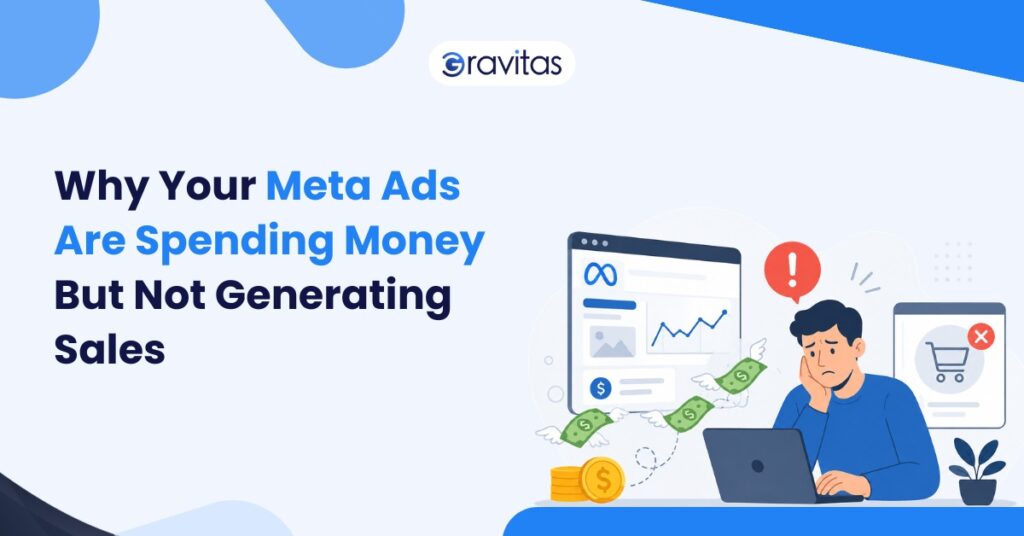
You launched a Meta Ads campaign with high expectations.
The ads are getting impressions. People are clicking. Your budget is being spent every day exactly as planned.
But when you check your sales dashboard, something doesn’t add up.
The clicks are there, but the sales aren’t.
This is one of the most common challenges business owners face with paid advertising. Many assume that spending more money will automatically generate more customers. Unfortunately, that’s not how Meta Ads work.
If your Meta Ads are not generating sales, the issue is usually not the platform itself. In most cases, the problem lies somewhere between the audience seeing your ad and the customer making a purchase.
We’ve worked with businesses that generated thousands of clicks but very few conversions. We’ve also seen companies achieve strong returns with modest budgets because they focused on the right strategy.
The truth is, Facebook Ads spending without conversions is often the result of avoidable mistakes in targeting, creative messaging, landing pages, tracking, or campaign structure.
Before increasing your budget, it’s important to understand what’s actually preventing your campaigns from generating revenue.
Why Your Meta Ads Not Generating Sales Despite Getting Clicks
Many business owners make the mistake of treating clicks as a sign of success.
A click simply means someone was interested enough to learn more. It doesn’t mean they were ready to buy.
Think of it like a retail store.
Hundreds of people may walk through the door every day, but only a percentage will make a purchase. The same principle applies to Meta Ads.
If people are clicking but not converting, there is usually a disconnect somewhere in the customer journey.
Common Meta Ads performance issues include:
- Reaching the wrong audience
- Weak ad messaging
- Poor landing page experience
- Incorrect campaign objectives
- Tracking problems
- Lack of trust signals
Successful advertising isn’t about generating traffic. It’s about guiding the right people toward a purchase decision.
Businesses looking to improve campaign profitability often invest in performance marketing services to focus on revenue-driven outcomes rather than vanity metrics.
Common Reasons Meta Ads Are Spending Money Without Sales
Wrong Audience Targeting Is Reducing Conversions
One of the biggest reasons Meta Ads fail is targeting people who are unlikely to buy.
Many businesses try to reach the largest audience possible because they believe more reach means more sales.
In reality, broad targeting often leads to wasted budgets.
For example, imagine you’re selling premium interior design services. If your ads are reaching homeowners who aren’t actively planning renovations, you’re paying for clicks that are unlikely to convert.
The most successful campaigns begin with a deep understanding of the ideal customer.
Ask yourself:
Meta provides powerful tools such as custom audiences, lookalike audiences, and retargeting capabilities through its Meta Ads audience targeting options.
The goal isn’t to reach more people.
The goal is to reach the people most likely to become customers.
Your Ad Creative Is Not Convincing Users to Take Action
Many businesses spend weeks perfecting targeting while paying very little attention to creative performance.
But even the perfect audience won’t convert if the ad fails to communicate value.
Think about how quickly people scroll through social media.
Your ad has only a few seconds to stop the scroll, grab attention, and persuade someone to take action.
Common creative mistakes include:
- Generic headlines
- Weak offers
- Poor-quality visuals
- No clear differentiation
- Missing calls-to-action
Business owners often focus on what they want to say rather than what customers need to hear.
Customers don’t care about features.
They care about outcomes.
Instead of saying:
“Our software includes automated reporting.”
Say:
“Save hours every week with automated reporting.”
That shift in messaging can dramatically improve performance.
Businesses often see stronger campaign results when Meta Ads are supported by a broader brand-building strategy that includes social media marketing services.
Poor Landing Pages Are Losing Potential Customers
Here’s a mistake that costs businesses thousands every month.
The ad works.
The landing page doesn’t.
A user clicks your ad because they’re interested. Then they land on a page that loads slowly, looks outdated, or fails to clearly explain the offer.
Within seconds, they’re gone.
This is where Meta Ads conversion optimization becomes critical.
Your landing page should continue the conversation started by the ad.
If your ad promotes a free consultation, the landing page should focus entirely on that consultation.
Not your company history.
Not unrelated services.
Not lengthy paragraphs that distract from the goal.
High-converting landing pages typically include:
- Fast loading speeds
- Mobile-friendly design
- Clear value propositions
- Strong calls-to-action
- Customer testimonials
- Trust signals
Businesses that improve landing page performance often see significant gains without increasing ad spend.
This is why many organizations prioritize conversion rate optimization services before increasing advertising budgets.
Your Meta Ads Tracking Is Incorrect
Imagine trying to improve a campaign when the data you’re looking at is wrong.
Unfortunately, this happens more often than most business owners realize.
Without accurate tracking, it’s impossible to know:
- Which campaigns generate sales
- Which audiences perform best
- Which creatives drive conversions
- Where customers drop off
Common tracking issues include:
- Missing Meta Pixel installation
- Incorrect event tracking
- Duplicate conversions
- Attribution errors
- Incomplete reporting
We’ve seen businesses pause profitable campaigns simply because tracking was set up incorrectly.
Before making major optimization decisions, ensure your tracking follows the Meta Pixel implementation guide and accurately measures business outcomes.
Good decisions require good data.
Your Budget Strategy Is Not Aligned With Your Goals
When campaigns underperform, many business owners respond with the same solution:
“Let’s increase the budget.”
Unfortunately, spending more money on an underperforming campaign rarely solves the problem.
In fact, it usually accelerates losses.
A successful paid ads strategy for better sales focuses on testing before scaling.
Before increasing spend, ask:
- Is the audience converting?
- Is the messaging working?
- Is the landing page optimized?
- Is tracking accurate?
If the answer to any of these questions is no, increasing the budget is unlikely to improve results.
The best advertisers scale only after they’ve identified a profitable formula.
How to Check Why Your Meta Ads Are Not Converting
Before making changes, review the data that matters most.
Click-Through Rate (CTR)
CTR tells you whether people are interested enough to click.
A low CTR often points to targeting or creative issues.
Cost Per Click (CPC)
If costs are rising while results remain flat, competition or audience quality may be affecting performance.
Conversion Rate
This metric reveals what happens after the click.
A low conversion rate often indicates landing page or offer-related problems.
Cost Per Acquisition (CPA)
CPA helps determine whether campaigns are generating customers profitably.
Audience Quality
Review who is actually engaging with your ads.
Sometimes the audience attracting clicks is very different from the audience most likely to buy.
Ad Placements
Not all placements perform equally.
Understanding which placements generate conversions can improve efficiency and profitability.
Regularly reviewing these metrics is one of the most effective ways to understand how to improve Meta Ads ROI.
Proven Strategies to Improve Meta Ads Sales Performance
1. Test Different Ad Creatives
Never assume your first creative is your best creative.
Test:
- Different headlines
- Images
- Videos
- Offers
- Calls-to-action
Small creative changes can have a major impact on conversion rates.
2. Improve Audience Targeting
Use customer insights to build better audiences.
Focus on:
- Retargeting website visitors
- Lookalike audiences
- Customer-based audiences
- Behavioral segmentation
The better the audience, the better the results.
3. Optimize Landing Pages
Every extra second of load time or unnecessary form fields can reduce conversions.
Focus on:
- Faster loading pages
- Clear messaging
- Mobile responsiveness
- Simplified conversion paths
4. Track and Analyze Campaign Data
Successful campaigns are built on continuous improvement.
Review performance regularly.
Identify winning campaigns.
Pause underperforming ads.
Reinvest the budget into what works.
How Long Does It Take to See Results From Meta Ads?
One of the biggest mistakes businesses make is expecting immediate success.
Meta Ads require testing, learning, and optimization.
During the learning phase, the platform gathers data about your audience and campaign performance.
Most campaigns follow a timeline like this:
Week 1–2: Testing audiences, creatives, and messaging.
Week 3–4: Optimization based on performance data.
Month 2 and Beyond: Scaling profitable campaigns and refining strategy.
The businesses that achieve the best results are usually the ones willing to optimize consistently rather than expecting instant returns.
Conclusion: Fix Your Meta Ads Not Generating Sales Problems With Better Optimization
If your Meta Ads are not generating sales, the problem is usually not the platform but the strategy behind targeting, creatives, tracking, and conversion optimization.
Successful Meta Ads campaigns aren’t built by spending more money. They’re built by understanding customers, delivering the right message, optimizing every stage of the customer journey, and making decisions based on data.
Business owners who focus only on clicks often become frustrated with paid advertising. Those who focus on conversions, customer experience, and continuous testing are far more likely to generate sustainable growth.
The good news is that most Meta Ads problems are fixable. With the right strategy, optimization process, and ongoing analysis, your ad spend can become a reliable driver of leads, sales, and long-term business growth.
Frequently Asked Questions
This usually happens because of poor audience targeting, weak ad creatives, ineffective landing pages, incorrect tracking, or campaigns optimized for clicks rather than conversions.
Improve targeting, test multiple creatives, optimize landing pages, ensure accurate tracking, and continuously monitor campaign performance.
The most common reasons include targeting the wrong audience, weak offers, poor landing page experience, inaccurate tracking, and scaling campaigns before they are profitable.
Most campaigns require several weeks of testing and optimization before delivering consistent results. Ongoing monitoring is essential for long-term success.
Focus on improving audience quality, refining creatives, optimizing landing pages, tracking conversions accurately, and investing more budget into campaigns that consistently generate profitable results.