Introduction
A website can rank well for several keywords and still miss valuable opportunities to attract potential customers. This often happens when its content does not cover the topics, questions, and search terms its target audience uses while researching a product or service. A content gap analysis helps identify these missed opportunities by comparing existing website content with competitor coverage and user search intent. Instead of adding pages without a clear direction, businesses can use this analysis to determine which topics deserve attention, which pages need improvement, and where their SEO strategy needs stronger coverage.
Understanding Content Gap Analysis
Content gap analysis is the process of evaluating your website’s existing content against competitor websites and the information users expect to find when searching for a particular topic.
It helps uncover three important areas:
- Missing Topics: Relevant subjects that competitors cover but your website has not addressed.
- Missing Keywords: Search terms that could attract relevant visitors but are not targeted by your existing pages.
- Incomplete or Outdated Content: Pages that cover a topic but lack important information, current details, or answers to specific user queries.
A thorough SEO content gap analysis looks beyond the number of keywords a website ranks for. It examines whether the content addresses the right search intent and supports the different stages of a customer’s research and decision-making process.
For example, a company offering enterprise software may have detailed service pages but lack content explaining implementation challenges, integration requirements, or software comparisons. These missing topics can leave potential customers with unanswered questions during their research.
Common Content Gaps That Affect SEO
Several content-related issues can prevent a website from competing effectively in search results. Identifying them is the first step towards improving its organic visibility.
1. Missing Topics
Competitors may publish useful resources around subjects closely related to your products or services that your website has not covered. This leaves gaps in your topical coverage and limits opportunities to appear for relevant searches.
2. Missing Keywords
Your existing pages may target broad industry terms while overlooking specific search queries used by potential customers. A keyword gap analysis helps identify these missing terms and determine whether they deserve dedicated content or can be incorporated into existing pages.
3. Outdated Content
Information that was accurate when a page was published may no longer reflect current industry practices, product features, search trends, or customer expectations. Outdated examples and references can reduce the usefulness of an otherwise relevant page.
4. Incomplete Content
A page may rank for a keyword but still fail to address the questions behind that search. Missing explanations, comparisons, supporting information, or practical examples can make the page less useful than competing resources.
5. Keyword Cannibalisation
When multiple pages target similar keywords and search intent, they may compete for the same search visibility. This can make it difficult for search engines to identify the most relevant page for a query. Reviewing overlapping content helps determine whether pages should be differentiated, updated, or consolidated.
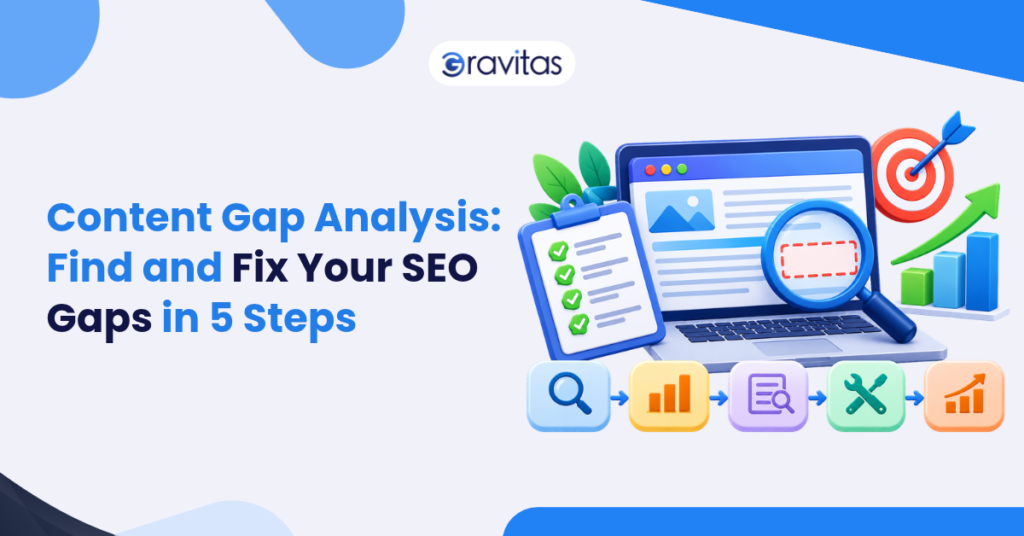
How to Perform a Content Gap Analysis in 5 Steps
A useful content gap analysis involves more than collecting a list of keywords from competitor websites. Each opportunity needs to be evaluated against your existing content, business priorities, and the search intent behind it.
Here are five steps to conduct the analysis.
Step 1. Identify Your Main Competitors
Start by identifying websites that compete with yours in organic search results. These may include direct business competitors as well as industry publications, specialist websites, and resource platforms that rank for the same search queries.
For example, if your business provides CRM implementation services, your search competitors may include other CRM consulting companies, technology comparison websites, and industry blogs.
Use tools such as SEMrush and Ahrefs to examine:
- Websites ranking for your primary industry keywords.
- Competitors receiving organic traffic from relevant search terms.
- Topics and website sections attracting search visibility.
- Pages that consistently appear for your target queries.
Do not restrict your analysis to the biggest websites in your industry. A smaller competitor with a well-developed resource section may reveal more relevant opportunities than a large website covering a broad range of subjects.
The objective is to identify websites that are attracting the audience you want to reach.
Step 2. Find Missing Keyword Opportunities
Once you have shortlisted competitors, compare their keyword rankings with your website’s existing keyword profile.
Tools such as SEMrush’s Keyword Gap and Ahrefs’ Content Gap can help identify search terms for which competitor websites rank, but your website does not.
For every keyword opportunity, examine:
- Search Intent: Is the user looking for information, comparing solutions, or preparing to make a purchase?
- Business Relevance: Does the keyword relate to your products, services, or areas of expertise?
- Search Volume: Does the term receive enough search interest to justify creating or improving content?
- Keyword Difficulty: How competitive is the search term, and what would it take to rank for it?
Consider a business offering cloud consulting services. Its website may already target broad terms such as cloud consulting and cloud migration. However, competitors may also rank for searches related to cloud migration costs, cloud security assessments, and cloud infrastructure management.
These additional terms can reveal specific areas where the website has room to expand its search visibility.
Prioritise keywords that align with your services and the questions potential customers are actively researching, rather than selecting terms based on search volume alone.
Step 3. Identify Missing Content Topics
Keyword comparisons reveal search terms, but a topic-level review helps you understand what information your website needs to cover.
Conduct a competitor content analysis by reviewing their:
- Blog articles and industry guides.
- Service and solution pages.
- Case studies and customer success stories.
- Frequently asked questions.
- Comparison pages and educational resources.
Look for subjects that appear repeatedly across competing websites, particularly those closely related to your business offerings.
Next, organise these opportunities according to search intent:
- Informational: Topics that answer questions or explain a problem. For example, how does CRM integration work?
- Commercial: Topics that help users evaluate available solutions. For example, CRM implementation services compared.
- Transactional: Topics indicating an intention to take action. For example, hire a CRM implementation consultant.
This classification helps identify whether your website needs educational articles, detailed service pages, comparison resources, or supporting content.
It also prevents a common SEO mistake: creating multiple blog posts when the missing information would be more useful as part of an existing service page.
Step 4. Audit and Improve Existing Content
Not every content gap requires a new page. Sometimes, the best opportunity is to improve a page that already receives impressions but does not attract enough clicks or address the topic comprehensively.
Review your existing website pages and look for:
- Pages with declining organic clicks or impressions.
- Important keywords for which the page ranks beyond the first few positions.
- Topics that are mentioned but not explained adequately.
- Outdated statistics, examples, product information, or references.
- Missing headings and related questions that users expect the page to answer.
- Multiple pages competing for similar search terms.
Use Google Search Console to examine the actual queries generating impressions and clicks for individual pages. This can reveal searches that your content already appears for but does not address directly.
For example, a blog about lead generation may receive impressions for searches related to lead qualification and lead scoring. If these subjects are only briefly mentioned, expanding the relevant sections with clear explanations and practical examples may make the page more useful.
Effective content optimisation should improve the quality and relevance of the information, not simply increase word count or insert additional keywords.
Step 5. Create an Action Plan and Track Performance
After identifying the gaps, organise your findings into a content action plan. This ensures that the analysis leads to specific improvements rather than remaining a spreadsheet of keywords and competitor URLs.
Classify each opportunity into one of three actions:
Create New Content: Develop a new page when a relevant topic or search intent is not adequately covered anywhere on your website.
Update Existing Content: Improve an existing page when it already targets the subject but lacks relevant information, supporting keywords, or useful explanations.
Consolidate Overlapping Pages: Review pages with similar search intent and determine whether combining them would create a more comprehensive resource.
Prioritise these actions based on business relevance, search intent, competition, and the potential value of the traffic.
Once the changes are implemented, monitor performance through Google Search Console and Google Analytics 4 (GA4).
Track key indicators such as:
- Organic Clicks: Whether more visitors are reaching your website through search.
- Search Impressions: Whether your pages are appearing for a wider range of relevant queries.
- Keyword Rankings: How individual pages perform for their target search terms.
- Organic Engagement: Whether visitors interact with your content after arriving.
- Conversions: Whether organic visitors take meaningful actions, such as submitting an enquiry or requesting a consultation.
Review these metrics regularly to understand which content improvements are working and where further optimization is required.
How Gravitas Consulting Helps Businesses
Identifying content gaps requires a clear understanding of search behaviour, competitor positioning, keyword opportunities, and the business objectives behind a website.
Gravitas Consulting helps businesses evaluate their existing SEO performance and develop content strategies around relevant search opportunities.
Our approach includes:
- Competitor Analysis: Evaluate competing websites, their ranking pages, and content coverage to identify opportunities your website may be missing.
- Keyword Research: Identify relevant search terms by analysing search intent, keyword competition, and alignment with your business offerings.
- Content Audit: Review existing website pages to find outdated information, missing subtopics, keyword gaps, and underperforming content.
- Content Strategy: Recommend new topics, page improvements, and content priorities based on your SEO goals.
- Performance Monitoring: Track keyword rankings, organic traffic, impressions, and engagement to assess the effectiveness of implemented changes.
From identifying search opportunities to improving existing website content, our SEO approach focuses on building visibility around the subjects that matter to your business and its potential customers.
Explore our SEO Services to understand how Gravitas Consulting can support your website’s organic search growth.
What Businesses Can Achieve Through Content Gap Analysis
A well-executed content gap analysis gives businesses a clearer direction for their SEO efforts. It helps identify relevant keyword opportunities, strengthen coverage of important topics, and improve existing pages to match user search intent. Over time, these improvements can support stronger organic visibility, attract more relevant website visitors, and create a more focused content strategy aligned with business objectives.
Conclusion
SEO performance depends on how effectively your website addresses the searches and information needs of its target audience. A content gap analysis helps uncover what your website is missing and where improvements can make a difference. By researching competitors, comparing keywords, identifying missing topics, optimising existing pages, and tracking performance, businesses can make more informed content decisions.
Looking to identify missed SEO opportunities and improve your website’s organic visibility? Connect with Gravitas Consulting for a data-driven SEO and content strategy built around your business goals