A potential customer searches for a service your business offers. They may find you on Google, ask an AI tool for a recommendation, or search for an answer and discover a competitor instead. SEO in 2026 is much more than just ranking for a few keywords, SEO specialists now have to deal with changing search behaviour, growing content competition, and the need to understand what people actually want from a search rather than simply targeting keywords.
They also need to research queries, identify content opportunities, analyse competitors, and review large amounts of existing content. Doing all of this manually can make SEO research and content planning increasingly time-consuming.
AI tools, such as Claude, can now help businesses research what customers are searching for, plan useful content, and review whether their website answers those questions clearly. If used well, Claude can accelerate some of the SEO tasks, while the strategy still comes from understanding your customers, market, and business goals. Let us deep dive into the benefits of incorporating Claude into your SEO strategy.
Why to Use Claude for SEO in 2026
SEO has undergone major shifts in the last few years. With the advent of AI, its applications and implications are huge. Business owners must leverage AI tools, like Claude for accelerating their online presence. You can now integrate Claude into your routine SEO strategies to expedite the process and get the most accurate search results for your brand and boost your ROI.
Claude can help turn simple business questions into keyword ideas, content topics, FAQs, and optimization opportunities. It can also help review existing website content before you spend more time or money on content writers and agencies. The important distinction is that Claude can support the process, but cannot replace customer research, SEO data, or business judgment.
How to Use Claude in SEO?
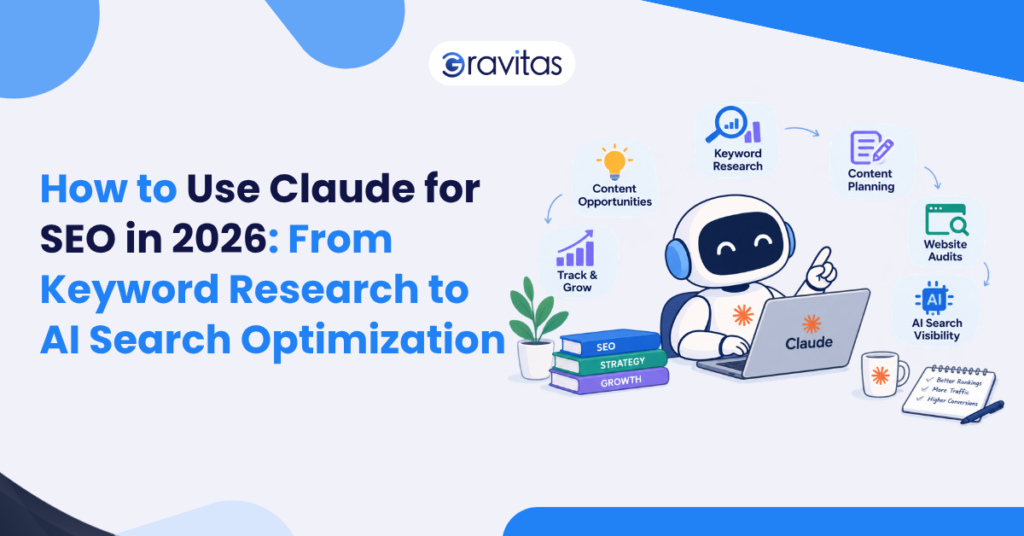
Claude can enhance these components in your SEO workflow:
- Finding the keywords and topic ideas
- Understanding search intent
- Planning website content
- Reviewing existing pages
- Finding unanswered customer questions
- Preparing content for AEO and AI search
- Identifying content gaps
A Practical Claude SEO Prompt
You do not need a complicated prompt to get started. The more context you provide about your business, audience, and SEO objective, the more useful the output can be.
“For my business, [describe business], what are customers likely to search for when looking for [product/service]? Group the searches by topic and intent, identify the questions behind those searches, and remove duplicate or closely related queries.”
This prompt can give you a starting point for understanding how potential customers might look for your products or services online.
If you want more examples of practical use cases, our guide to Claude AI prompts for SEO covers additional ways to use Claude for SEO.
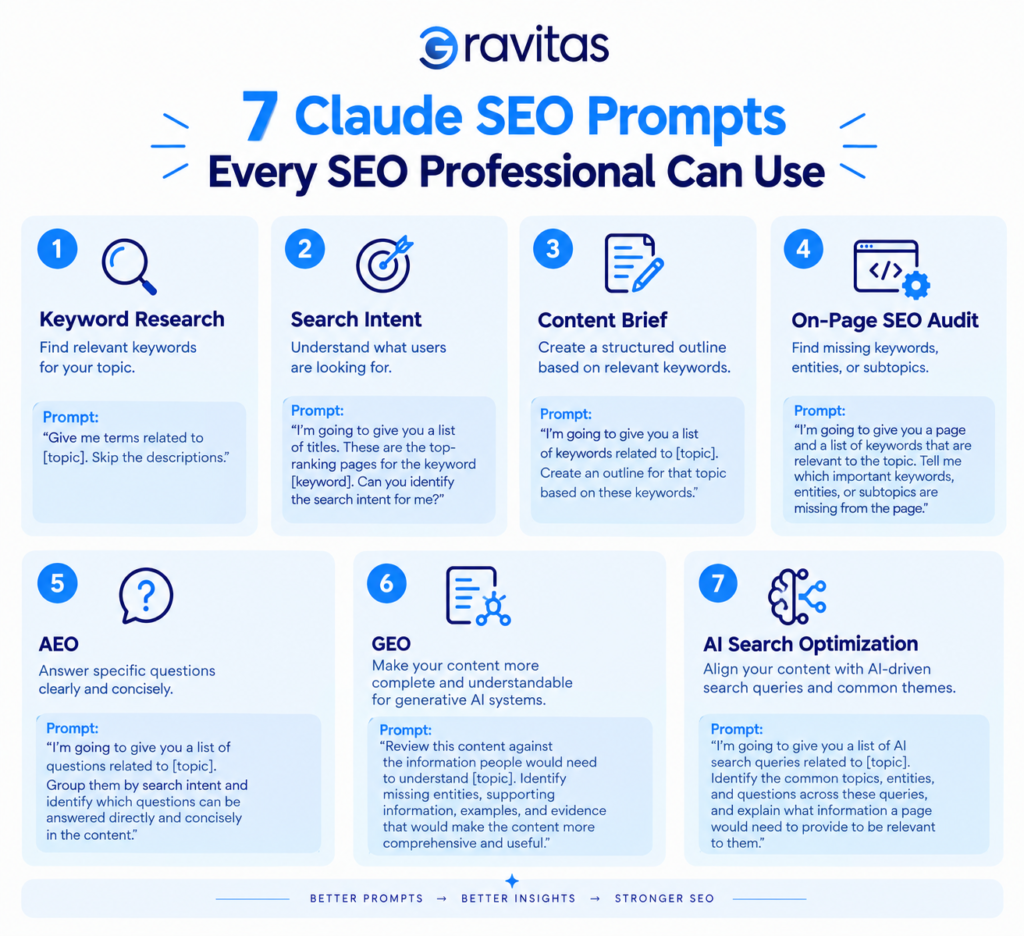
1. Finding Keywords and Topic Ideas
Claude can help expand initial keyword research by identifying related searches, long-tail queries, customer questions, and topics that may not be obvious from a single keyword.
Instead of generating a large list of similar keywords, the focus should be on understanding the different ways a potential customer may search for a solution.
Sample Prompt:
“I run a B2B marketing agency offering SEO, PPC, content marketing, and lead generation. Identify the main topics and search queries a business owner may use when looking for these services. Group them by service and search intent. Include informational, commercial and transactional searches. Remove duplicate keyword variations.”
The output can provide a starting point for further keyword research. Search volume, competition, keyword difficulty, and ranking potential should still be validated using dedicated SEO tools.
2. Understanding Search Intent
A keyword alone does not tell you what type of content a user expects to find. The same subject can lead to an informational article, a service page, a comparison, or a product page depending on the intent behind the search.
Claude can help organise a keyword list around the underlying need.
Sample Prompt:
“Analyse these keywords: [paste keywords]. For each keyword, identify the likely search intent, what the searcher is trying to find, and the most appropriate content type: blog post, service page, comparison page, landing page or FAQ. Flag any keywords where the intent is unclear.”
This can help SEO specialists avoid creating a blog post when the search requires a service page, or a sales-focused page when the searcher is still looking for information.
The results should be checked against the actual search results because search engines provide the strongest indication of the content they consider relevant to a query.
3. Planning Website Content
Once you understand what people are searching for, the next step is deciding what your website should cover.
Claude can turn a target keyword and audience into a content structure that addresses the main topic, supporting questions, FAQs, and relevant information.
Sample Prompt:
“Create a content brief for [keyword] for [target audience]. Include the main search intent, questions the page should answer, important supporting topics, relevant FAQs, information that would help the reader make a decision, and internal linking opportunities. Avoid generic sections added only to increase word count.”
This can help a business owner or marketing team create content around what the audience actually needs rather than simply producing an article because a keyword has search volume.
It can also help identify internal linking opportunities between service pages, blogs, and other useful resources.
For businesses looking at the wider role of AI in SEO, Gravitas has also covered AI SEO automation tools.
4. Reviewing Existing Pages
You do not always need to create something new to improve SEO. An existing page may already contain useful information but still leave important customer questions unanswered, lack supporting details, or fail to match the intent behind the target search.
Sample Prompt:
“Review this page for the search intent behind [keyword]. Identify important questions the page does not answer, information that is unclear or too generic, claims that need supporting evidence, and sections that are repetitive or unnecessary. Prioritize the changes that would make the page more useful to a potential customer.”
This can help determine whether an existing service page or blog needs improvement before creating another piece of content.
The recommendations should still be checked against actual search results, website performance data, and the business’s expertise.
5. Finding Unanswered Customer Questions
Some of the most useful SEO topics may not come from keyword tools. They can come directly from sales calls, customer enquiries, reviews, support conversations, and questions asked before a purchase. Claude can organise this information and highlight recurring questions that the website has not addressed.
Sample Prompt:
“Here are questions collected from our sales calls, customer enquiries and reviews: [paste questions]. Group similar questions together, identify recurring concerns, and separate questions already answered on our website from questions that are not addressed. Recommend which unanswered questions should be covered on a service page, FAQ, blog post or comparison page.”
This can turn real customer conversations into content opportunities. For example, repeated questions about implementation time, pricing factors, integrations, results, or ongoing support can indicate information that potential customers need before they are ready to enquire.
6. Preparing Content for AEO and AI Search
Google is no longer the only place where people can discover information about a business. AI-powered search engines, such as ChatGPT, Gemini, and Perplexity can summarise information and provide answers based on content available online.
This brings AEO, GEO, and AI search optimization into the SEO workflow.
Claude for AEO
Answer Engine Optimization (AEO) focuses on providing clear answers to specific questions.
Sample Prompt:
“For [business/service], identify the questions a potential customer is likely to ask before making a decision. Group them by pricing, process, results, features, comparisons and implementation. Prioritise questions where a clear answer could help the customer evaluate the service.”
The resulting questions can help businesses build clearer FAQ sections, service pages, and supporting content.
Claude for GEO
Generative Engine Optimization (GEO) focuses on making information easier for generative AI systems to understand and use when producing answers.
Sample Prompt:
“Review this page and identify information that is vague, missing, unsupported or difficult to understand without additional context. Check whether the page clearly explains who the company is, what it offers, who it serves, the problem it solves, and the evidence supporting its claims.”
This can highlight areas where a page needs more specific information rather than simply more content.
Claude for AIO and AI Search Optimization
AI search optimization also depends on clear, factual information about the business.
Sample Prompt:
“Review this page for AI search. Identify the key facts an AI system would need to accurately describe this business, its services, target audience and areas of expertise. List any important facts that are missing, unclear or buried in the content. Do not add information that is not supported by the page.”
Think of the progression as:
SEO → AEO → GEO → AIO
The formats may differ, but the underlying principle remains useful content that clearly answers real questions.
7. Identifying Content Gaps
Your competitors may already be answering questions that your website has never addressed. A content gap can also exist when your page covers a topic but does not provide enough information for the reader to make a decision.
Claude can compare your content with competitor pages, identify the gaps, and enhance the content further.
Sample Prompt:
“Compare our page with these competitor pages: [add pages]. Identify topics, customer questions, examples, evidence and useful information covered by competitors but missing from our page. Also identify areas where our page provides more specific information. Do not copy competitor wording or recommend copying their content.”
This is not about copying competitors. It is about finding opportunities to make your own content more complete and useful.
For actual competitor rankings, traffic, backlinks, and keyword performance, use dedicated SEO tools and your own analytics data. Claude can help analyse and organise the information, but it should not replace the data sources used to make SEO decisions.
Used this way, Claude becomes part of the SEO workflow rather than the SEO strategy itself. It can reduce the time spent on research, organisation, and content analysis while leaving keyword validation, prioritisation, and business decisions with the SEO team.
What Claude Cannot Replace in SEO
Claude can help you work faster, but it cannot tell you everything about your market. You still need real search data, Google Search Console and GA4 insights, competitor research, SERP analysis, and fact-checking.
A keyword with high search volume is not automatically valuable if it brings visitors who will never become customers. That is why SEO automation with AI works best when it supports business strategy rather than replacing it.
How Gravitas Consulting Supports Modern SEO
At Gravitas Consulting, SEO is approached as more than just a ranking exercise. Our focus combines SEO, AEO, GEO, and AIO, wherein the strategies are aligned with your business objectives to help brands become easier to find across both traditional and AI-driven search.
AI can help speed up the work, however the strategy still starts with understanding the business and its customers.
For businesses exploring AI beyond SEO, Gravitas also covers Claude skills for PPC.
Using Claude to Make SEO More Efficient
Claude can take a significant amount of manual work out of SEO, from keyword research and search intent analysis to content planning, competitor research, and content gap analysis. The value for a business is not simply that these tasks get done faster. The time saved can be redirected towards higher-value SEO work, such as improving pages that can attract qualified visitors, identifying opportunities that support lead generation, and focusing resources on areas with stronger business potential.
But more content, more keywords, or more website traffic do not automatically mean better results. SEO needs to contribute to business outcomes. A keyword may bring thousands of visitors without generating meaningful enquiries, while a smaller group of highly relevant searches may bring potential customers who are much closer to making a purchase. That is why SEO performance needs to be considered alongside metrics such as qualified traffic, conversions, leads, customer acquisition cost, and ROI.
Claude can support this process by making research and analysis more efficient, but it still needs reliable SEO data, customer insight, and human expertise. The goal is not to use AI to produce more content. It is to reduce repetitive work, identify better opportunities, and give SEO teams more time to focus on work that can contribute to visibility, leads, revenue, and return on SEO investment.
At Gravitas Consulting, we combine SEO, AEO, GEO, and AI search optimization to help businesses improve how they are discovered across Google and AI-driven search while keeping the strategy connected to business goals.
Explore Gravitas’ SEO services to build a search strategy focused on qualified traffic, leads, and measurable business growth.