Your business is getting inquiries, but sales are not growing as expected.
The natural response is to ask for more leads. Increase the ad budget. Run another campaign, expand outreach, and get the marketing team to push harder.
But there is a question worth asking before doing any of that: What is happening to the leads you already have?
A prospect enquires about your service. Someone from the team gets in touch. There is a conversation, perhaps a meeting, and a proposal follows. Then the communication slows down. The prospect stops responding, the opportunity gets marked as lost, and the team moves on to the next enquiry.
If this happens often enough, the problem may not be a lack of leads.
It may be that the business is losing opportunities somewhere between the first enquiry and the final decision.
That is why looking at the sales process matters. More leads can fill the top of the funnel, but if the journey after that is unclear, inconsistent, or difficult to track, the business can keep generating opportunities without seeing the expected growth.
The first step, then, is not always generating more leads. It is finding out where the existing ones are getting stuck.
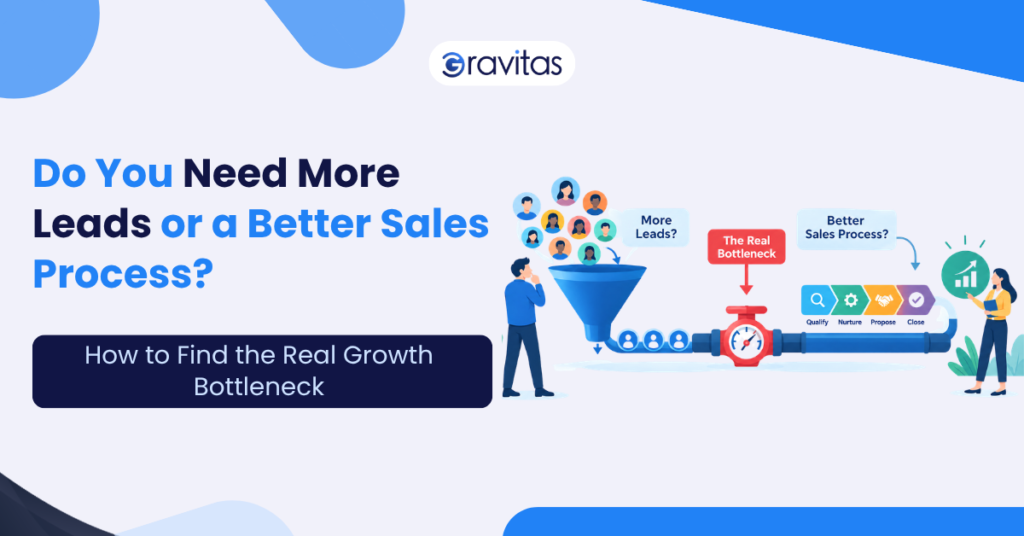
More Leads or a Better Sales Process? Start by Finding the Bottleneck
When sales slow down, lead volume is often the easiest number to look at. It is visible, measurable, and directly connected to marketing activity. But the number of leads entering the funnel tells only one part of the story.
What happens after those leads arrive matters just as much.
If the business is receiving very few relevant enquiries, the problem may be at the demand-generation end. The business may not be reaching enough of its target audience, or its marketing may be attracting people who are unlikely to become customers.
If there is a healthy flow of relevant enquiries but very few are moving forward, the issue may sit further down the funnel. Prospects could be waiting too long for a response, sales conversations may not be progressing, or follow-up may stop before the prospect is ready to make a decision.
This is the difference between lead generation vs sales process.
Before deciding where to spend more money, look at the journey between the first enquiry and the final sale. Understanding the sales funnel stages can help businesses identify where prospects are moving forward and where opportunities are being lost.
That is the starting point for sales funnel optimization.
The goal is simple: understand the leak before trying to pour more into the funnel.
How to Identify Whether Leads or Sales Are the Real Problem
Once the funnel is visible, the problem becomes easier to investigate.
Start with the leads coming into the business. Are they from the audience you actually want to sell to? Are they showing genuine interest in the service? Are they reaching sales with enough information to start a useful conversation?
This is particularly important with B2B lead generation, where a lead can look promising on paper but still have little potential to become a customer. A business may be generating hundreds of enquiries while only a small percentage are genuinely relevant.
Then look at what happens after qualification.
Are leads contacted quickly? Does someone own the opportunity? Is there a clear next step after the first conversation? What happens when a prospect asks for a proposal? How often are opportunities followed up?
The answers can reveal whether the problem sits with lead generation or conversion.
For example, if the business has plenty of qualified opportunities but very few proposals turn into customers, generating another batch of leads may not address the real issue. The business needs to understand what is happening between proposal and decision.
On the other hand, if the sales team is consistently waiting for enough qualified opportunities to enter the pipeline, the focus needs to move towards attracting the right prospects.
The numbers do not need to be complicated. They simply need to tell the story of what happens to an opportunity from beginning to end.
Common Sales Process Problems That Slow Business Growth
Many sales problems are created by small gaps rather than one obvious mistake.
A lead might arrive on a Monday and receive a response several days later. A salesperson might have a good first conversation but fail to schedule the next one. A proposal might be sent without agreeing on when the prospect will review it. Another opportunity might be passed from marketing to sales without enough context about what the prospect was interested in.
Over time, these gaps become part of the way the business operates.
There may also be no consistent definition of what makes a lead qualified. One salesperson may consider an enquiry ready for a sales conversation, while another may consider the same enquiry too early.
The result is an inconsistent sales conversion process. Some opportunities receive attention at the right time, while others gradually disappear from the pipeline.
This is why simply asking sales teams to “follow up more” rarely solves the underlying problem. The business needs to understand where the process is breaking down and why.
How to Improve Your Sales Process and Convert More Leads
Improving the process does not mean creating a complicated sales manual.
Start with the journey that already exists.
Define the stages a prospect moves through and make each stage meaningful. A qualified lead should meet a clear set of criteria. A proposal should have a defined next step. An opportunity that is not ready to buy should have a reason and a follow-up plan rather than simply sitting in the pipeline.
Response time also deserves attention. When someone has actively shown interest in a service, a long gap between enquiry and first contact can create unnecessary friction.
The same applies to follow-up. Not every prospect will make a decision after one conversation, particularly in B2B sales. A structured follow-up approach keeps genuine opportunities from being forgotten.
Then look at the data.
If opportunities consistently disappear after the first meeting, investigate that stage. If proposals are being sent but rarely converted, examine what happens before and after the proposal. If qualified leads are too few, move your attention towards demand generation.
That is what sales process optimization should achieve: not more activity, but fewer unnecessary gaps between interest and purchase.
Understanding how to improve sales process performance becomes much easier when the business knows exactly where prospects are being lost.
How Gravitas Consulting Can Help Fix the Growth Bottleneck
For a business owner, identifying the problem can be harder than recognising that there is one.
Marketing may say the business needs better follow-up. Sales may say the leads are not good enough. The business owner sees the same outcome: opportunities are coming in, but revenue is not growing as expected.
Gravitas Consulting can help bring these parts together by looking at the complete journey from marketing and lead generation through to sales conversion.
The focus is on identifying where the gap actually exists. If the business needs more qualified opportunities, marketing activity can be reviewed. If enough opportunities are already entering the funnel but conversion is weak, attention can shift towards the sales journey, qualification, follow-up, and movement between stages.
Businesses looking for additional sales support can explore Gravitas Consulting’s Sales-as-a-Service, while businesses looking to strengthen demand generation can explore its digital marketing services.
The objective is not to add more activity simply because sales are slow. It is to understand what the business actually needs.
The Right Growth Strategy Depends on the Bottleneck
If the business does not have enough qualified prospects entering the funnel, stronger B2B lead generation may be necessary.
If qualified opportunities are already coming in but are not progressing, the sales journey needs attention.
And if both problems exist, marketing and sales need to work together rather than trying to solve each issue independently.
The important distinction is this: more leads increase the number of opportunities, but a better process determines how effectively those opportunities move towards revenue.
Conclusion
When sales are slow, generating more leads can feel like the obvious answer. Sometimes it is. But before increasing marketing spend, it is worth looking at what is happening to the opportunities already entering the business.
Are the leads relevant? Are they being contacted quickly? Are sales stages clearly defined? Are prospects receiving consistent follow-up? Where are opportunities disappearing?
Once those questions are answered, the growth problem becomes much easier to understand.
The business can then invest in the area that actually needs attention, whether that means generating more qualified demand, improving conversion, or strengthening both sides of the journey.
FAQs
Look at the number of qualified opportunities entering your pipeline rather than total enquiries. If the sales team consistently has too few relevant prospects to work with, lead generation may need attention. If enough qualified opportunities exist, examine the sales journey first.
Look for repeated drop-offs after leads enter the business. Delayed responses, inconsistent follow-ups, unclear qualification, stalled proposals, and low conversion between sales stages can indicate that opportunities are being lost within the existing sales journey.
They address different parts of growth. Lead generation brings potential customers into the funnel, while sales process optimization helps move suitable prospects towards a purchase. The right priority depends on where the business is currently losing opportunities.
Start by mapping the existing customer journey. Define clear sales stages, establish qualification criteria, create consistent follow-up practices, and track where prospects drop out. Reviewing conversion data regularly can help identify which parts of the process need attention.
Improving qualification, response times, follow-up, and stage-to-stage movement can help businesses make better use of their existing opportunities. The impact can be measured by looking at conversion rates across individual sales stages and the number of opportunities that ultimately become customers.