Artificial intelligence has changed the way businesses approach content marketing. What once took hours of research, writing, and editing can now be done in minutes with AI-powered writing tools. From blogs and landing pages to product descriptions and social media posts, AI has made content creation faster and more accessible than ever before.
But speed has also created uncertainty.
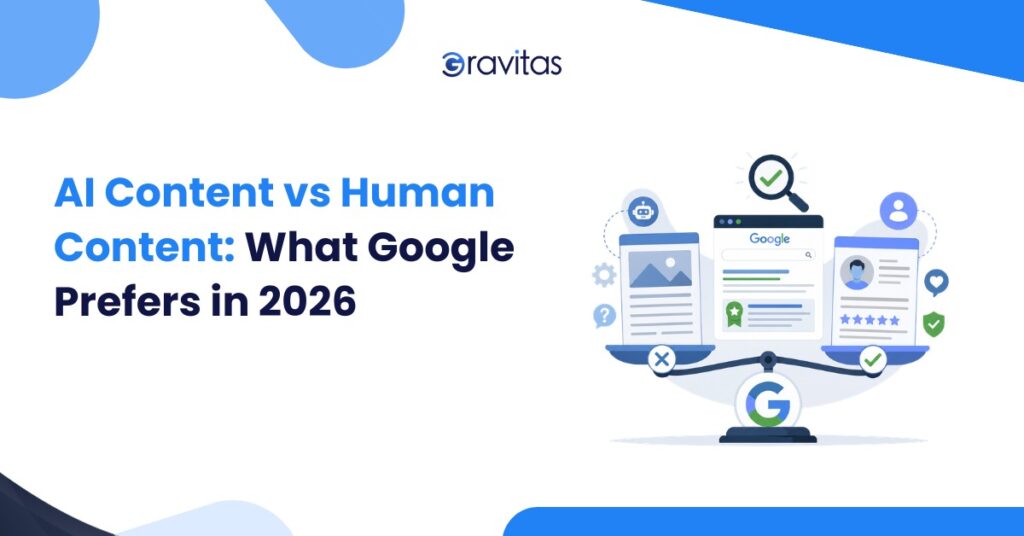
Many marketers and business owners are asking the same question: AI content vs human content which one actually performs better on Google? Some believe Google penalizes AI-generated content, while others think publishing large volumes of AI-written articles is enough to improve rankings. The truth lies somewhere in between.
Google doesn’t reward or reject content based on whether it was written by AI or a human. Its focus is on whether the content is helpful, original, accurate, and genuinely satisfies what users are looking for. That’s why AI-generated content SEO is no longer about choosing one approach over the other. It’s about using AI strategically while relying on human expertise to create content that stands out.
In this blog, we’ll explore how Google evaluates content in 2026, compare AI-generated and human-written content, and discuss why combining both is the smartest SEO strategy for businesses looking to build long-term organic visibility.
AI Content vs Human Content: Understanding the Difference
Before deciding which approach works better for SEO, it’s important to understand what separates AI-generated content from human-written content. While both can help businesses create content at scale, they bring different strengths to the table.
What Is AI Content?
AI content is created using artificial intelligence tools that generate text based on prompts and patterns learned from large datasets. These tools can quickly produce blog drafts, website copy, product descriptions, email campaigns, FAQs, and much more.
For businesses managing a busy content calendar, AI offers several advantages:
- Generates content in minutes
- Speeds up research and brainstorming
- Creates blog outlines and first drafts
- Suggests keywords and headings
- Improves productivity across marketing teams
Instead of spending hours staring at a blank page, marketers can use AI to build a solid starting point and then refine it into a polished piece of content.
However, AI isn’t perfect.
Because it predicts language rather than thinking independently, AI-generated content can sometimes feel repetitive, overly generic, or lacking in originality. It also doesn’t have firsthand experience or an understanding of your business, customers, or industry nuances.
What Is Human Content?
Unlike AI, human-written content for SEO is built on knowledge, experience, creativity, and context.
Human writers don’t just present information, they interpret it. They understand customer pain points, communicate a brand’s personality, and add practical insights that make content more engaging and trustworthy.
Human-written content often includes:
- Personal experiences
- Industry expertise
- Original opinions
- Customer success stories
- Practical examples
- A unique brand voice
These qualities help create content that resonates with readers while building authority in search engines.
For example, an article written by an SEO consultant who has managed hundreds of campaigns is likely to include lessons, observations, and recommendations that AI simply cannot generate authentically.
Why Both Approaches Have a Place
The conversation around AI content versus human content often creates the impression that businesses need to choose one over the other. In reality, the most successful content strategies combine both.
AI excels at handling repetitive and time-consuming tasks like research, outlining, and drafting. Human writers take that foundation and improve it by verifying facts, adding expertise, refining the tone, and ensuring the content genuinely answers the reader’s questions.
When used together, AI and human expertise complement each other rather than compete.
Does Google Prefer AI Content or Human Content in 2026?
One of the biggest misconceptions in SEO is that Google automatically penalizes AI-generated content.
That’s not true.
Google has consistently stated that it evaluates content based on quality not the method used to create it. According to Google’s Helpful Content Guidelines, the goal is to reward content created for people rather than content produced solely to manipulate search rankings.
Whether an article is drafted using AI or written entirely by a human, Google’s priority remains the same: Does this content help the user?
If the answer is yes, it has the potential to perform well.
What Google Actually Looks For
Instead of focusing on who created the content, Google’s algorithms evaluate whether the content:
- Answers the user’s question clearly
- Provides original insights
- Demonstrates real expertise
- Is factually accurate
- Matches search intent
- Delivers a good user experience
These principles align closely with the Google content quality guidelines, which continue to emphasize useful, reliable, and people-first content.
In other words, publishing AI-generated articles simply to target keywords isn’t enough anymore. Search engines are becoming better at identifying content that lacks originality or fails to provide meaningful value.
Why E-E-A-T Matters More Than Ever
Google’s emphasis on Experience, Expertise, Authoritativeness, and Trustworthiness (E-E-A-T) continues to shape how content is evaluated in 2026.
Here’s what each element means:
Experience: Has the author actually worked with the topic?
Expertise: Does the content demonstrate deep subject knowledge?
Authoritativeness: Is the website recognised as a trusted source within its industry?
Trustworthiness: Can readers rely on the information provided?
Imagine you’re searching for advice on recovering from a drop in Google rankings.
Would you trust an article that simply repeats common SEO tips, or one that explains how an agency helped multiple clients recover after a core update using real examples and measurable results?
The second article naturally offers more value because it’s supported by genuine experience.
That’s exactly the type of content Google wants to reward.
It’s About Value, Not the Writer
Two articles can target the same keyword.
One may be generated entirely by AI and published without editing.
The other may begin with AI-assisted research but be enhanced by an experienced marketer who adds industry insights, customer examples, updated information, and actionable recommendations.
While both discuss the same topic, the second article provides a far better experience for readers and that’s what improves its chances of ranking.
The takeaway is simple: don’t ask whether Google prefers AI or human writers. Ask whether your content is genuinely helping the person who lands on your page.
How AI Content Performs in Google Search
AI has become one of the most valuable productivity tools in modern content marketing. When used correctly, it can help businesses publish content faster, improve workflow efficiency, and support SEO efforts without replacing human expertise.
The key is understanding where AI adds value and where it still needs human input.
Faster Content Creation
One of AI’s biggest strengths is speed.
Tasks that once took several hours can now be completed in minutes.
AI can help marketers:
- Generate blog outlines
- Create first drafts
- Brainstorm topic ideas
- Write meta titles and descriptions
- Produce FAQ sections
- Repurpose existing content into different formats
This allows marketing teams to spend less time on repetitive work and more time refining content quality.
For businesses managing multiple websites or publishing content regularly, this efficiency can significantly improve productivity.
AI as an SEO Assistant
Beyond writing, AI also supports many aspects of SEO.
It can help identify relevant keywords, suggest semantic variations, improve heading structures, recommend internal linking opportunities, and enhance readability.
These capabilities make AI a valuable assistant during content planning and optimization.
However, AI should support SEO strategy but not replace it.
Search intent, audience understanding, competitive analysis, and content quality still require human judgment.
Where AI Still Falls Short
Despite its advantages, AI-generated content has limitations that businesses should be aware of.
Common challenges include:
- Generic explanations that sound similar across multiple websites
- Limited ability to share firsthand experiences
- Occasional factual inaccuracies or outdated information
- Repetitive sentence structures
- Weak emotional connection with readers
These limitations continue to influence AI content ranking factors 2026.
Google increasingly rewards content that demonstrates originality, expertise, and practical value qualities that AI alone cannot consistently provide.
That’s why successful businesses don’t treat AI as a replacement for content writers.
Instead, they use AI to speed up research and drafting while relying on experienced professionals to edit, verify, expand, and personalize every article before publication.
This balanced approach not only improves content quality but also creates a better experience for readers, which is ultimately what Google aims to reward.
Why Human-Written Content Still Matters for SEO
AI can generate thousands of words in minutes, but there’s one thing it still can’t replicate consistently human experience.
When people search on Google, they’re not just looking for information. They’re looking for reassurance, expert advice, practical solutions, and real-world examples. That’s where human-written content continues to have a significant advantage.
Google’s search systems increasingly reward content that demonstrates genuine experience. A marketing agency sharing lessons from actual SEO campaigns or a healthcare professional explaining treatment options from years of practice naturally provides more value than content generated solely from existing information.
1. Real Experience Makes Content More Credible
Anyone can ask an AI tool to explain what a Google algorithm update is.
But only someone who has managed SEO campaigns during multiple algorithm updates can explain:
- What actually changed
- Which strategies stopped working
- How rankings recovered
- What businesses should prioritize moving forward
This kind of practical knowledge helps readers make informed decisions instead of simply consuming information.
For example, if a business is struggling with declining organic traffic, they don’t just want definitions they want proven solutions based on experience.
That’s the kind of content Google increasingly values.
2. Brand Personality Builds Recognition
One of the biggest drawbacks of publishing AI-generated content without editing is that it often sounds like everyone else’s content.
The wording may be polished, but it rarely reflects the personality of the business behind it.
Your brand voice is what differentiates you from competitors.
Whether your communication style is educational, conversational, data-driven, or authoritative, maintaining consistency helps readers recognize your content and builds long-term trust.
A strong brand voice also improves engagement because readers feel like they’re learning from real people rather than reading automated text.
3. Human Expertise Strengthens Trust
Trust isn’t built by simply answering questions.
It’s built by answering them better than everyone else.
Businesses can achieve this by including:
- Original insights
- Industry observations
- Customer success stories
- Expert opinions
- Practical recommendations
- Data from real campaigns
These elements make content more useful while supporting Google’s focus on Experience, Expertise, Authoritativeness, and Trustworthiness (E-E-A-T).
In highly competitive industries, these human insights often become the deciding factor between content that ranks on page one and content that never gains visibility.
AI Content vs Human Content: SEO Performance Comparison
Rather than asking whether AI or humans create better content, businesses should understand where each approach performs best.
| Factor | AI Content | Human Content |
| Speed | Creates content within minutes | Takes more time to research and write |
| Creativity | Based on learned patterns | Generates original ideas and perspectives |
| Experience | Limited firsthand knowledge | Includes practical expertise and real examples |
| SEO Optimization | Assists with keywords and structure | Aligns content with search intent and business goals |
| Trust | Requires verification | Naturally builds authority and credibility |
The comparison makes one thing clear.
AI improves efficiency.
Humans improve quality.
Businesses that rely entirely on AI often struggle with originality, while businesses that ignore AI miss valuable opportunities to increase productivity.
The strongest SEO strategies combine both.
Best Approach: Combining AI and Human Expertise for SEO
The future of content marketing isn’t AI versus humans.
It’s AI working alongside experienced marketers, writers, and SEO professionals.
This hybrid approach allows businesses to create high-quality content faster while maintaining originality and credibility.
Step 1: Use AI for Research
AI can dramatically reduce the time spent gathering information.
Use it to:
- Brainstorm content ideas
- Identify supporting keywords
- Research competitor topics
- Generate outlines
- Organize information
This gives writers a strong starting point without replacing their expertise.
Step 2: Create a Structured Draft
Instead of starting with a blank page, use AI to build the initial framework of the article.
A well-structured draft helps writers focus on improving quality rather than formatting content from scratch.
Step 3: Add Human Experience
This is where average content becomes exceptional.
Expand the AI draft with:
- Real project examples
- Industry-specific insights
- Customer challenges
- Personal observations
- Practical recommendations
- Recent market developments
These additions make your content unique which something Google increasingly rewards.
Step 4: Optimize for Search Intent
SEO isn’t just about placing keywords throughout a page.
It’s about understanding what users actually expect when they search.
Review your content to ensure it:
- Answers the primary question
- Covers related subtopics
- Uses clear headings
- Includes relevant internal links
- Provides actionable takeaways
If your business wants content that’s optimized for both readers and search engines, professional SEO content writing services can help create articles that align with search intent while supporting long-term organic growth.
Step 5: Review Before Publishing
Never publish AI-generated content without a thorough review.
Before hitting publish, check for:
- Accuracy
- Grammar
- Tone consistency
- Updated information
- Original insights
- Readability
- Internal linking opportunities
Editing is what transforms an AI-generated draft into content that earns trust and rankings.
Common Mistakes When Using AI Content for SEO
AI can improve productivity, but using it carelessly can weaken your SEO performance.
Here are five common mistakes businesses should avoid.
1. Publishing AI Content Without Editing
This is perhaps the biggest mistake.
AI-generated drafts often require fact-checking, restructuring, and refinement before publication.
Skipping this step can lead to inaccurate information, repetitive content, and a poor user experience.
2. Using Generic AI Outputs
If your article contains the same advice readers can find on dozens of other websites, there’s very little reason for Google to rank it highly.
Every article should include original insights, examples, or expertise that make it genuinely useful.
3. Ignoring Search Intent
Many businesses focus so heavily on keywords that they forget why users are searching in the first place.
Before publishing, ask yourself:
- Does this article answer the reader’s question completely?
- Have we solved the problem they searched for?
- Is there additional value we can provide?
Content that satisfies search intent consistently outperforms content written solely around keywords.
4. Creating Content Only for Rankings
Publishing large volumes of AI-generated content simply to target keywords is becoming less effective.
Google’s ranking systems continue to prioritize quality over quantity.
One exceptional article often delivers more long-term value than ten average ones.
5. Forgetting to Add Expertise
AI can summarize information.
It cannot replace experience.
Businesses should always strengthen AI-generated drafts with practical examples, expert commentary, and original perspectives before publishing.
How Businesses Can Create Google-Friendly Content in 2026
As Google’s algorithms continue to evolve, one principle remains: constant content should help people.
Businesses that consistently perform well in search focus less on publishing more content and more on publishing better content.
Create Helpful Content
Every article should solve a genuine problem or answer an important question.
Before publishing, ask:
“Would someone still find this article useful if search engines didn’t exist?”
If the answer is yes, you’re creating the kind of content Google wants to rank.
Add Original Insights
The easiest way to outperform competitors is to publish information they can’t.
Share:
- Campaign learnings
- Customer success stories
- Industry observations
- Internal research
- Practical frameworks
- Lessons from experience
Originality is becoming one of the strongest competitive advantages in SEO.
Optimize Every SEO Element
Great content deserves great optimization.
Review every article for:
- SEO-friendly titles
- Compelling meta descriptions
- Clear heading hierarchy
- Internal linking
- Optimized images
- Readability
- Mobile experience
Businesses looking to improve both content quality and search visibility can explore Gravitas’ SEO content writing services, which combine strategic SEO with content designed to engage readers and drive organic growth.
Update Existing Content Regularly
SEO isn’t a one-time activity.
Refreshing existing content with:
- Updated statistics
- New screenshots
- Recent examples
- Additional insights
- Improved internal links
helps maintain rankings while keeping your website relevant.
Tools Marketers Can Use for AI-Powered SEO Content
Creating high-performing content requires more than a writing tool.
Successful SEO teams combine AI with specialized platforms that support every stage of the content lifecycle.
Useful tools include:
- AI writing assistants for brainstorming and drafting
- Keyword research tools for identifying search opportunities
- SEO auditing platforms for technical improvements
- Analytics tools for measuring content performance
- Content optimization platforms for improving readability and topical coverage
Once content is published, monitoring its performance is just as important as creating it.
Google Search Console helps businesses understand how their pages appear in search results, identify indexing issues, monitor keyword performance, and uncover opportunities for optimization.
Using these tools together allows businesses to make data-driven decisions instead of relying on assumptions.
Conclusion: AI Content vs Human Content — The Future of SEO in 2026
The debate around AI content vs human content often assumes businesses must choose one approach over the other.
In reality, the most successful SEO strategies don’t rely exclusively on either.
AI content vs human content is not about choosing one over the other; successful SEO in 2026 depends on combining AI efficiency with human creativity and expertise.
AI makes content creation faster by simplifying research, outlining, and drafting. Human expertise adds originality, practical knowledge, brand personality, and credibility qualities that continue to influence how both users and search engines evaluate content.
Businesses that use AI responsibly while investing in high-quality editing, strategic optimization, and authentic expertise will be better positioned to build authority, improve organic rankings, and create content that continues delivering value long after it’s published.
The future of SEO belongs to businesses that create content for people first—and use AI as a powerful assistant, not a replacement.
Frequently Asked Questions
No. Google doesn’t favor AI or human-written content. It ranks content based on quality, originality, usefulness, and how well it satisfies user intent. Helpful, people-first content has the best chance of ranking.
Yes. AI-generated content can rank if it’s accurate, well-edited, and provides value. Adding human expertise, fact-checking, and original insights improves its SEO performance and credibility.
Human-written content adds real experience, unique perspectives, and a consistent brand voice. These elements build trust, improve engagement, and help content stand out in competitive search results.
Use AI for research, outlines, and first drafts, but always review and refine the content. Adding expert insights, checking accuracy, and optimizing for search intent helps maintain strong SEO performance.
The best strategy is to combine AI’s speed with human expertise. Let AI assist with content creation, while human writers add originality, industry knowledge, and SEO optimization to create content that ranks and resonates.