The problem wasn’t effort. It was efficient.
Sales and marketing teams spent countless hours chasing prospects who were never likely to buy while genuinely interested buyers often went unnoticed.
In 2026, that model is rapidly disappearing.
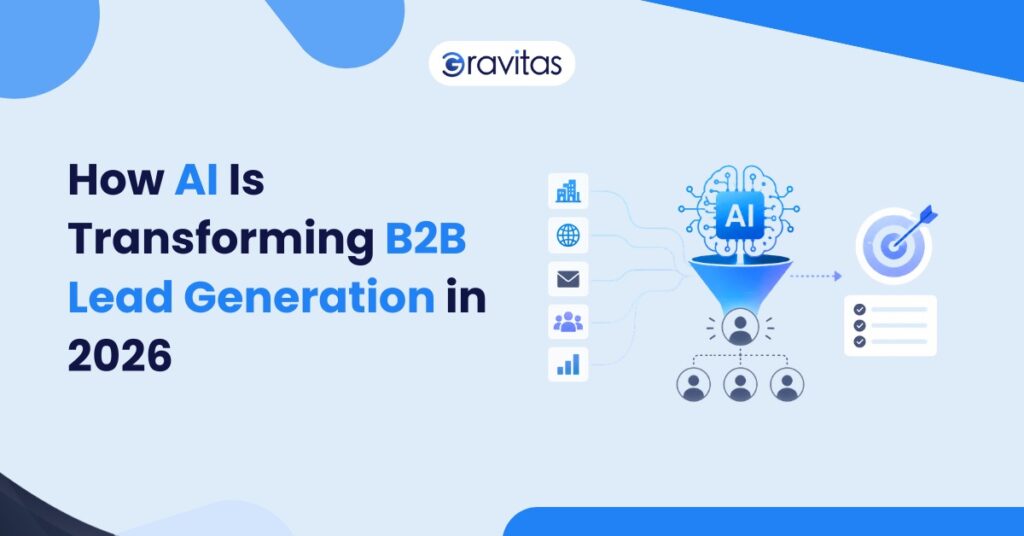
Artificial intelligence is changing how businesses discover opportunities, identify buying intent, personalize outreach, and move prospects through the sales funnel. Instead of relying on assumptions, companies now have access to real-time insights that reveal who is most likely to convert and when they are ready to engage.
This shift is why AI B2B lead generation has become one of the most important competitive advantages in modern marketing. Organizations that embrace AI-driven prospecting, predictive analytics, and automated engagement are generating higher-quality leads while reducing acquisition costs and shortening sales cycles.
Businesses already preparing for the future of AI in digital marketing are finding that AI is no longer just a marketing tool, it is becoming a growth engine.
Why AI B2B Lead Generation Is Growing Rapidly
The Shift From Traditional to AI-Driven Lead Generation
Traditional lead generation often depended on broad targeting and manual prospecting. Sales teams built lists based on job titles, industries, or company size and then reached out to hundreds of prospects hoping a small percentage would respond.
While this approach can still produce results, it lacks precision.
AI introduces a completely different model.
Instead of asking, “Who might be interested?” AI asks, “Who is already showing signs of interest?”
By analyzing search behavior, content engagement, website activity, technology adoption, and market signals, AI-powered prospecting tools can identify potential buyers before they actively enter a sales process.
This shift allows businesses to spend less time searching for opportunities and more time closing them.
AI Improves Lead Quality and Conversion Rates
The biggest challenge in B2B marketing has never been generating leads.
It has been generating the right leads.
AI helps businesses move beyond volume-based lead generation and focus on quality. Machine learning models analyze thousands of behavioral signals to identify prospects with the highest probability of becoming customers.
Instead of treating every lead equally, organizations can prioritize:
- High-intent prospects
- Decision-makers
- Accounts actively researching solutions
- Buyers showing strong engagement signals
This enables sales teams to focus their efforts where they are most likely to generate revenue.
Data-Driven Decision Making in B2B Marketing
Marketing leaders are increasingly expected to justify every investment with measurable outcomes.
AI provides visibility into customer behavior, campaign performance, and buying patterns that would be difficult to identify manually.
Rather than relying on assumptions, teams can make decisions based on real-time data, allowing them to optimize campaigns faster and improve overall marketing efficiency.
Businesses exploring advanced automation often leverage solutions such as Google AI solutions to improve data analysis and customer insights.
AI B2B Lead Generation Strategies Businesses Use in 2026
Predictive Lead Scoring
Not all leads are equal.
Predictive lead scoring uses machine learning to evaluate prospects based on historical conversion patterns and behavioral indicators.
Instead of assigning arbitrary scores, AI identifies which actions most closely resemble those of existing customers.
The result is a dynamic prioritization system that helps sales teams focus on leads with the highest buying potential.
AI-Powered Chatbots and Conversational Marketing
The modern buyer expects immediate answers.
AI-powered chatbots provide instant engagement, qualify leads automatically, answer common questions, and schedule meetings without requiring human intervention.
Unlike traditional contact forms, conversational experiences create a more natural and responsive interaction.
Businesses are increasingly using AI assistants to capture opportunities that might otherwise leave the website without taking action.
Automated Email Personalization
Generic email campaigns continue to lose effectiveness.
AI can now create personalized outreach based on:
- Industry
- User behavior
- Website interactions
- Content consumption patterns
- Previous communications
This level of personalization allows businesses to deliver relevant messages at the right time, improving engagement and response rates.
AI-Based Audience Targeting
Audience targeting is becoming increasingly precise.
AI systems analyze intent signals, behavioral patterns, and demographic data to identify highly relevant audiences.
Instead of targeting broad segments, marketers can focus budgets on prospects most likely to convert.
Many organizations use platforms that incorporate HubSpot AI marketing tools to automate segmentation and campaign optimization.
How AI Is Improving B2B Sales Funnels
Faster Lead Qualification
One of the largest productivity challenges for sales teams is spending time on unqualified opportunities.
AI eliminates much of this inefficiency by automatically evaluating prospects against predefined qualification criteria.
Sales representatives can focus on meaningful conversations instead of manual filtering.
Better Customer Journey Mapping
Modern B2B buyers rarely follow a linear path.
They interact with content, attend webinars, read reviews, compare vendors, and revisit websites multiple times before making decisions.
AI tracks these interactions across channels, helping marketers understand where prospects are in the buying journey and what information they need next.
Improved Conversion Optimization
AI is also transforming how businesses optimize landing pages and conversion paths.
By analyzing user behavior patterns, AI can identify:
- High-performing CTAs
- Drop-off points
- Conversion bottlenecks
- User engagement trends
These insights support more effective website conversion optimization strategies and help businesses improve sales performance.
AI B2B Lead Generation and SEO in 2026
AI Search Engines Influence Buyer Behavior
B2B buyers increasingly rely on AI-powered search experiences when evaluating vendors and researching solutions.
Instead of reviewing dozens of websites, decision-makers now ask AI assistants for recommendations, comparisons, and summaries.
This shift is changing how businesses approach lead generation and digital visibility.
Optimizing Content for AI Search Platforms
Content designed for AI search must be structured differently.
Successful content includes:
- Clear headings
- Direct answers
- Semantic relevance
- Strong topical authority
- Well-organized information
These elements help platforms such as ChatGPT, Gemini, and AI Overviews understand and surface content more effectively.
EEAT Signals Matter More Than Ever
AI search systems increasingly prioritize credibility.
Organizations demonstrating expertise, experience, authority, and trustworthiness are more likely to earn visibility and influence buying decisions.Businesses should regularly review guidance such as Google AI search documentation to understand how AI-powered search experiences continue evolving.
Common Challenges in AI B2B Lead Generation
Poor Data Quality
AI systems are only as effective as the data they receive.
Incomplete, outdated, or inaccurate data can lead to poor targeting and unreliable recommendations.
Strong CRM management and data governance remain essential.
Over-Automation Risks
Automation creates efficiency, but excessive automation can damage customer relationships.
Prospects still value authentic conversations and human expertise.
The most successful organizations use AI to enhance relationships rather than replace them.
Privacy and Compliance Concerns
As AI becomes more sophisticated, businesses must carefully manage customer data and comply with evolving privacy regulations.
Trust remains a critical component of successful lead generation.
How Businesses Can Implement AI B2B Lead Generation Successfully
Invest in the Right AI Tools
Businesses should prioritize solutions that integrate with existing CRM, marketing automation, and sales platforms.
Technology should simplify workflows rather than create additional complexity.
Align Sales and Marketing Teams
AI performs best when sales and marketing share common goals, data sources, and lead qualification criteria.
Alignment improves lead quality and accelerates revenue growth.
Focus on Personalization and Customer Experience
Technology alone is not enough.
The most successful AI strategies combine automation with highly personalized customer experiences that build trust and engagement.
Continuously Analyze and Optimize Campaigns
AI systems improve over time.
Organizations should continuously monitor performance, test new approaches, and refine campaigns using data-driven insights.
Businesses investing in broader B2B digital marketing strategies often see the greatest long-term benefits from AI adoption.
Future Trends in AI B2B Lead Generation
Hyper-Personalized Marketing Will Dominate
Mass marketing is becoming less effective.
Future AI systems will deliver highly individualized experiences tailored to each buyer’s interests, behavior, and intent.
Conversational AI Will Replace Traditional Forms
The era of lengthy lead forms is fading.
Intelligent assistants and voice-driven interactions will increasingly become the preferred method of engagement.
Predictive Analytics Will Become More Advanced
Future AI models will predict not only who is likely to buy but also when they are most likely to make purchasing decisions.
This will significantly improve sales forecasting accuracy.
AI and Human Collaboration Will Drive Better Results
The future of lead generation is not AI versus humans.
It is AI working alongside humans.
Organizations that combine automation, data intelligence, and relationship-building will achieve the strongest results.
Conclusion
AI is fundamentally reshaping how B2B organizations identify, engage, and convert prospects. From predictive lead scoring and intelligent targeting to conversational marketing and sales automation, businesses now have access to capabilities that were impossible just a few years ago.
Companies that embrace AI B2B lead generation are generating higher-quality opportunities, improving conversion rates, and making smarter decisions throughout the customer journey.
As competition increases in 2026, organizations that successfully integrate AI into their sales and marketing strategies will gain a significant advantage in attracting, nurturing, and converting valuable business opportunities.
CTA
Want to generate smarter B2B leads and improve sales conversions with AI-driven marketing?
Leverage AI automation, predictive analytics, and personalized lead generation strategies to attract better prospects, shorten sales cycles, and accelerate business growth.
Contact Gravitas Consulting today to build an AI-powered B2B lead generation strategy designed for measurable results.
FAQs
AI B2B lead generation uses artificial intelligence to identify, qualify, and engage potential business customers through automation, predictive analytics, and behavioral insights.
AI analyzes customer behavior, intent signals, and engagement patterns to prioritize prospects most likely to convert.
Yes. AI chatbots can engage visitors instantly, answer questions, qualify leads, and schedule meetings while providing a seamless customer experience.
AI helps businesses improve targeting, personalization, efficiency, and decision-making, allowing them to generate better results with fewer resources.
No. AI enhances sales performance by automating repetitive tasks and providing insights, but human expertise remains essential for building relationships and closing complex deals.