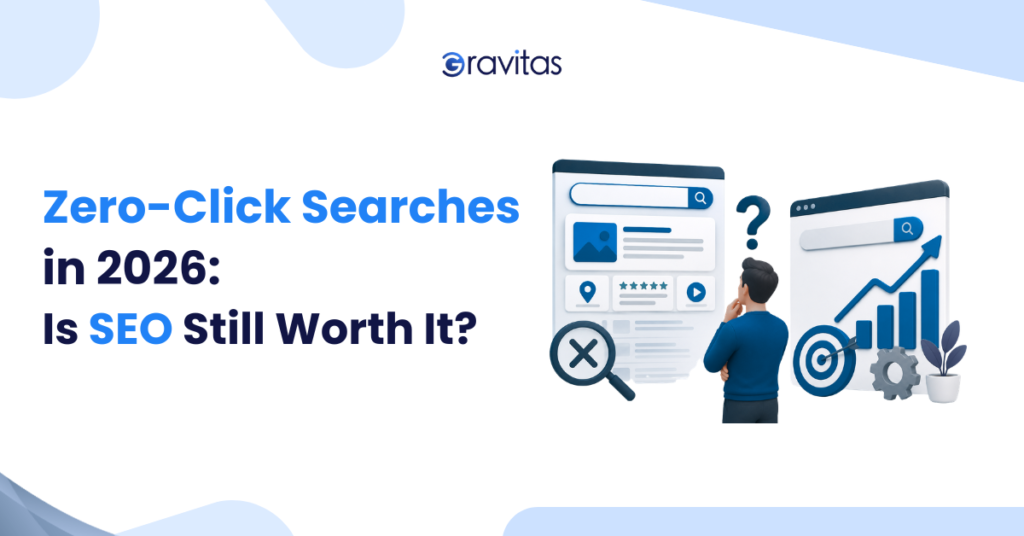
A few years ago, ranking #1 on Google almost guaranteed traffic.
Today, someone searches for a question, reads the AI-generated answer at the top of the page, and leaves without clicking a single website.
That shift is changing the entire SEO landscape.
From Google AI Overviews to conversational platforms like ChatGPT and Gemini, search engines are no longer just showing links, they are becoming answer engines.
And the impact is already visible.
Organic clicks are declining for many informational searches. AI-powered SERPs are keeping users inside the search experience longer. Even high-ranking pages are seeing reduced click-through rates because users are getting instant summaries before they ever visit a website.
But here’s the bigger question:
If users stop clicking websites, what happens to SEO?
Is investing in rankings, content, and optimization still worth it in 2026?
The answer is yes but the rules have changed.
SEO is no longer only about chasing clicks. It is now about becoming the source AI platforms trust, summarize, recommend, and cite.
The brands winning in 2026 are not necessarily the ones publishing the most content. They are the ones building authority, creating genuinely useful information, and optimizing for how modern search actually works.
This is where AI search optimization, topical authority, and search intent strategy become critical. For brands adapting to evolving SEO trends in 2026, understanding zero-click searches is no longer optional, it is the foundation of future search visibility.
What Are Zero-Click Searches in 2026?
Definition of Zero-Click Searches 2026
Zero-click searches happen when users get the information they need directly from the search results page without visiting a website.
Instead of opening multiple tabs and comparing pages, users now get answers instantly through:
- AI-generated summaries
- Featured snippets
- Knowledge panels
- Voice assistants
- AI chat interfaces
- Search previews
In many cases, the search journey begins and ends on Google itself.
That is exactly why zero-click searches are becoming one of the biggest conversations in SEO.
Why Zero-Click Searches Are Growing
The growth of generative AI search experience is changing user expectations completely.
People no longer want to “search and browse.”
They want immediate answers.
Search engines are responding by prioritizing:
- Faster responses
- Conversational experiences
- Context-aware answers
- AI-generated summaries
- Personalized search experiences
Platforms like ChatGPT, Gemini, and AI Mode are training users to interact with search differently. Instead of typing fragmented keywords, users are asking complete questions and expecting direct explanations.
That behavior shift is accelerating the rise of zero-click searches.
How AI Search Engines Are Changing User Behavior
Search behavior in 2026 is more conversational than ever.
Users now trust search engines to summarize information instead of manually researching every topic themselves.
That changes how content gets discovered.
Earlier, ranking higher often depended on keyword density and backlinks alone. Now, trust signals, topical authority, clarity, and structured information matter far more.
AI search engines are prioritizing content that feels:
- Credible
- Helpful
- Human
- Contextually relevant
- Easy to summarize
Google’s Search Generative Experience is a clear example of how AI-powered SERPs are reshaping modern search behavior.
Is SEO Still Worth It in the Era of Zero-Click Searches 2026?
Why SEO Still Matters
The idea that “SEO is dead” resurfaces every few years.
But what is actually happening in 2026 is not the death of SEO, it is the evolution of search visibility.
Because even when users do not click, they still notice.
Appearing in AI summaries, featured snippets, and conversational search responses builds familiarity and trust long before someone becomes a customer.
Visibility itself has become valuable.
When AI systems repeatedly reference a brand as a trusted source, that authority compounds over time.
That is why SEO still matters, maybe even more than before.
SEO Has Shifted From Clicks to Visibility
Traditional SEO focused heavily on rankings and traffic.
Modern SEO is broader.
Today, success is increasingly measured through:
- AI citations
- Brand mentions
- Search visibility
- Entity recognition
- Impression share
- Topical authority
The goal is no longer just “getting clicks.”
The goal is becoming discoverable across every search experience — including AI-generated answers.
The brands adapting fastest understand this shift already.
Organic Traffic Is Evolving, Not Dying
Not every search ends without a click.
When users need depth, comparison, expertise, or decision-making support, they still visit websites.
People continue clicking for:
- Product research
- Service evaluations
- Industry insights
- Case studies
- Detailed explanations
- Purchase decisions
High-intent traffic still converts extremely well.
What is disappearing is low-value traffic driven by shallow informational content.
Brands investing in AI Overviews and SEO strategies are focusing less on vanity traffic and more on visibility that actually influences decisions.
How to Optimize for Zero-Click Searches 2026
Create AI-Friendly Content
AI search engines prefer content that is easy to understand, summarize, and extract.
That means overly complicated writing and bloated paragraphs often perform worse than clear, structured information.
Content optimized for AI visibility usually includes:
- Clear headings
- Direct answers
- Conversational phrasing
- Short paragraphs
- Logical structure
- Context-rich explanations
The easier your content is to interpret, the more likely AI systems are to surface it.
Optimize for Featured Snippets and AI Overviews
Featured snippets still play a major role in AI-generated search results.
Most AI summaries pull information from content that is already structured clearly.
Simple optimizations can improve visibility significantly:
- Add FAQ sections
- Use bullet points
- Answer questions directly
- Include concise summaries
- Structure content logically
AI search engines reward clarity.
Not complexity.
Build Topical Authority
Publishing random isolated blogs is no longer enough.
Search engines now evaluate how deeply a website understands a topic overall.
That is why topical authority matters.
Instead of creating disconnected content, strong SEO strategies focus on:
- Content clusters
- Interlinked articles
- Niche expertise
- Consistent publishing
- Topic depth
The more context your website provides around a subject, the more trustworthy it becomes to AI systems.
Focus on EEAT Signals
Google continues prioritizing EEAT:
- Experience
- Expertise
- Authoritativeness
- Trustworthiness
But in 2026, EEAT influences more than rankings.
It directly impacts whether AI systems trust your content enough to reference it.
Content that demonstrates real expertise consistently performs better across AI-powered SERPs.
Use Structured Data
Structured data helps search engines understand your content more accurately.
It improves discoverability across both traditional and AI-driven search experiences.
Important schema types include:
- FAQ schema
- Article schema
- Organization schema
- Review schema
Following Google structured data guidelines helps search engines interpret content more effectively.
SEO Strategies That Work Best in 2026
Optimize for AI Search Engines
Search optimization is no longer limited to Google rankings.
Brands now need visibility across:
- ChatGPT
- Gemini
- AI assistants
- Conversational search engines
- AI-generated SERPs
That changes how content should be written.
Modern SEO content must answer questions naturally, provide contextual depth, and align with conversational search behavior.
The future belongs to brands that optimize for discovery everywhere, not just blue links.
Prioritize Search Intent Over Keywords
Keyword stuffing stopped working years ago.
In 2026, search engines understand context and intent more deeply than ever.
Successful SEO strategies now focus on understanding why users search in the first place.
That includes:
- Informational intent
- Commercial intent
- Transactional intent
- Research intent
The better your content aligns with intent, the stronger its visibility becomes across AI-powered search.
Invest in Brand SEO
AI search engines are more likely to trust recognizable brands and authoritative publishers.
That makes brand visibility increasingly important.
Strong brand SEO includes:
- Thought leadership
- Expert-driven content
- Consistent publishing
- PR visibility
- Cross-platform discoverability
The stronger the brand presence, the easier it becomes to earn AI citations and search trust.
Multimedia SEO Is Essential
Search is becoming more visual and interactive.
Text alone is no longer enough to dominate visibility.
Modern SEO strategies should include:
- Videos
- Infographics
- Podcasts
- Interactive tools
- Visual explainers
Multimedia content increases engagement while expanding discoverability across multiple search surfaces.
A strong keyword research for SEO strategy combined with multimedia optimization creates better long-term visibility.
Common SEO Mistakes Brands Must Avoid in 2026
Writing Only for Search Engines
One of the biggest mistakes in modern SEO is creating content that feels robotic.
Users and AI systems can identify low-value content instantly. If the content sounds manufactured purely for rankings, it rarely builds trust. Useful content performs better than “optimized” content that lacks depth.
Ignoring AI Search Optimization
Traditional SEO alone is no longer enough.
Many websites still optimize only for rankings while ignoring how AI search platforms extract and summarize information. That creates a major visibility gap.
AI optimization is becoming a core part of SEO itself.
Publishing Thin Content
Publishing more content does not automatically improve rankings anymore.
In fact, shallow content often hurts authority.
Search engines now reward:
- Original insights
- Depth
- Expertise
- Contextual relevance
- Comprehensive explanations
One strong article often outperforms ten generic ones.
Neglecting Technical SEO
Even the best content struggles without strong technical foundations.
Technical SEO still matters because AI systems need to crawl, understand, and process websites efficiently.
Critical areas include:
- Site speed
- Mobile UX
- Crawlability
- Structured data
- Clean architecture
- Core Web Vitals
Technical SEO remains the backbone of discoverability.
The Future of SEO Beyond Zero-Click Searches 2026
SEO Will Become Search Experience Optimization
The future of SEO is bigger than rankings.
Search visibility will increasingly depend on how consistently brands appear across different discovery platforms.
That includes:
- AI search engines
- Voice assistants
- Conversational AI
- Social search
- Visual search
- Traditional SERPs
SEO is evolving into full search experience optimization.
AI Search and SEO Will Work Together
AI search engines still rely on trusted web content to generate answers.
Without websites, AI systems would have nothing credible to summarize.
That is why SEO remains foundational.
The relationship between AI search and SEO is not competitive, it is interconnected.
Websites continue powering the information ecosystem behind AI-generated responses.
Brands That Adapt Early Will Win
Every major search evolution creates a gap between early adopters and late adopters.
The same is happening with AI search optimization.
Brands building authority today will gain stronger visibility over time because AI trusts compounds.
The earlier brands adapt, the harder they become to outrank later.
Conclusion
Zero-click searches 2026 are changing how users interact with search engines, but SEO is far from dead.
What is disappearing is outdated SEO focused only on rankings and traffic volume.
Modern SEO is becoming AI search optimization built around authority, discoverability, trust, and user experience.
The brands that continue winning will be the ones creating genuinely useful content, building topical authority, and optimizing for how people actually search today.
Because in the era of AI-powered search, visibility matters before the click even happens.
CTA
Want your business to rank in Google AI Overviews, ChatGPT, and modern search engines in 2026?
Start building AI-optimized SEO strategies today with high-authority content, structured data, and search intent optimization.
Contact Gravitas Consulting today to future-proof your SEO strategy.
FAQs
Zero-click searches happen when users get answers directly on the search results page without clicking a website. AI-generated summaries, featured snippets, and conversational AI tools are driving this trend.
No. SEO is evolving rather than disappearing. Modern SEO focuses more on visibility, authority, AI discoverability, and user intent optimization.
Websites can improve visibility in AI Overviews by creating structured, authoritative, AI-friendly content with strong topical relevance and schema markup.
AI search engines influence how users discover information online. Optimizing for AI-powered search improves brand visibility, authority, and discoverability.
The best SEO strategy for 2026 combines AI search optimization, topical authority, intent-driven content, multimedia SEO, technical SEO, and strong brand visibility.