The PPC industry has quietly entered a new phase.
For years, marketers used AI like a shortcut tool to generate a few headlines, rewriting ad copy, or brainstorming keywords with one-off prompts. It saved time, but it didn’t fundamentally change how campaigns operated.
That’s changing now.
In 2026, high-performing PPC teams are no longer relying on random prompts. They’re building repeatable AI systems that handle campaign workflows with consistency, speed, and scale. And one of the biggest drivers behind this shift is the rise of Claude skills for PPC.
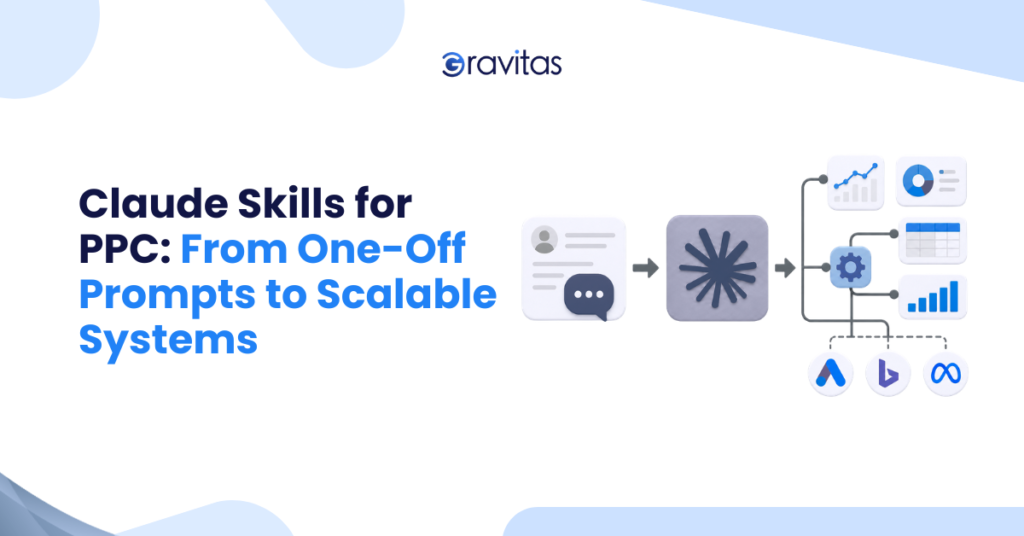
Instead of asking AI to perform isolated tasks, marketers are designing structured frameworks that generate ads, organize keywords, analyze campaign performance, and support optimization decisions continuously.
The result is not just faster execution. It’s a smarter and more scalable way to run paid advertising.
What are Claude’s skills for PPC?
Claude skills for PPC are structured AI workflows created using Anthropic’s Claude platform to automate repetitive advertising tasks while maintaining consistency and strategic control.
Unlike traditional prompting, Claude skills are designed to work like operational systems.
A standard AI prompt might look like this:
“Write 10 Google Ads headlines for a CRM software company.”
A Claude skill-based workflow looks very different.
It includes:
- Defined campaign goals
- Audience targeting rules
- Brand tone instructions
- Ad structure requirements
- Conversion-focused CTAs
- Output formatting systems
- Testing logic
That difference matters.
One-off prompts generate content.
Claude skills generate repeatable campaign operations.
This is why modern PPC teams are increasingly adopting AI-driven workflows instead of using AI only as a writing assistant. Businesses exploring broader automation trends are also investing in AI tools for digital marketing to improve campaign efficiency across departments.
Why Claude Skills for PPC Matter in 2026
Paid advertising has become significantly harder to manage manually.
Campaigns now involve:
- Multi-platform targeting
- Dynamic audience segmentation
- Continuous creative testing
- Real-time bidding adjustments
- Search intent mapping
- Performance forecasting
- Automated budget distribution
For growing brands and agencies, scaling PPC operations without automation is becoming unrealistic.
The Problem With Modern PPC Workflows
Most PPC teams still operate with fragmented processes:
- Separate keyword research workflows
- Manual ad testing
- Inconsistent reporting
- Repeated creative requests
- Slow optimization cycles
Even when AI is used, it’s often disconnected from the larger campaign process.
That creates bottlenecks.
Claude skills solve this by turning scattered PPC activities into connected workflows.
Instead of repeatedly instructing AI every day, marketers create systems that:
- Generate outputs consistently
- Follow campaign logic automatically
- Reduce repetitive work
- Improve execution speed
- Support faster scaling
AI Is Becoming an Operational Layer
The biggest shift in PPC isn’t AI-generated copy.
It’s AI-assisted operations.
Teams are increasingly using Claude skills to:
- Standardize campaign structures
- Automate recurring PPC tasks
- Build internal optimization systems
- Reduce dependence on manual execution
This operational advantage becomes more valuable as advertising complexity increases.
According to Google Ads automation insights, automation is now central to how modern campaigns are managed and optimized across search advertising ecosystems.
From One-Off Prompts to Claude Skills for PPC Systems
Why One-Off Prompts Eventually Fail
Most marketers start with isolated prompts because they’re easy.
But over time, serious limitations appear.
Inconsistent Outputs
AI-generated content changes depending on how prompts are written.
That means:
- Different tones across campaigns
- Misaligned CTAs
- Inconsistent messaging
- Unstable ad quality
For brands managing multiple campaigns, inconsistency becomes a major performance issue.
Repetition Slows Teams Down
PPC teams repeatedly ask AI for:
- Headlines
- Descriptions
- Keyword groups
- Audience angles
- Retargeting copy
- Reporting summaries
Without systems, the process becomes repetitive and inefficient.
Scaling Becomes Difficult
A freelancer running 5 campaigns can manage prompts manually.
An agency managing 200 campaigns cannot.
This is where reusable Claude skills become essential.
Building Reusable Claude Skills for PPC
Claude skills work best when they are treated like operational frameworks instead of content generators.
Prompt Templates Become Systems
Strong PPC systems include reusable prompt frameworks that define:
- Business type
- Offer positioning
- Customer pain points
- Audience intent
- Platform requirements
- Conversion objectives
Instead of rewriting prompts daily, teams reuse proven structures.
Structured Workflows Improve Campaign Consistency
A scalable Claude workflow may include:
- Keyword clustering
- Search intent classification
- Ad copy generation
- Landing page alignment
- A/B testing variations
- Performance analysis
- Optimization recommendations
Each step feeds into the next.
This creates a repeatable system rather than isolated tasks.
Claude Skills Reduce Operational Friction
One of the biggest advantages of Claude skills for PPC is operational clarity.
Instead of scattered workflows:
- Teams follow standardized processes
- Outputs become easier to review
- Campaign launches become faster
- Scaling becomes more predictable
Key Use Cases of Claude Skills for PPC
Ad Copy Generation Using Claude Skills for PPC
This is where most marketers begin.
But advanced Claude workflows go beyond generating random ad text.
They can create:
- Platform-specific ads
- Funnel-stage messaging
- Emotional angle variations
- Offer-based campaigns
- Brand-aligned creative systems
High-Converting Headlines at Scale
Claude skills can generate headlines based on:
- Search intent
- User psychology
- Competitor positioning
- Pain-point analysis
- Conversion goals
Instead of brainstorming manually, teams can generate dozens of structured ad variations within minutes.
Faster A/B Testing
Testing is essential in PPC.
Claude workflows make it easier to:
- Generate multiple creative angles
- Test CTA variations
- Compare emotional triggers
- Experiment with offer positioning
This dramatically improves testing velocity.
Keyword Research Automation
Keyword research is one of the most repetitive PPC activities.
Claude skills help automate:
- Keyword clustering
- Search intent mapping
- Negative keyword identification
- Topic segmentation
- Long-tail keyword generation
Intent-Based Keyword Grouping
Instead of organizing keywords manually, Claude can classify search terms into categories such as:
- Commercial intent
- Transactional intent
- Informational searches
- High-conversion opportunities
This creates cleaner campaign structures and stronger targeting.
Businesses improving targeting strategies can also review this keyword research guide for deeper SEO and PPC keyword planning techniques.
Campaign Optimization Workflows
Optimization is where Claude’s skills become especially powerful.
Modern PPC campaigns generate massive amounts of data. Reviewing everything manually takes time.
Claude workflows can analyze:
- CTR trends
- Conversion patterns
- Cost fluctuations
- Audience performance
- Creative fatigue signals
- Budget inefficiencies
AI-Assisted Optimization Decisions
Claude can support campaign managers by:
- Identifying underperforming segments
- Suggesting bid adjustments
- Recommending creative refreshes
- Highlighting wasted spend areas
This speeds up optimization cycles without replacing strategic oversight.
How to Build Claude Skills for PPC Systems
Creating scalable Claude systems requires structure.
Start With Clear Campaign Objectives
Every workflow should begin with a defined goal:
- Lead generation
- Revenue growth
- Lower CPA
- Higher ROAS
- Traffic acquisition
- Product sales
Without clear objectives, AI outputs become generic.
Create Repeatable Prompt Frameworks
Strong frameworks define:
- Input rules
- Output formats
- Tone guidelines
- Audience instructions
- CTA structures
- Testing requirements
This creates consistency across campaigns.
Standardize Inputs and Outputs
The best AI workflows rely on standardized data.
Inputs may include:
- Product details
- Customer personas
- Target keywords
- Competitor positioning
- Offer messaging
Outputs should follow predictable structures for easier implementation.
Integrate Claude Into Existing PPC Operations
Claude skills become more valuable when connected with:
- Analytics dashboards
- Reporting systems
- CRM platforms
- PPC management tools
- Performance tracking workflows
This transforms AI from a content tool into an operational layer.
Marketers can also review PPC campaign optimization tips to strengthen long-term optimization strategies.
Benefits of Claude Skills for PPC
Faster Campaign Execution
Tasks that previously took hours can now happen in minutes.
This includes:
- Ad creation
- Keyword grouping
- Reporting summaries
- Creative testing preparation
Better Campaign Consistency
Structured workflows reduce:
- Messaging inconsistencies
- Tone variations
- Formatting issues
- Process errors
Consistency improves both brand perception and operational efficiency.
Improved Campaign Scalability
Claude skills allow agencies and marketing teams to manage larger campaign volumes without dramatically increasing team size.
That scalability becomes a major competitive advantage.
Reduced Manual Workload
By automating repetitive PPC tasks, marketers can focus more on:
- Strategy
- Creative direction
- Offer positioning
- Growth planning
- Performance analysis
Best Practices for Claude Skills for PPC
Use Structured Prompts
Detailed prompts outperform vague instructions.
The more context Claude receives, the better the outputs become.
Maintain a Centralized Prompt Library
Successful teams build libraries of:
- Ad generation prompts
- Keyword research systems
- Optimization workflows
- Reporting frameworks
This creates repeatable operational processes.
Combine AI With Human Strategy
AI improves execution speed, but strategic decisions still require human judgment.
The best results happen when:
- AI handles repetitive tasks
- Humans guide positioning and strategy
Optimize for Revenue, Not Just Clicks
Many AI-generated campaigns focus too heavily on CTR.
Strong PPC systems prioritize:
- Conversions
- ROAS
- Customer quality
- Revenue growth
Clicks alone do not guarantee profitability.
Start building your Claude skills for PPC today and transform repetitive prompting into scalable advertising systems that drive faster execution, better optimization, and long-term campaign growth.
Conclusion
The future of PPC is not about generating more prompts.
It’s about building smarter systems.
Claude skills for PPC are helping marketers move beyond isolated AI usage and toward structured operational workflows that improve efficiency, consistency, and scalability.
As advertising platforms become more automated and competitive, teams that adopt reusable AI systems will gain a significant advantage in campaign execution and optimization.
The shift has already started.
The question is no longer whether AI belongs in PPC workflows, it’s how effectively marketers can turn AI into scalable systems that produce measurable business outcomes.
FAQs
Claude skills for PPC are reusable AI-powered workflows that automate advertising tasks such as ad creation, keyword research, campaign analysis, and optimization.
Normal prompts are isolated requests, while Claude skills are structured systems designed for repeatable and scalable PPC workflows.
Yes. Claude skills can improve efficiency, testing speed, campaign consistency, and optimization workflows, helping teams scale campaigns more effectively.
No advanced technical expertise is required. Most marketers can build Claude workflows using structured prompts and clear campaign frameworks.
Claude skills can support campaigns across platforms such as Google Ads, Meta Ads, Microsoft Advertising, and other paid advertising ecosystems.