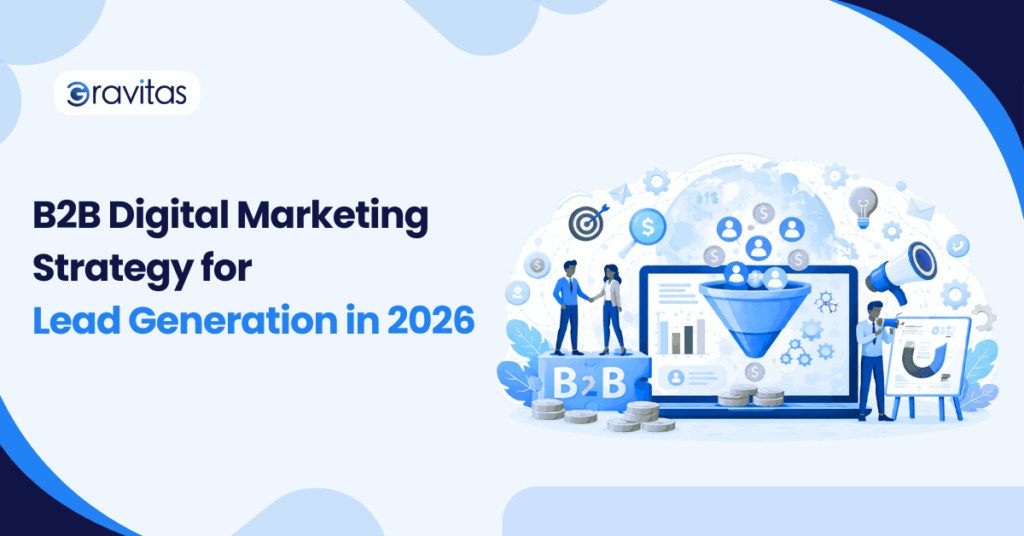
Many B2B companies invest heavily in marketing but still struggle to generate consistent, high-quality leads. The issue is rarely the channel, it is usually the lack of a clear B2B Digital Marketing Strategy that connects marketing efforts directly to revenue.
A successful strategy does more than create visibility. It builds a system that attracts the right companies, nurtures decision-makers, and converts interest into qualified opportunities. Businesses that approach marketing strategically treat it as a growth engine rather than a collection of campaigns.
At the same time, several digital marketing trends 2026 are reshaping how B2B buyers evaluate vendors. Decision-makers expect deeper insights, proof of expertise, and personalized engagement before they even consider a conversation. Companies that adapt to these expectations position themselves as trusted partners rather than just service providers.
Why a Strong B2B Digital Marketing Strategy Is Essential in 2026
Generating leads in B2B markets has become more complex because buying decisions rarely happen instantly. Instead, companies conduct an extended evaluation process before selecting a partner.
Changing buyer behavior
B2B buyers prefer researching solutions independently. They explore blogs, reports, LinkedIn insights, and case studies to understand potential solutions before reaching out to vendors.
Longer B2B sales cycles
Major business decisions involve multiple stakeholders like executives, finance teams, and technical experts. Each of these stakeholders evaluates the solution from a different perspective, which naturally extends the decision process.
Digital marketing trends 2026
Advanced analytics, targeted advertising, and highly personalized content are becoming central to modern marketing strategies. Companies that use data to understand their audience can create campaigns that speak directly to real business problems.
Without a structured strategy, marketing activities may generate traffic but fail to produce meaningful pipeline growth.
Core Elements of a B2B Digital Marketing Strategy
A strong strategy begins with clarity about who your business wants to reach and how those organizations make decisions.
Defining Your B2B Lead Generation Strategy
A well-structured B2B lead generation strategy focuses on attracting organizations that are genuinely likely to become clients.
Instead of focusing only on increasing website traffic, businesses should concentrate on creating opportunities to engage potential clients through meaningful content and valuable insights.
Effective lead generation often includes:
- Insight-driven blogs and industry articles
- Research reports or downloadable resources
- Landing pages designed around specific challenges
- CRM systems that track and qualify leads
When these elements work together, marketing becomes a system that continuously introduces your brand to potential clients.
Mapping the B2B Marketing Funnel
Understanding the B2B marketing funnel helps businesses create the right content and campaigns for each stage of the buyer journey.
Awareness stage
Companies first discover your brand through search results, industry content, or professional networks.
Consideration stage
Prospects begin evaluating potential solutions by exploring case studies, whitepapers, webinars, or detailed service pages.
Decision stage
Decision-makers assess whether your organization has the expertise to solve their problem effectively.
When marketing efforts address each stage of this funnel, prospects move naturally from awareness to serious engagement.
Identifying Ideal Customer Profiles (ICP)
Not every company will benefit from your services. That is why defining an Ideal Customer Profile is essential.
An ICP helps identify organizations that are most likely to become long-term clients.
Typical ICP characteristics include:
- Industry and market sector
- Company size and revenue level
- Operational complexity
- Type of decision-makers involved
- Business challenges they commonly face
Clear ICP definitions help marketing teams focus their efforts on companies that match the business’s strengths.
Aligning Marketing With Sales Goals
Many organizations treat marketing and sales as separate functions, which often leads to inefficiencies.
A strong strategy ensures both teams work toward shared goals by:
- Establishing clear lead qualification criteria
- Sharing data through CRM platforms
- Setting common revenue targets
- Collaborating on account targeting
This alignment ensures that marketing efforts translate into real business opportunities rather than just increased visibility.
Top B2B Digital Marketing Strategy Tactics for 2026
With the right strategic foundation, several marketing approaches can significantly improve lead generation results.
Content-Driven Lead Generation
Content remains one of the most effective ways to attract and educate potential clients.
Decision-makers often prefer learning about industry challenges through informative content before engaging with vendors.
Valuable content formats include:
- Industry analysis and insights
- Case studies demonstrating real results
- Detailed guides and frameworks
- Educational webinars and discussions
Consistently publishing valuable content positions a business as a trusted authority within its industry.
SEO and Thought Leadership
Search engines remain a powerful channel for attracting potential clients who are actively researching solutions.
SEO combined with thought leadership helps companies reach prospects during the early stages of their research process.
Businesses that publish high-quality insights, expert commentary, and practical strategies often become trusted sources of information within their industry.
Over time, this credibility attracts more qualified prospects organically.
Account-Based Marketing (ABM) for High-Value Leads
When targeting large enterprises or high-value clients, Account-Based Marketing (ABM) can be particularly effective.
Instead of marketing broadly to thousands of companies, account-based marketing (ABM) focuses on a carefully selected group of organizations that match your ideal client profile.
This approach typically involves:
- Personalized campaigns for specific companies
- Industry-specific insights and content
- Close collaboration between marketing and sales teams
- Direct engagement with key decision-makers
ABM allows businesses to concentrate their efforts on opportunities that have the greatest potential impact.
Performance Marketing for B2B Campaigns
While organic marketing builds long-term visibility, performance marketing for B2B can accelerate lead generation by reaching targeted audiences through paid campaigns.
Performance marketing focuses on measurable outcomes such as leads, conversions, and pipeline growth.
LinkedIn Ads for B2B
LinkedIn is one of the most powerful advertising platforms for B2B companies because it allows highly specific targeting.
Businesses can target audiences based on:
- Job roles and seniority levels
- Industry sectors
- Company size
- Professional interests
This precision makes LinkedIn particularly effective for reaching decision-makers.
Retargeting & Email Automation
Many prospects interact with several pieces of content before making a decision.
Retargeting campaigns help maintain visibility with people who previously visited your website or engaged with your content.
Email automation supports this process by nurturing leads through:
- Educational insights
- Case studies and success stories
- Industry updates
- Invitations to webinars or consultations
This consistent communication gradually builds trust and keeps your brand top-of-mind.
How to Optimize Your B2B Digital Marketing Strategy for Conversions
Generating leads is only one part of the marketing process. Businesses must also focus on converting those leads into clients.
Key optimization approaches include:
Funnel-based content creation
Content should address specific questions prospects have at each stage of the buying journey.
Data-driven campaign optimization
Marketing campaigns should be continuously refined based on analytics and performance data.
Lead nurturing automation
Automation tools help maintain ongoing communication with prospects throughout the decision cycle.
Conversion tracking
Tracking systems help businesses identify which marketing activities generate the highest-quality leads.
These practices help transform marketing into a predictable lead generation system.
Measuring the Success of Your B2B Digital Marketing Strategy
To evaluate whether a marketing strategy is working, businesses must track the right performance metrics.
Cost Per Lead
This metric measures how efficiently marketing campaigns generate new leads.
Lead Quality & SQLs
The number of Sales Qualified Leads (SQLs) indicates whether the leads generated are genuinely valuable to the sales team.
Customer Acquisition Cost (CAC)
Customer Acquisition Cost calculates the total investment required to convert a prospect into a paying customer.
ROI & Revenue Attribution
Revenue attribution reveals which marketing channels and campaigns contribute directly to business growth.
Organizations that track these metrics gain valuable insights that help refine their strategy over time.
How Gravitasin.com Builds High-Performance B2B Digital Marketing Strategy
At Gravitasin.com, digital marketing is approached as a structured growth system rather than isolated marketing activities.
The process includes:
- Strategy-first planning aligned with business objectives
- Integration of SEO, content marketing, and performance campaigns
- Account-based marketing initiatives for high-value clients
- Continuous optimization using analytics and performance data
This approach ensures that marketing efforts contribute directly to pipeline growth and measurable revenue outcomes.
Conclusion – Future-Proof Your B2B Digital Marketing Strategy
A well-designed B2B Digital Marketing Strategy helps businesses move beyond unpredictable marketing efforts and build a consistent pipeline of qualified opportunities.
Companies that invest in strategic planning, targeted campaigns, and data-driven optimization position themselves for sustainable growth. By focusing on valuable insights, strong customer understanding, and measurable performance, marketing becomes a powerful driver of long-term business success.
FAQs
A B2B digital marketing strategy is a structured plan that uses online channels such as content marketing, SEO, and paid advertising to attract and convert business clients.
B2B lead generation involves attracting decision-makers through valuable content, targeted campaigns, and personalized engagement, then nurturing them until they become qualified opportunities.
SEO, LinkedIn marketing, content marketing, email automation, and performance advertising are among the most effective channels.
Account-Based Marketing focuses on targeting high-value companies with personalized campaigns, making it highly effective for enterprise-level B2B sales.
Gravitas helps businesses build strategic digital marketing systems that generate qualified leads, improve conversion rates, and drive measurable revenue growth.
CTA
Looking to build a powerful B2B Digital Marketing Strategy in 2026?
Partner with Gravitas to generate high-quality leads and turn marketing into predictable revenue.