A business can generate leads every week and still have no clear idea what its sales will look like next month.
That usually happens when the sales process is being managed as a series of disconnected activities. Marketing generates leads, sales reaches out to prospects, someone follows up when they have time, and opportunities are updated in the CRM whenever there is a major development.
The result is a pipeline that is active, but not predictable.
A reliable B2B sales pipeline needs more than a steady supply of contacts. Businesses need a clear understanding of who they want to reach, a consistent way to engage those prospects, a process for identifying genuine buying opportunities, and a system for keeping those opportunities moving.
This is where Gravitas’ Sales-as-a-Service approach fits in. By supporting different stages of the sales process from prospecting and lead generation to qualification, outreach, opportunity management, and closing Gravitas helps businesses create a more structured approach to B2B sales.
What Makes a B2B Sales Pipeline Predictable?
Predictability comes from consistency.
A business should be able to look at its pipeline and understand where opportunities are coming from, how many are genuinely qualified, what stage they are in, and what needs to happen next.
That starts with consistent prospecting. If new prospects enter the pipeline only when the existing pipeline starts running low, revenue will naturally become difficult to forecast.
Qualification is equally important. A pipeline containing 500 unqualified leads may be less valuable than one containing 100 prospects with a clear business need and realistic buying potential.
The sales process itself also needs structure. Clearly defined sales pipeline stages make it easier for salespeople and managers to understand what qualifies an opportunity to move forward.
Follow-up plays another important role. B2B decisions rarely happen after one conversation, so prospects need timely and relevant communication throughout the buying process.
Finally, businesses need reliable information. Accurate CRM data makes it possible to see which opportunities are active, which have gone cold, and where sales teams are losing momentum.
A predictable pipeline, therefore, is not about predicting every deal. It is about creating enough consistency and visibility to make better sales decisions.
Why Businesses Struggle to Build a Predictable B2B Sales Pipeline
The gap between having a pipeline and having a productive pipeline often comes down to a few recurring problems.
Inconsistent Prospecting
Prospecting tends to slow down when salespeople become busy with existing opportunities.
That feels logical in the short term, but it creates a problem later. Once those opportunities close, there may not be enough new prospects ready to replace them.
This is why businesses often experience sudden peaks and drops in sales activity.
Consistent sales outreach keeps prospecting active even when the current pipeline looks healthy. It creates a better balance between working today’s opportunities and creating tomorrow’s.
Poor Lead Qualification
A lead is not automatically a sales opportunity.
Someone may download a resource, respond to an email, attend a webinar, or request information without having an immediate intention to buy.
When every lead is pushed into the sales pipeline, salespeople spend time chasing prospects that may never progress.
A stronger qualification process looks at whether the prospect is a good fit, has a relevant business need, has buying potential, and can realistically move toward a decision.
This helps sales teams focus on sales-qualified leads rather than simply working through a large database.
Inconsistent Follow-Ups
A prospect might be interested but not ready to make a decision today.
They may need to speak with their leadership team, compare vendors, get budget approval, or gather information from another department.
Without a structured sales follow-up process, these opportunities can quietly disappear.
The issue is often not a lack of interest. It is a lack of continuity.
A good follow-up process keeps the conversation relevant and gives both the salesperson and prospect a clear next step.
Limited Pipeline Visibility
Sales managers need more than a list of open opportunities.
They need to know which deals are genuinely active, which have stalled, which require immediate attention, and which are unlikely to close.
That becomes difficult when CRM records are outdated or opportunity information is scattered across different tools.
Poor CRM data can make a pipeline appear healthier than it really is.
Reliable pipeline visibility helps businesses identify sales pipeline bottlenecks early and take action before those bottlenecks affect revenue.
How Gravitas Helps Build a More Predictable B2B Sales Pipeline
Gravitas approaches sales as a connected process rather than treating lead generation, outreach, and opportunity management as separate services.
Through its Sales-as-a-Service model, Gravitas supports businesses across the sales journey, including ICP development, database creation, outreach, lead generation, qualification, discovery, need analysis, presentations, objection handling, proposals, negotiation, closing, and sales reporting.
The advantage of this approach is that each activity is connected to the next. The objective is not simply to create more activity at the top of the funnel, but to build a stronger path from prospecting to revenue.
Defining the Ideal Customer Profile
The first question should not be “How many leads do you need?”
It should be:
“Which companies are most likely to become customers?”
Gravitas starts by understanding the business, its solution, target market, existing customers, and sales objectives before defining the ideal customer profile.
This can include company size, industry, geography, business model, technology environment, decision-makers, and the problems the solution is designed to address.
This step has a direct impact on B2B lead generation.
If the target market is too broad, sales teams may spend time contacting companies that have little need for the product or service.
A well-defined ICP gives the entire sales process a clearer direction.
Building a Targeted Prospect Database
Once the target customer is clear, the next challenge is finding the right companies.
This is where the quality of a prospect database becomes more important than its size.
Imagine a sales team receives a list of 10,000 contacts. If most of those companies do not match the target market, the team has not gained 10,000 opportunities. It has gained 10,000 records that still need filtering.
Gravitas focuses on building targeted prospect databases around the defined customer profile, helping businesses identify relevant companies and decision-makers for their sales activity.
This gives sales teams a stronger starting point for B2B lead generation and sales outreach.
Generating and Qualifying B2B Leads
Generating interest is only one part of the process.
The real value comes from identifying which prospects have a realistic chance of becoming customers.
Gravitas combines B2B lead generation with lead qualification to help separate relevant prospects from low-fit leads.
Qualification considers factors such as the prospect’s business need, authority, budget, and timeline. Gravitas uses the BANT framework which means Budget, Authority, Need, and Timeline as part of its lead qualification approach.
This prevents sales teams from treating every response as an opportunity.
Instead, the focus moves toward prospects that have stronger buying potential and a clearer reason to continue the conversation.
Businesses looking to strengthen this part of their sales process can explore Gravitas B2B lead generation services.
Executing Consistent Sales Outreach
Once the right prospects have been identified, the next challenge is starting a conversation.
Effective sales outreach is not about sending the same message to every contact in a database.
A business decision-maker is more likely to respond when the message connects with something relevant to their situation.
Gravitas supports outreach across channels such as email, LinkedIn, and calls, with messaging tailored to the target audience and business context.
For example, the message used to approach a company that is actively expanding into a new market should be different from the message used for a business that is struggling with operational inefficiencies.
The purpose of outreach is to create a relevant conversation that can progress into the next stage of the buying process.
Managing Sales Follow-Ups
A first conversation does not always produce an immediate opportunity.
Sometimes the prospect needs more information. Sometimes another decision-maker needs to be involved. Sometimes the timing is not right.
That is why follow-up needs to be part of the sales process.
Gravitas supports follow-up throughout the sales cycle, including tracking conversations, addressing objections, confirming requirements, and maintaining communication with prospects.
Instead of repeatedly asking for an update, follow-ups can be based on what happened in the previous conversation.
If the prospect raised a pricing concern, the next interaction should address that concern.
If they requested a product demonstration, the next step should help move that demonstration forward.
This makes sales follow-up more purposeful and helps prevent qualified opportunities from losing momentum.
Managing Opportunities Through the Sales Pipeline
Once a prospect becomes a genuine opportunity, sales activity needs to become more structured.
The team needs to understand where the opportunity stands, what the prospect needs, who is involved in the decision, and what could prevent the deal from progressing.
Gravitas supports opportunity management across activities such as discovery calls, need analysis, solution presentations, objection handling, proposals, negotiation, and closing.
This gives businesses better visibility into the actual sales journey rather than simply knowing that an opportunity exists in the CRM.
Clear sales pipeline stages also help managers distinguish between a recently qualified opportunity and one that is already close to a buying decision.
Improving Pipeline Performance
Pipeline improvement starts with knowing what the numbers are actually saying.
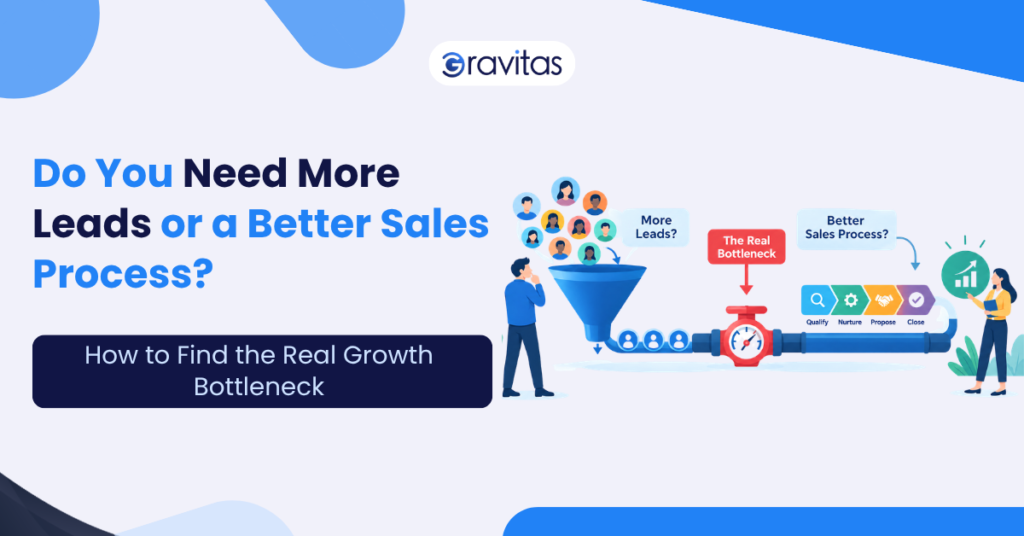
Suppose a business generates plenty of leads, but very few become qualified opportunities.
The problem may be targeting or qualification.
If plenty of qualified opportunities are being created but very few reach the proposal stage, the issue may be the sales conversation, requirements gathering, or buyer engagement.
If proposals are regularly sent but deals rarely close, pricing, objections, decision-making, or value communication may need attention.
This is why Gravitas looks beyond lead volume and focuses on measures such as sales conversion rate, sales velocity, pipeline coverage, opportunity movement, and sales pipeline bottlenecks.
The goal is to understand where the process is losing momentum and improve that specific part of the sales journey.
The Gravitas Approach to B2B Sales Pipeline Management
A strong sales pipeline is not created by improving one activity in isolation.
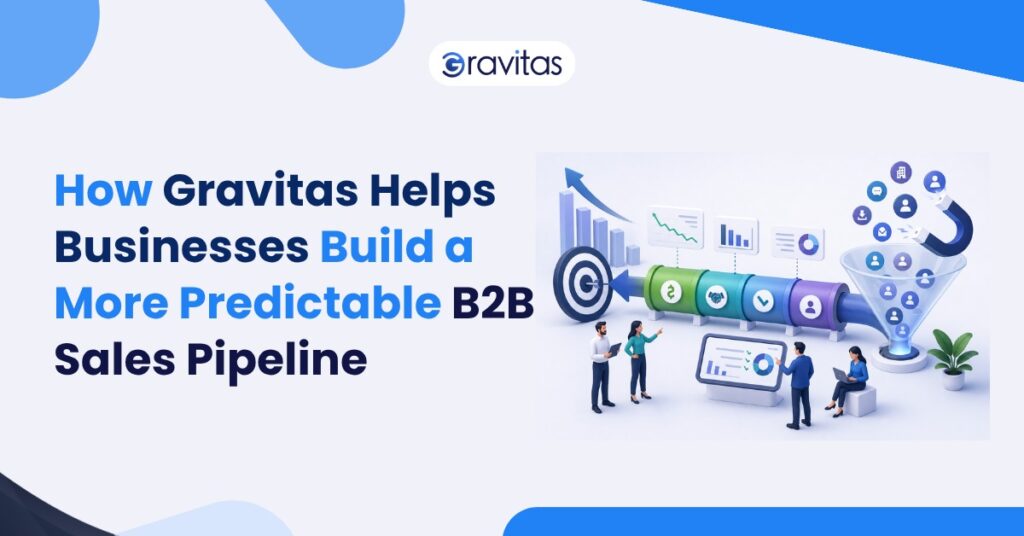
The ICP influences the prospect database.
The prospect database influences outreach.
Outreach determines which prospects enter conversations.
Qualification determines which conversations become opportunities.
Follow-up influences whether those opportunities continue moving.
Opportunity management determines how effectively those deals progress toward closure.
Finally, pipeline analysis shows where the process needs improvement.
This connected approach allows businesses to look at the entire sales process rather than trying to fix pipeline problems by simply increasing lead volume.
How a Structured Sales Process Improves Pipeline Predictability
A structured sales process gives businesses greater visibility into what is happening and why.
When the target market is clearly defined, sales teams spend less time pursuing poor-fit accounts.
When qualification is consistent, the pipeline contains more meaningful opportunities.
When outreach is systematic, businesses are less dependent on occasional bursts of prospecting.
When follow-ups are tracked, fewer opportunities disappear because communication stopped.
When opportunity stages are clearly defined, managers can identify deals that are moving and those that have stalled.
And when performance is measured across the pipeline, businesses can make decisions based on actual sales data rather than assumptions.
The result is not simply a larger pipeline.
It is a pipeline that is easier to understand, manage, and improve.
When Should Businesses Consider Sales-as-a-Service?
Sales-as-a-Service can be useful when a business needs more sales capacity but does not necessarily want to build a larger internal team immediately.
For example, an internal team may be strong at handling product demonstrations and closing but have limited time for prospect research and outbound outreach.
Another business may have plenty of leads but struggle to qualify and follow up with them consistently.
A growing company entering a new market may also need additional sales expertise without having the time to build an entire sales function from scratch.
These are situations where external sales support can add value.
Gravitas Sales-as-a-Service offering supports businesses across prospecting, database creation, lead generation, outreach, qualification, opportunity management, sales execution, and reporting.
The aim is to complement the internal team and create greater consistency across the sales process.
Why Choose Gravitas for B2B Sales Pipeline Support?
Choosing a sales partner should not come down to how many leads they promise to generate.
The more important question is what happens to those leads afterward.
Gravitas brings together the key activities needed to manage a B2B sales process—from defining the target customer and identifying prospects to engaging decision-makers, qualifying opportunities, managing conversations, handling objections, progressing proposals, and supporting deal closure.
This means businesses can get support across the sales process instead of having to coordinate separate providers for prospecting, lead generation, outreach, and pipeline management.
The approach is particularly useful for businesses that want to increase sales activity while keeping the process structured and measurable.
Build a More Predictable B2B Sales Pipeline with Gravitas
A predictable pipeline does not start with a bigger contact list.
It starts with knowing which businesses are worth pursuing and having a consistent process for turning those prospects into genuine sales opportunities.
That means better targeting, relevant outreach, proper qualification, timely follow-ups, and disciplined opportunity management.
Gravitas brings these activities together through its Sales-as-a-Service approach, helping businesses create a more structured and manageable sales process.
Is your B2B sales pipeline inconsistent or difficult to scale?
Talk to Gravitas about building a more structured and predictable sales process.
Frequently Asked Questions About B2B Sales Pipelines
Start with a clear ICP, targeted prospecting, consistent outreach, proper qualification, and structured follow-ups. Regular pipeline reviews help identify bottlenecks.
It is the process of tracking prospects and opportunities as they move through different sales stages, from initial engagement to conversion.
It brings relevant prospects into the sales process. Proper qualification then helps identify which prospects have genuine sales potential.
Sales-as-a-Service provides external support across activities such as prospecting, lead generation, outreach, qualification, opportunity management, and closing.
Improve targeting, qualification, outreach, follow-ups, CRM visibility, and opportunity management. Then use pipeline data to identify areas that need improvement.