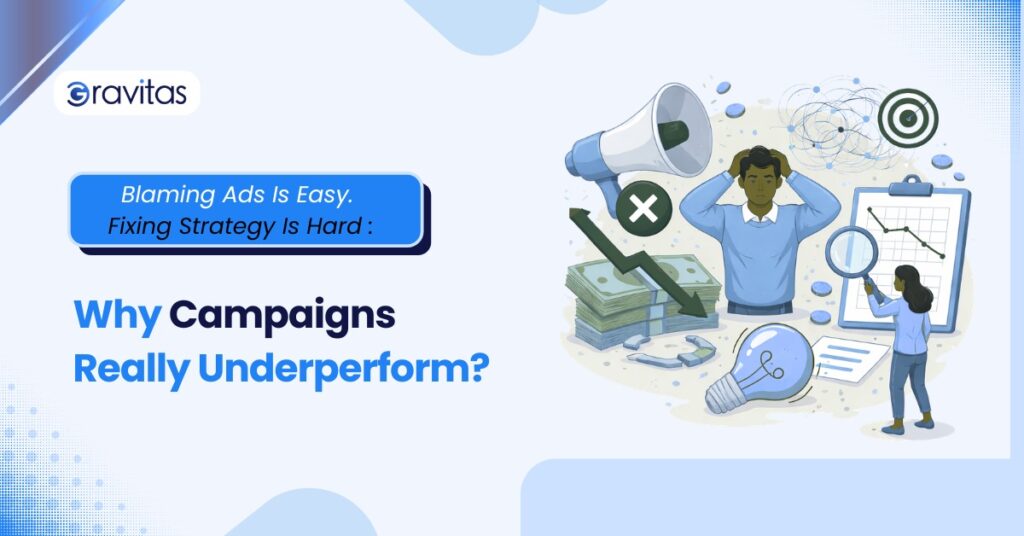
Why Campaigns Underperform : When marketing campaigns fail to deliver results, the first instinct for many businesses is to blame the ads. Marketers often assume that the platform algorithm has changed, the audience is not responding, or that the ad creatives simply didn’t perform well.
However, the reality is that ads are rarely the root cause of poor campaign performance. Most campaigns struggle because of strategic gaps in targeting, messaging, or funnel design.
Ads act as amplifiers. If the underlying marketing strategy is weak, advertising will only magnify those weaknesses.
In 2026, successful campaigns depend on strong strategy, audience understanding, and continuous optimization.
Understanding why campaigns underperform helps businesses focus on fixing the right problems and building marketing campaigns that generate consistent ROI.
Why Campaigns Underperform in 2026
Many businesses immediately blame advertising platforms such as Google or Meta when campaigns fail to generate results.
They assume the platform algorithm has changed or that ad costs have increased, leading to poor performance. While these factors can influence campaigns, they are rarely the main reason behind low ROI campaigns.
The real issue often lies in strategy gaps.
Common marketing strategy mistakes include:
- Launching campaigns without clear objectives
- Targeting audiences too broadly
- Using generic messaging that does not resonate with users
- Sending traffic to poorly optimized landing pages
These gaps lead to marketing campaign performance issues, where ads generate traffic but fail to convert.
Changing Digital Landscape
Digital marketing continues to evolve rapidly, making it more challenging for businesses to maintain strong campaign performance.
Several factors contribute to this shift:
Increased competition
More brands are investing in paid advertising, which increases competition and drives up costs.
Smarter algorithms
Advertising platforms now prioritize user relevance, engagement, and quality experiences.
Higher user expectations
Modern consumers expect personalized messaging, fast websites, and clear value propositions.
According to digital marketing performance trends, businesses that combine strong targeting, data insights, and clear messaging achieve significantly better marketing outcomes.
Top Reasons Why Campaigns Underperform
1. Poor Audience Targeting
Audience targeting problems are one of the biggest reasons campaigns fail.
If ads reach the wrong people, even the most creative campaign will struggle to generate conversions.
Common targeting issues include:
- Choosing audience segments that are too broad
- Not using customer data effectively
- Ignoring behavioral signals and buyer intent
Successful campaigns rely on data-driven targeting and audience segmentation to ensure the right message reaches potential customers.
Without proper audience insights, campaigns often result in paid ads not converting despite high impressions or clicks.
2. Weak Value Proposition
Even with strong targeting, campaigns can still underperform if the messaging fails to communicate value.
A weak value proposition often leads to low engagement and poor campaign results.
Common problems include:
- No clear messaging about the product or service
- Lack of differentiation from competitors
- Focusing on product features instead of customer benefits
High-performing campaigns clearly explain how the product solves a problem or improves the customer’s situation.
3. Ineffective Funnel Strategy
Another major reason why campaigns underperform is a poorly designed marketing funnel.
Many businesses focus heavily on ads but overlook the customer journey after the click.
Typical funnel issues include:
- Ads that promise something the landing page does not deliver
- Landing pages that lack clear calls to action
- A disconnected customer journey from awareness to conversion
Implementing strong conversion rate optimization services helps businesses improve funnel performance and turn traffic into leads or customers
4. Lack of Creative Strategy
Creative quality is critical for campaign success.
In a crowded digital environment, generic ads struggle to capture attention.
Common creative issues include:
- Poor ad creatives that fail to stand out
- Messaging that focuses only on features
- Lack of storytelling or emotional engagement
Successful campaigns combine strong visuals, compelling narratives, and clear value propositions to capture audience attention.
5. Ignoring Data and Analytics
Another common cause of poor campaign results is the absence of proper tracking and analytics.
Without data, marketers cannot perform effective campaign performance analysis.
Typical problems include:
- No tracking tools installed
- No monitoring of key metrics
- No optimization based on campaign performance
Businesses that follow marketing analytics best practices can identify performance gaps and improve campaign results through data-driven decisions.
Why Fixing Strategy Matters More Than Ads
Ads Amplify Strategy, Not Replace It
Advertising platforms do not replace strategy, they amplify it.
When a campaign has a strong strategic foundation, ads can significantly improve reach and conversions.
Good strategy = better results
Bad strategy = wasted budget
If audience targeting, messaging, and funnel design are aligned, advertising becomes a powerful growth driver.
However, if those elements are weak, increasing ad spend will only increase losses.
Long-Term vs Short-Term Thinking
Many businesses approach campaigns with a short-term mindset.
They expect immediate results from paid advertising without investing in long-term marketing strategy.
Sustainable marketing performance requires:
- Continuous optimization
- Strong brand positioning
- Ongoing audience insights
Businesses that focus on long-term growth instead of quick wins achieve more consistent results from their campaigns.
How to Fix Why Campaigns Underperform
Step 1: Define Clear Goals and KPIs
Every campaign should start with clearly defined goals.
Examples include:
Lead generation targets
Conversion rate improvements
Customer acquisition cost limits
Defining measurable KPIs ensures campaigns remain aligned with business objectives.
Step 2: Understand Your Audience Deeply
Strong campaigns begin with a deep understanding of the target audience.
Businesses must analyze:
- Customer pain points
- Buying motivations
- Online behavior patterns
These insights help marketers create messaging that resonates with their audience and improves engagement.
Step 3: Build a Strong Funnel
A strong funnel guides users smoothly from awareness to conversion.
An effective funnel typically includes:
- Awareness-stage content
- Consideration-stage engagement
- Conversion-focused landing pages
A well-structured funnel optimization strategy improves both lead generation and sales outcomes.
Step 4: Improve Messaging and Creatives
Clear messaging is essential for improving campaign performance.
Businesses should communicate:
- The problem their product solves
- The benefits customers receive
Why their solution is different from competitors
Following a strong content marketing strategy guide helps brands develop more engaging and persuasive messaging.
Step 5: Test, Analyze, and Optimize Continuously
High-performing campaigns rely on continuous improvement.
Important optimization techniques include:
- A/B testing different ad creatives
- Testing multiple landing page designs
- Making data-driven decisions based on campaign results
Continuous ad campaign optimization ensures marketing strategies evolve and improve over time.
Common Mistakes to Avoid
Over-Reliance on Paid Ads
Paid advertising should support a broader marketing strategy that includes SEO, content marketing, and brand building.
Ignoring Customer Journey
Customers rarely convert after seeing a single advertisement. They interact with multiple touchpoints before making a decision.
Understanding the full customer journey improves campaign performance.
Not Aligning Marketing and Sales
Marketing teams generate leads, while sales teams convert them into customers.
When these teams operate independently, valuable insights about customer needs and objections may be lost.
Chasing Vanity Metrics
Metrics such as impressions and clicks may look impressive but do not necessarily reflect business success.
Businesses should prioritize meaningful metrics like:
- Conversion rates
- Customer acquisition cost
- Return on investment
Future of Campaign Performance in 2026
Campaign performance is increasingly influenced by emerging marketing technologies.
Key trends shaping the future include:
- AI-driven campaign optimization
- Predictive analytics for performance forecasting
- Hyper-personalization based on user behavior
- Data-first marketing strategies
Businesses that adopt these approaches will be better positioned to achieve stronger marketing outcomes.
Call-To-Action (CTA)
Tired of campaigns that don’t deliver results?
Gravitasin helps businesses fix their strategy and build high-performing campaigns that drive real ROI.
👉 Contact us today to transform your marketing performance:
https://gravitasin.com/contact/
Conclusion
Campaigns don’t fail because of ads, they fail because of weak strategies. In 2026, success depends on understanding your audience, building strong funnels, and continuously optimizing based on data. Instead of blaming platforms, businesses must focus on fixing the foundation of their marketing strategy to achieve sustainable growth.
FAQs
Marketing campaigns often underperform due to poor audience targeting, weak messaging, ineffective funnels, and lack of data-driven optimization.
Ads are rarely the main issue. They amplify the strategy behind the campaign, so weak strategy leads to poor results.
Improving campaign performance requires better audience insights, stronger messaging, optimized funnels, and continuous testing.
Data helps marketers analyze campaign performance, identify problems, and optimize strategies to improve results.
Yes. AI helps marketers analyze large datasets, identify patterns, and optimize campaigns for better performance.