Most companies are not losing money on marketing because they spend too little.
They lose it because they spend without knowing who is actually going to convert.
That gap between activity and outcome is where CAC rises.
In many organizations, campaigns still run on assumptions:
- Broad targeting
- Static funnels
- Delayed insights
By the time results are analyzed, the budget is already spent.
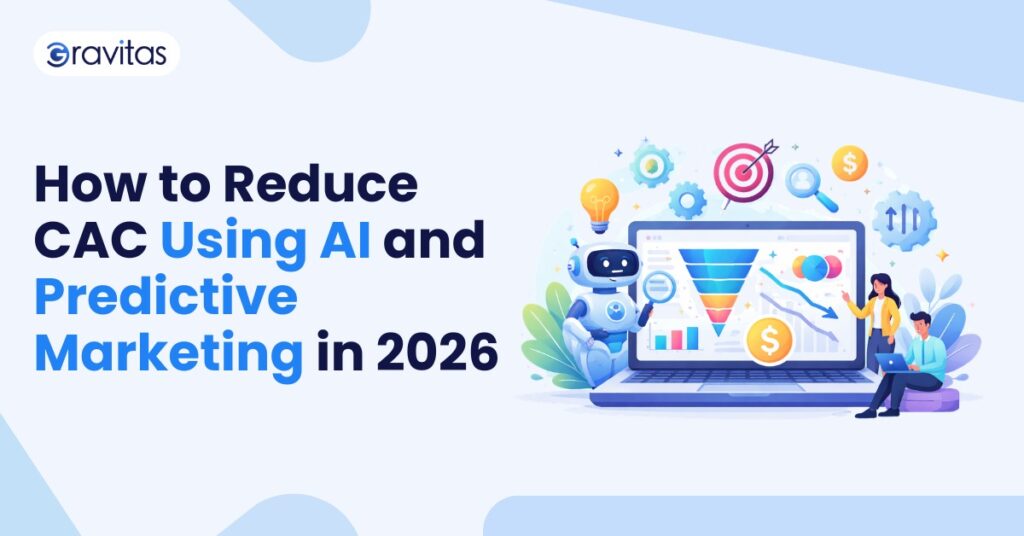
AI and predictive marketing change this completely. They shift marketing from reacting to outcomes to anticipating them before money is spent.
That shift is what reduces CAC.
What is CAC and Why It Matters in 2026?
Understanding Customer Acquisition Cost (CAC)
CAC is not just a metric. It is a reflection of how efficient your entire growth system is.
When CAC increases, it signals one of three problems:
- Poor targeting
- Low conversion efficiency
- Weak alignment between marketing and sales
The formula is simple. The implications are not.
CAC = Total Sales and Marketing Spend ÷ Customers Acquired
If this number keeps rising, scaling becomes expensive and unpredictable.
Why CAC is Increasing for Businesses
The common explanation is rising ad costs. That is only part of the story.
The real issue is structural.
More competition, same targeting logic
Most brands are still targeting audiences in similar ways. This drives up costs without improving outcomes.
More data, less clarity
Teams collect data but do not use it effectively. Decisions are still based on averages, not probabilities.
More tools, disconnected execution
Marketing automation exists, but strategy is fragmented. This creates inefficiencies across the funnel.
What is AI and Predictive Marketing?
Role of AI in Modern Marketing
AI does not just automate tasks. It changes how decisions are made.
Instead of asking:
- Which audience should be targeted?
- Which campaign might work?
AI evaluates:
- Who is most likely to convert
- When they are likely to convert
- What action will influence them
This is where AI in digital marketing becomes practical, not theoretical.
What is Predictive Marketing?
Predictive marketing is the ability to act on future probability instead of past performance.
It uses historical data and behavioral signals to estimate outcomes before they happen.
If you want a deeper breakdown, refer to predictive analytics explained .
This is the foundation of predictive analytics marketing.
How AI Helps Reduce CAC in 2026
AI-Powered Audience Targeting
Most campaigns fail before they begin because they target the wrong audience.
AI changes targeting from selection to filtration.
Instead of choosing who to target, AI removes:
- Low-intent users
- Unlikely converters
- Poor-fit segments
What remains is a smaller, higher-quality audience.
That alone reduces wasted spend significantly and supports customer acquisition cost reduction.
Smart Lead Scoring and Qualification
In many companies, sales teams still treat leads with equal priority.
That creates inefficiency.
Lead scoring AI ranks leads based on conversion probability, not just activity.
This changes how teams operate:
- Less time spent on low-value leads
- Faster movement through the pipeline
- Better conversion ratios
This is where CAC starts improving in measurable terms.
Personalized Marketing Campaigns
Personalization is often misunderstood as inserting a name into an email.
In reality, it is about aligning timing, message, and intent.
AI enables campaigns to adjust based on:
- User behavior
- Stage in the journey
- Channel preference
This improves conversion rate optimization without increasing spend.
Predictive Marketing Techniques to Reduce CAC with AI
Predictive Lead Scoring
Static scoring models become outdated quickly.
Predictive models update continuously based on new data.
This ensures that teams always focus on high-probability opportunities.
Customer Behavior Prediction
With machine learning in marketing, the focus shifts from tracking behavior to anticipating it.
This allows teams to:
- Engage before intent declines
- Trigger actions at the right moment
- Avoid unnecessary follow-ups
The result is lower effort per conversion.
Churn Prediction and Retention
Many businesses focus only on acquisition when discussing CAC.
That is incomplete.
Retention directly impacts acquisition efficiency.
AI identifies early signals of churn and enables intervention before the customer disengages.
These customer retention strategies show how retention improves overall unit economics.
This is where customer lifetime value optimization balances CAC.
Tools and Technologies for AI-Driven CAC Reduction
AI Marketing Automation Platforms
Tools like HubSpot and Salesforce are no longer just automation platforms.
They act as decision systems:
- Prioritizing leads
- Triggering actions
- Optimizing campaigns
When used correctly, they reduce manual dependency and improve consistency.
Data Analytics and CRM Tools
The biggest limitation in most AI initiatives is not technology. It is data structure.
Without centralized and clean data:
- Predictions lose accuracy
- Segmentation becomes weak
- Insights become delayed
For a broader landscape, explore AI marketing tools comparison .
Chatbots and Conversational AI
Speed plays a critical role in conversion.
Delays reduce intent.
AI-driven chat systems engage users instantly, qualify them, and move them forward without waiting for human intervention.
This reduces drop-offs and acquisition cost.
Step-by-Step Guide to Reduce CAC with AI
Step 1: Collect and Structure Customer Data
- Consolidate data from ads, website, CRM, and sales
- Remove duplicate and inconsistent data
- Create a single customer view
- Ensure data is clean before using AI
Step 2: Implement AI in High-Impact Areas
- Start with audience targeting, lead scoring, and campaign optimization
- Avoid applying AI across all processes at once
- Focus on areas that directly influence CAC
- Use tools that integrate with your existing systems
Step 3: Segment Audience Based on Behavior
- Move beyond demographic segmentation
- Group users based on intent and engagement
- Identify high-intent vs low-intent segments
- Prioritize segments with higher conversion probability
Step 4: Continuously Optimize Campaigns
- Monitor campaign performance in real time
- Adjust targeting based on conversion data
- Test creatives, messaging, and channels
- Use AI insights to refine campaigns continuously
Step 5: Measure and Improve ROI
- Track CAC, conversion rate, and customer lifetime value
- Identify which channels deliver efficient acquisition
- Eliminate underperforming campaigns
- Strengthen your data-driven marketing strategy with insights
A strong data-driven marketing strategy depends on this.
Common Mistakes to Avoid
Treating AI as a tool instead of a strategy
Leads to poor outcomes and wasted investment.
Over-reliance on automation
Reduces effectiveness when not guided by insight.
Ignoring sales and marketing alignment
Creates friction and increases acquisition cost.
Separating acquisition from retention
Limits long-term growth potential.
Future of Reduce CAC with AI in 2026 and Beyond
Marketing is moving toward:
- Real-time decision systems
- Probability-based targeting
- Continuous optimization
The advantage will not come from more tools.
It will come from using intelligence earlier in the decision process.
CTA
If reducing CAC is a priority, the focus should not be on adding more campaigns.
It should be on improving how decisions are made within those campaigns.
Gravitasin works with businesses to implement AI-driven marketing systems that improve targeting, conversion efficiency, and acquisition outcomes.
Connect with us to build a more efficient growth system.
Conclusion
Reducing CAC in 2026 is not about cutting budgets.
It is about eliminating inefficiencies.
AI and predictive marketing enable businesses to:
- Focus on high-probability outcomes
- Act earlier in the customer journey
- Improve conversion efficiency
The companies that adapt will not just reduce CAC. They will build predictable and scalable growth systems.
FAQs
Customer Acquisition Cost measures the total cost required to acquire a new customer.
AI improves targeting, prioritization, and conversion efficiency.
Predictive marketing uses data and machine learning to anticipate customer behavior.
HubSpot, Salesforce, and advanced analytics tools are widely used.
Yes, it improves efficiency and scalability for businesses of all sizes.