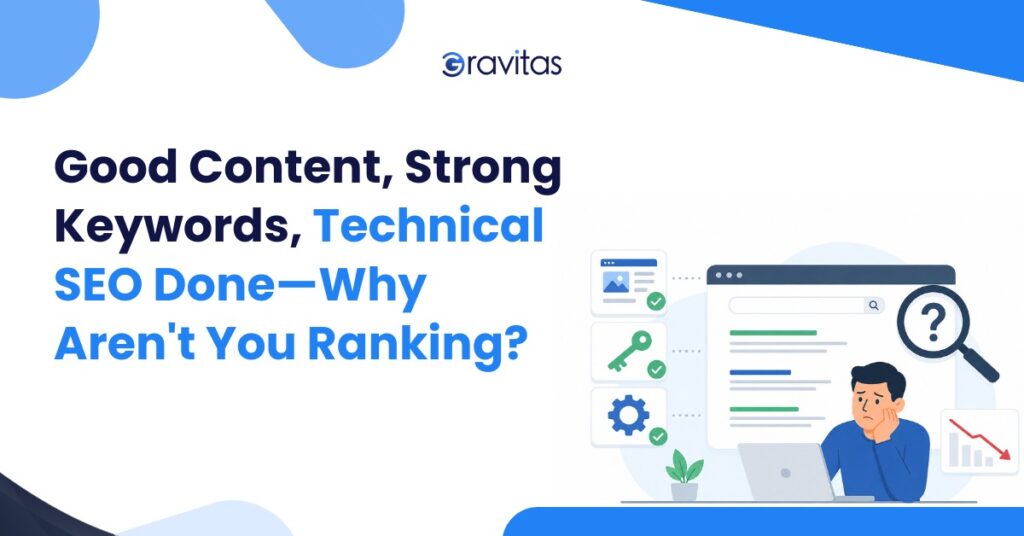
There is a point in every SEO campaign when the usual checklist stops being useful.
The keywords are researched.
The pages are optimized.
The technical errors have been fixed.
The content is well-written.
The website is fast and mobile-friendly.
Yet the rankings barely move.
Meanwhile, a competitor with seemingly similar content continues to appear above your website for the searches that matter to your business.
This is where SEO becomes less about “what have we optimized?” and more about “what are we still missing?”
Search results are not a certification system where completing ten SEO tasks earns a first-page position. Every ranking is relative. Your page is being evaluated alongside other pages that may have stronger authority, better topical coverage, more relevant backlinks, a closer match to search intent, or a more established reputation.
That is why a technically strong website can still struggle with website ranking problems.
The next stage of SEO is not about doing more of everything. It is about finding the factor that is preventing your website from becoming the stronger result.
Why SEO Optimization Alone Does Not Guarantee Rankings
SEO optimization can make a website easier to crawl, understand, and associate with relevant searches. But search engines still have to decide which of several relevant pages deserves the strongest visibility.
Consider a search where ten websites have technically optimized pages.
All ten may have:
- Relevant keywords
- Optimized headings
- Good page speed
- Mobile-friendly designs
- Internal links
- Useful content
If technical optimization were enough, all ten would rank equally.
They don’t.
Some have stronger websites behind them. Some have better resources. Some have earned industry recognition. Others have built years of topical relevance around the subject.
This is why SEO should not be treated as a checklist. Technical optimization establishes eligibility; competitive strength determines how far a page can go.
Google Looks Beyond Keywords and Content
The days of treating SEO as a keyword-placement exercise are long gone.
A page can contain the target keyword in the title, headings, URL, introduction, and body copy and still fail to perform.
Why?
Because the keyword represents the search, not necessarily the need behind the search.
Someone searching for “email marketing software” could be researching options, comparing platforms, checking features, or preparing to purchase. A page that only defines email marketing software may be relevant but still fail to satisfy the searcher’s actual objective.
This is why content relevance has to be evaluated in context.
The strongest content isn’t simply optimized around what people type. It addresses what they are trying to accomplish once they enter that search.
10 Hidden Reasons Your Website Is Still Not Ranking
The most frustrating ranking problems are often the ones that do not appear in a standard SEO audit.
Your website may be technically healthy and still have a competitive weakness somewhere else.
Here are ten areas worth investigating.
Your Content Matches the Keyword but Not the Search Intent
This is one of the easiest SEO problems to miss because the page can look perfectly optimized.
Suppose the target keyword is:
“CRM for real estate.”
Your article explains what CRM software is, lists its general benefits, and includes the keyword throughout the page.
But the pages ranking above you are discussing:
- Property lead management
- Agent follow-ups
- Automated communication
- Property pipelines
- CRM features for real estate teams
- Industry-specific use cases
The difference isn’t necessarily keyword optimization.
It is intentional.
The competing pages may be answering the question behind the search more effectively.
Before changing your keywords, examine the search results. They provide a practical indication of what Google considers relevant for that query.
Your Competitors Have Stronger Topical Authority
A website can publish one excellent article and still be less authoritative than a competitor with an entire ecosystem of relevant content.
Imagine two websites targeting the same topic.
Website A has one comprehensive article.
Website B has:
- A primary guide
- Supporting educational articles
- Industry-specific resources
- Comparison pages
- Case studies
- FAQs
- Related service pages
The second website has created considerably more context around the subject.
This is where topical authority becomes important.
The solution isn’t to produce hundreds of articles. It is to build a focused content ecosystem around subjects that matter to your audience and business.
Your Website Lacks Quality Backlinks
There is a major difference between having backlinks and having authority-building backlinks.
A report showing hundreds of referring domains may look impressive, but the real questions are:
Are those websites relevant?
Are they credible?
Are the links editorially earned?
Do they point to pages that deserve authority?
A relevant reference from a respected industry publication can carry considerably more strategic value than a collection of unrelated links.
For businesses competing in difficult search results,link building services can help develop a stronger and more relevant authority profile.
Your Pages Are Not Optimized for User Experience
A visitor shouldn’t have to work to find the information they came for.
Slow pages, difficult navigation, cluttered layouts, poor mobile experiences, and unclear page structures can create friction even when the underlying content is valuable.
Look beyond technical scores.
Ask whether the page:
- Loads quickly
- Works effectively on mobile
- Has a clear visual hierarchy
- Makes important information easy to find
- Guides users naturally to the next relevant step
A search visitor isn’t evaluating your Core Web Vitals report.
They’re evaluating how easy your website is to use.
Your Website Has Indexing or Crawling Problems
Sometimes the problem isn’t that Google dislikes your content.
Google may simply not be processing the page the way you expect.
A noindex directive, incorrect robots.txt rule, broken sitemap, canonical issue, duplicate URL, or technical error can interfere with how pages are discovered and indexed.
This is particularly important when an important page has little or no search visibility.
Before rewriting the content for the fifth time, verify that the page is actually accessible to search engines.
Your Content Is Not Fresh Enough
A page doesn’t become permanently competitive on the day it is published.
Markets change.
Products change.
Statistics change.
Competitors improve.
And searchers’ expectations change with them.
A three-year-old guide may still contain the correct keywords but provide information that is no longer complete.
Refreshing content should involve more than changing the date. Look for:
- Outdated statistics
- Old examples
- Missing developments
- New competitor information
- Questions users now ask
- Sections that need greater depth
The objective is simple: make an existing resource more useful today than it was when originally published.
Your Website Has Weak Internal Linking
Internal linking is often treated as an afterthought.
It shouldn’t be.
Suppose your most important service page receives links from only one or two other pages, while dozens of unrelated blog posts sit disconnected across the website.
That structure isn’t helping your priority pages.
A better approach creates logical pathways:
Educational content → Supporting topic → Solution → Service
This helps users move through related information and gives search engines clearer context about the relationships between pages.
Your Website Does Not Build Enough Trust Signals
A website can provide information without demonstrating why that information should be trusted.
Who wrote it?
What experience do they have?
Does the business actually work in this industry?
Are there real examples?
Are customers willing to recommend the company?
Trust can be supported through:
- Author expertise
- Industry experience
- Case studies
- Reviews
- Original research
- Company information
- Clear contact details
- Credible references
This is where E-E-A-T—Experience, Expertise, Authoritativeness, and Trustworthiness provides a useful framework for evaluating content credibility.
Your Target Keywords Are Too Competitive
Some SEO strategies fail before the content is even created.
The keyword looks attractive because it has thousands of searches. But the first page is occupied by highly authoritative websites with years of content and thousands of relevant links.
Trying to outrank them immediately may not be the most efficient use of your SEO budget.
Instead, build a keyword portfolio containing:
- Highly relevant long-tail searches
- Industry-specific queries
- Problem-based searches
- Commercial-intent terms
- Realistic lower-competition opportunities
A keyword with fewer searches but stronger business intent can sometimes be far more valuable than a high-volume term that produces little qualified traffic.
SEO Changes Need More Time to Show Results
SEO doesn’t operate on the same timeline as paid advertising.
You can launch a campaign today and see paid traffic almost immediately.
Organic search works differently.
Google needs to discover changes, process them, reassess the page, and compare it with competing results.
The timeline can depend on:
- Website authority
- Competition
- Keyword difficulty
- Content quality
- Website history
- Technical health
Constantly changing a page before enough data is available can make it difficult to determine what actually improved performance.
The Google Ranking Factors You Might Be Missing
Google does not use one universal formula that determines where every website appears.
Its ranking systems evaluate different aspects of content and search results to determine what is most relevant and useful for a particular query. Google’s officialSearch ranking systems documentation provides more detail on how these systems work.
For businesses, the practical takeaway is more important than memorizing individual ranking systems.
A competitive page needs to bring several elements together:
Relevance — Does it address the subject accurately?
Intent — Does it satisfy what the searcher wants?
Quality — Does it provide genuinely useful information?
Authority — Does the website have credibility in this subject?
Experience — Is the page easy to use?
Technical health — Can search engines access and understand it?
Trust — Is there evidence supporting the website and its information?
A weakness in one area can limit the impact of improvements in another.
How to Diagnose Why Your Website Is Not Ranking
Before investing in another round of SEO changes, diagnose the problem.
Analyze Google Search Console Data
Google Search Console can reveal patterns that aren’t visible from manually checking rankings.
Look at:
- Impressions
- Clicks
- Average position
- Queries
- Page performance
- Indexing status
The relationship between these metrics matters.
A page with thousands of impressions but very few clicks requires a different approach from a page that barely receives impressions.
Similarly, pages ranking around positions 8–20 may represent immediate opportunities because they already have some level of search visibility.
Search Console should be treated as a source of strategic information—not simply a monthly reporting dashboard.
Compare Your Website With Competitors
Your strongest SEO insights may be sitting directly above you in the search results.
Take the pages ranking for your target terms and compare:
- What topics do they cover?
- How deeply do they cover them?
- What type of content do they provide?
- What questions do they answer?
- How strong is their backlink profile?
- How are their pages internally linked?
- What expertise or evidence do they demonstrate?
The purpose isn’t to reproduce competing content.
It is to identify why Google may consider their result more useful or authoritative.
Audit Technical and On-Page SEO Elements
Technical and on-page SEO should be assessed together.
A technical audit should examine:
- Crawlability
- Indexing
- Site architecture
- Canonicals
- Redirects
- Mobile usability
- Page performance
On-page analysis should examine:
- Titles
- Headings
- Content structure
- Search intent
- Keyword targeting
- Internal links
- Metadata
A comprehensiveSEO audit service can bring these areas together and help prioritize the issues with the greatest potential impact.
What You Should Do When SEO Is Not Improving Rankings
Once the problem is identified, resist the temptation to change everything.
The most effective improvement is usually the one that directly addresses the actual weakness.
Improve Existing Content Instead of Only Creating New Pages
New content isn’t automatically better content.
Your website may already have pages sitting on the edge of page one.
These pages deserve attention.
Look for URLs that:
- Already receive impressions
- Rank within positions 5–30
- Have backlinks
- Target valuable keywords
- Previously generated organic traffic
Improve what already has potential before continually adding new URLs.
Build Authority Through Strategic Content
Content should have a purpose beyond filling the editorial calendar.
Build topic clusters around areas that connect directly to your expertise and business objectives.
For example:
Core topic → Supporting questions → Industry applications → Comparisons → Solutions → Case studies
This approach creates depth while connecting informational content with commercial opportunities.
Original research, expert insights, first-hand experience, and case studies can also provide differentiation that generic content often lacks.
Strengthen Technical SEO Foundations
Technical SEO should not be considered “finished” after the first audit.
Websites change constantly.
New pages are added. URLs change. Plugins are installed. Designs are updated. Redirects are created. Content is removed.
Any of these changes can introduce new technical problems.
Regular monitoring should cover:
- Crawlability
- Indexing
- Broken links
- Redirects
- Mobile usability
- Site architecture
- Performance
Track SEO Performance Regularly
A ranking report alone doesn’t tell the complete story.
Track the journey:
Impressions → Rankings → Clicks → Organic traffic → Leads → Conversions
This connects SEO activity with actual business performance.
A keyword ranking first is useful. A keyword ranking first and consistently generating qualified leads is considerably more valuable.
Common SEO Mistakes That Prevent Ranking Growth
Even well-funded SEO campaigns can lose momentum when they become too focused on individual tactics.
Focusing Only on Keywords
Keywords matter, but search intent and content quality determine whether those keywords are being addressed effectively.
Ignoring Competitors
SEO performance is relative. Your page has to compete with the pages currently ranking not with an abstract SEO benchmark.
Publishing Thin Content
Increasing the number of URLs does not automatically increase organic visibility.
Building Low-Quality Backlinks
A large backlink count means little if the links lack relevance or credibility.
Not Updating Existing Content
Previously successful content can lose its competitive advantage as information and search results evolve.
Not Measuring Results
Without performance data, it becomes difficult to distinguish between productive SEO work and activity that simply increases workload.
A long-term SEO strategy should connect keyword research, content, technical optimization, authority building, and performance measurement into one process.
Conclusion
A website can have excellent content, carefully selected keywords, and technically sound SEO and still struggle to rank.
That does not necessarily mean the fundamentals are wrong.
It may mean the website has reached a more competitive stage of SEO—one where relevance alone is no longer enough.
The next gains may come from stronger topical authority, better search-intent alignment, higher-quality backlinks, improved content depth, better internal linking, stronger trust signals, or a more realistic keyword strategy.
The key is to identify the gap before trying to fix it.
Because better rankings rarely come from simply doing more SEO. They come from doing the right SEO work for the specific reason your pages are not competitive enough yet.
If your website has already invested in SEO but isn’t achieving the expected visibility, Gravitas can help identify the barriers holding your organic performance back and develop a data-driven strategy to improve rankings, search visibility, and qualified organic traffic.
Frequently Asked Questions
A technically optimized website can still struggle when competing pages have stronger authority, greater topical depth, better search-intent alignment, stronger backlinks, or more useful content. SEO fundamentals create the foundation, but competitive strength determines how effectively a page performs.
There is no fixed timeline. Competition, website authority, content quality, keyword difficulty, technical health, and the scale of changes can all affect how quickly results become visible.
Competitors may have stronger topical authority, more relevant backlinks, deeper content, greater credibility, or a better match for the searcher’s intent. Comparing your page directly with theirs can help identify the gap.
Yes. Crawling, indexing, canonicalization, robots.txt, redirects, site architecture, and performance problems can prevent search engines from properly processing important pages.
No. Good content is essential, but it still has to compete with other relevant resources. Search intent, authority, credibility, technical accessibility, and competition also influence performance.
Start with Google Search Console to review impressions, clicks, queries, positions, and indexing. Then compare your pages with competitors and evaluate content, intent, technical SEO, internal linking, backlinks, and authority.
First identify the limiting factor. Determine whether the issue is related to content, search intent, technical SEO, authority, keyword competition, or insufficient time. Then prioritize the strategy around that specific problem instead of increasing SEO activity across every area.